阿魏酸对人肝癌HepG2细胞增殖、侵袭和凋亡的影响
2021-08-16 05:10:27音金萍卓少元
中国药房
2021年13期
关键词:肝癌
音金萍 卓少元
中圖分类号 R965 文献标志码 A 文章编号 1001-0408(2021)13-1565-07
DOI 10.6039/j.issn.1001-0408.2021.13.05
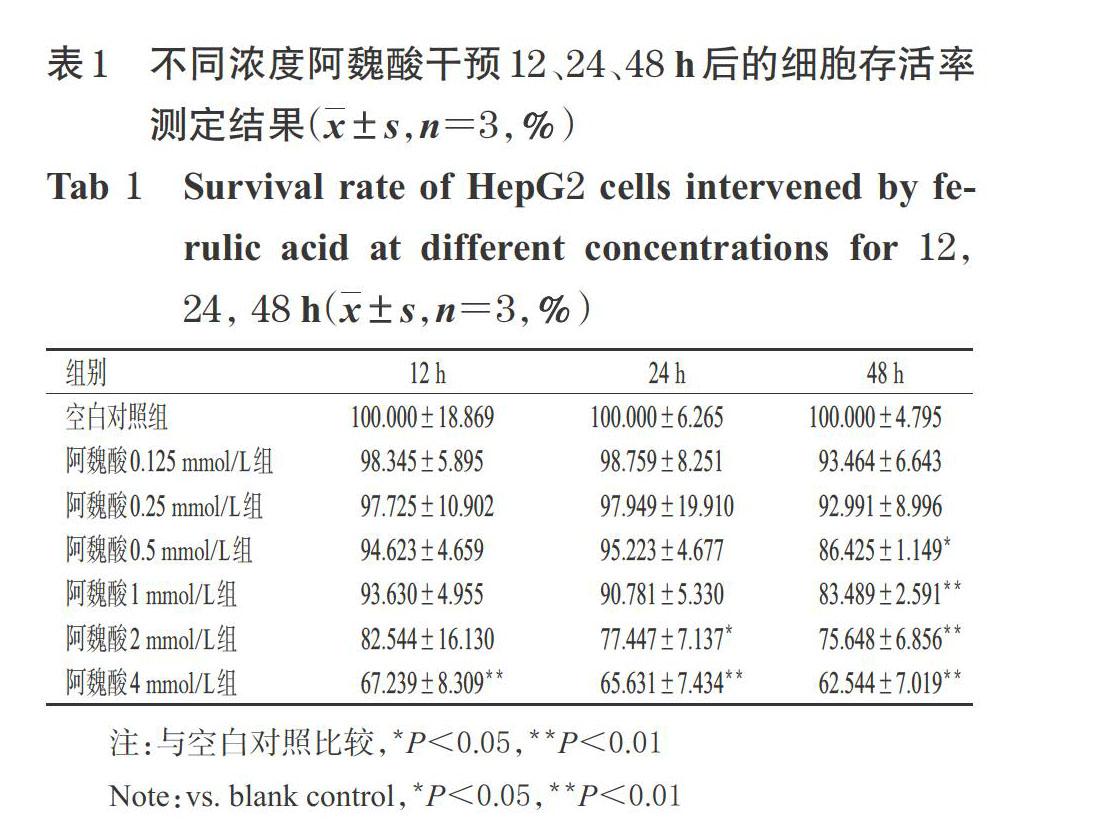
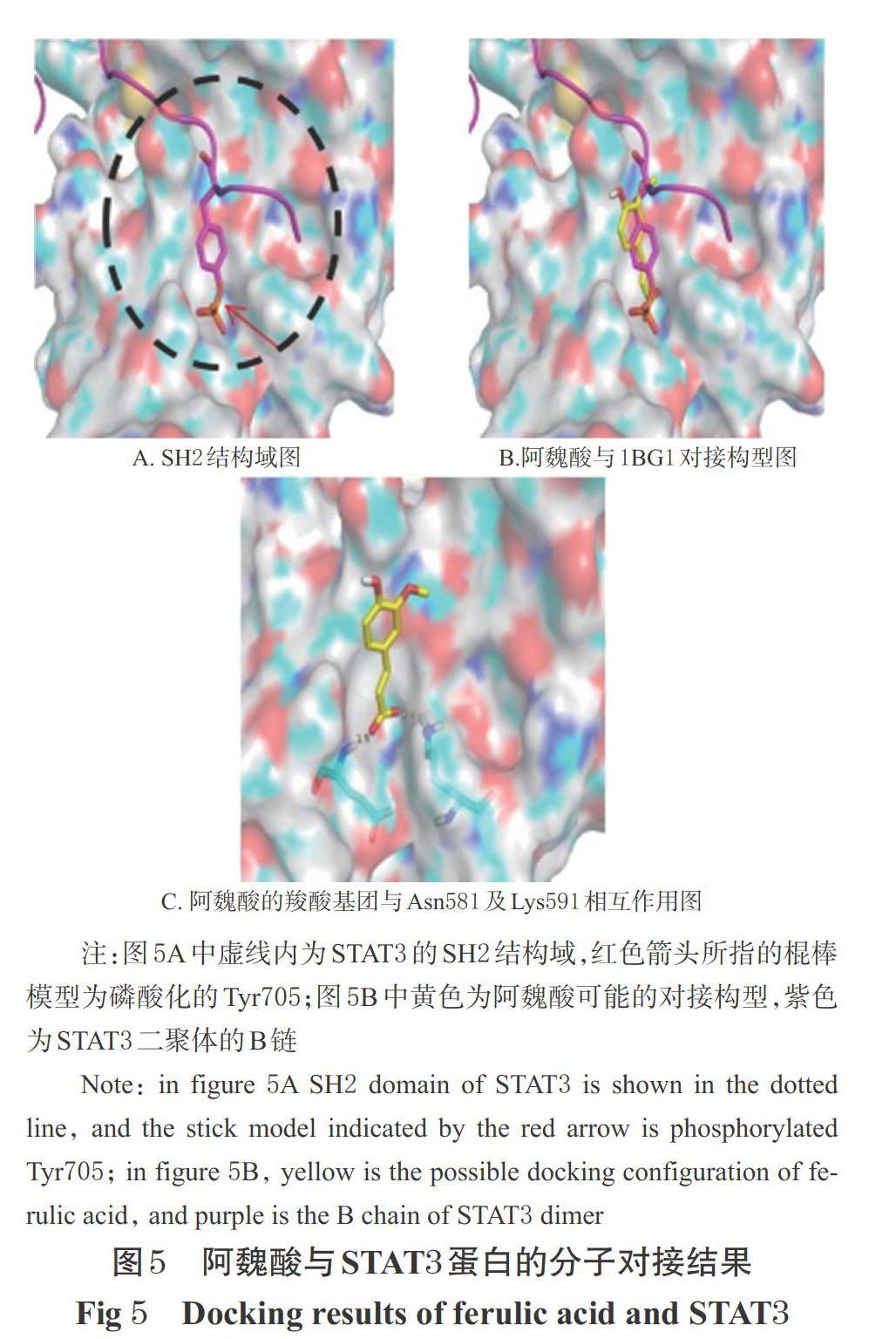
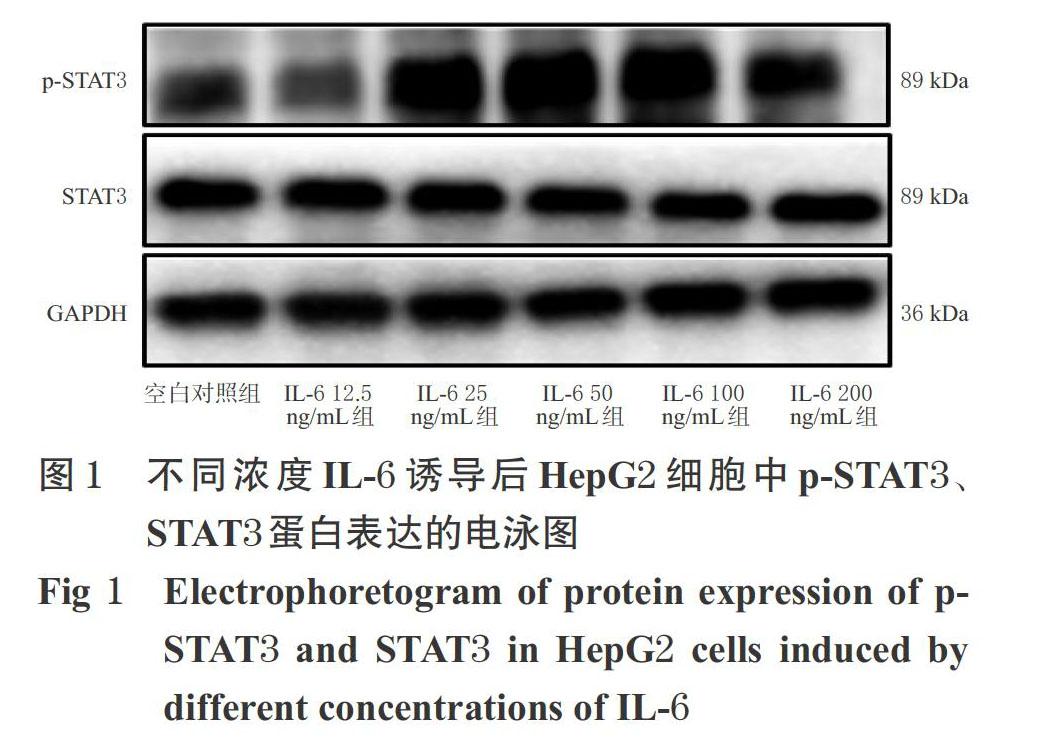
摘 要 目的:研究阿魏酸对人肝癌HepG2细胞增殖、侵袭和凋亡的影响。方法:采用CCK-8法筛选阿魏酸的给药浓度;采用Western blot法筛选白细胞介素6(IL-6)诱导磷酸化信号转导蛋白及转录激活子3(p-STAT3)蛋白高表达的HepG2细胞模型的最佳造模浓度。将HepG2细胞分为空白对照组、模型组、阿魏酸组(0.5 mmol/L)和阳性对照组(p-STAT3抑制剂C188-9,10 μmol/L),除空白对照组外,模型组加入IL-6、各给药组加入IL-6和相应药物分别进行培养。采用CCK-8法、 Transwell法和Annexin V-FITC/PI双染色法分别检测各组细胞存活率、侵袭数和早期、晚期凋亡率;采用Western blot法检测各组细胞中p-STAT3、胱天蛋白酶3(caspase-3)、锌指蛋白(ZBP-89)和波形蛋白(vimentin)的表达水平。基于PDB蛋白数据库,以STAT3高度相似晶体结构1BG1为对接模板,以Tyr705周围的区域为假定的结合口袋,进行阿魏酸与STAT3蛋白的分子对接分析。结果:选择以0.5 mmol/L 阿魏酸干预HepG2细胞48 h作为后续实验条件,以50 ng/mL IL-6为造模条件。与空白对照组比较,模型组细胞侵袭数和p-STAT3/STAT3比值、vimentin蛋白表达水平均显著增加或升高(P<0.05或P<0.01),细胞晚期凋亡率和caspase-3蛋白表达水平均显著降低(P<0.05或P<0.01)。与模型组比较,阿魏酸组和阳性对照组细胞存活率、侵袭数、p-STAT3/STAT3比值和vimentin蛋白表达水平均显著减少或降低(P<0.05或P<0.01),细胞早期凋亡率(阿魏酸组除外)、晚期凋亡率和caspase-3、ZBP-89(阳性对照组除外)蛋白表达水平均显著升高(P<0.05或P<0.01)。分子对接结果表明,阿魏酸的羧酸基团与Asn581、Lys591分别存在1.9?、2.0?的氢键作用,结合能为-4.4 kcal/mol。结论:阿魏酸可能通过与STAT3磷酸化位点直接结合来抑制p-STAT3的活性;并可通过STAT3依赖性途径上调caspase-3蛋白表达,或可通过STAT3非依赖性途径上调ZBP-89蛋白表达,进而下调vimentin蛋白表达,从而抑制HepG2细胞的增殖、侵袭与凋亡。
关键词 阿魏酸;人肝癌HepG2细胞;信号转导蛋白及转录激活子3;胱天蛋白酶3;波形蛋白
Effects of Ferulic Acid on the Proliferation, Invasion and Apoptosis of HepG2 Hepatocellular Carcinoma Cells
YIN Jinping,ZHUO Shaoyuan(School of Basic Medical Science, Guangxi University of TCM, Nanning 530200, China)
ABSTRACT OBJECTIVE: To study the effects of ferulic acid on the proliferation, invasion and apoptosis of HepG2 hepatocelluar carcinoma cells. METHODS: CCK-8 assay was used to screen the concentration of ferulic acid. Western blot assay was adopted to screen the optimal concentration of interleukin 6 (IL-6) to induce HepG2 cell model with high expression of phosphorylated signal transduction protein and activator 3 (p-STAT3) protein. HepG2 cell were divided into blank control group, model group, ferulic acid group (0.5 mmol/L) and positive control group (p-STAT3 inhibitor C188-9, 10 μmol/L). Except for blank control group, model group treated with IL-6, while administration groups were treated with IL-6 and relevant drugs. Cell survival rate, invasion and apoptosis rate in early and late stage were detected by CCK-8 assay, Transwell assay and Annexin V-FITC/PI double staining, respectively. Western blot assay was used to detect the expression of p-STAT3, caspase-3, ZBP-89 and vimentin proteins in each group. On the basis of the PDB protein database, using 1BG1, a highly similar crystal structure of STAT3, as docking template, using the region around Tyr705 as the putative binding pocket, the docking analysis of ferulic acid with STAT3 protein was carried out. RESULTS: It is selected to use 0.5 mmol/L ferulic acid intervention for 48 h as the follow-up experimental condition; 50 ng/mL IL-6 was selected as the modeling condition. Compared with blank control group, the number of cell invasion, p-STAT3/STAT3 ratio and protein expression of vimentin were increased significantly in model group (P<0.05 or P<0.01), while late apoptosis rate and protein expression of caspase-3 were decreased significantly (P<0.05 or P<0.01). Compared with model group, cell survival rate, the number of cell invasion, p-STAT3/STAT3 ratio and protein expression of vimentin were decreased significantly in ferulic acid group and positive control group (P<0.05 or P<0.01); early apoptotic rate (except for ferulic acid group), late apoptotic rate, the protein expression of caspase-3 and ZBP-89 (except for positive control group) were increased significantly (P<0.05 or P<0.01). The results of molecular docking showed that the carboxylic groups of ferulic acid could interact with 1.9 ? hydrogen bond of Asn581 and 2.0 ? hydrogen bond of Lys591, with binding energy of -4.4 kcal/mol. CONCLUSIONS: Ferulic acid may inhibit the activity of p-STAT3 by directly binding to the phosphorylation site of STAT3; it may up-regulate the protein expression of caspase-3 via STAT3 dependent pathway, or up-regulate the protein expression of ZBP-89 via STAT3 independent pathway and then down-regulate the protein expression of vimentin, so as to inhibit the proliferation, invasion and apoptosis of HepG2 cells.
KEYWORDS Ferulic acid; HepG2 hepatocellular carcinoma cell; STAT3; Caspase-3; Vimentin
原发性肝癌是全球第六大常见癌症,2020年其新发病例约90.6万,病死病例约83万;其中最常见的是肝细胞癌,约占原发性肝癌的75%~85%[1]。
阿魏酸是来源于阿魏和当归等中药的一种酚酸类成分,其性质稳定、毒性低,具有解毒、保肝等作用,且可有效抑制肝癌细胞的生长、促进肝癌细胞的凋亡[2-3],但其抗肝癌的分子机制及作用靶点尚未完全明确。研究表明,信号转导蛋白及转录激活子3(STAT3)和波形蛋白(vimentin)均在肝癌组织或肝癌细胞株中过度表达,并作为一种重要的信号分子和转录因子,参与肝癌细胞的快速增殖、侵袭和转移[4-6]。……
登录APP查看全文
猜你喜欢
天津医科大学学报(2019年3期)2019-08-13 06:53:08
中成药(2016年8期)2016-05-17 06:08:14
癌症进展(2016年12期)2016-03-20 13:16:17
罕少疾病杂志(2016年5期)2016-03-11 16:34:44
肿瘤预防与治疗(2015年1期)2015-09-26 07:26:20
中国当代医药(2015年16期)2015-03-01 02:03:11
中国医药导报(2015年26期)2015-02-28 22:07:59
肝胆胰外科杂志(2015年4期)2015-02-27 11:12:34
肝胆胰外科杂志(2015年4期)2015-02-27 11:12:24
癌变·畸变·突变(2015年4期)2015-02-27 06:15:25