
团体生物反馈治疗在癌症患者抑郁、焦虑、失眠中的应用
2021-09-17 20:31:25代莹凌乐姣姜媛媛邱海燕黄艺詹发平胡志俊
医学食疗与健康
2021年7期
代莹 凌乐姣 姜媛媛 邱海燕 黄艺 詹发平 胡志俊
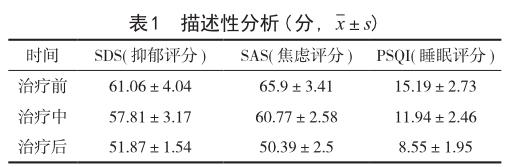

【摘要】目的:观察团体生物反馈疗法对癌症患者抑郁、焦虑和失眠的影响。方法:选取2019年6月至2020年5月在我院收治的癌症患者30例。基于抑郁自评量表(SDS),焦虑自评量表(SAS),匹兹堡睡眠质量指数(PSQI)测试确定癌症患者的心理状况。并采用团体生物反馈仪对参与者进行包括了四种分体化训练和四种团体游戏化训练干预。在干预前,10次及20次后分别对患者进行SDS、SAS和PSQI测量,并对结果进行统计分析。结果:进行10次和20次干预后,抑郁评分由(61.06±4.04)降至(57.81±3.17)和(51.87±1.54),差异具有统计学意义(F=149.561,P<0.001)。焦虑评分由(65.9±3.41)降至(60.77±2.58)与(50.39±2.5),差异存在统计学意义(F=481.247,P<0.001),睡眠质量评分由(15.19±2.73)降至(11.94±2.46)和(8.55±1.95),差异存在统计学意义(F=399.051,P<0.001)。通过两两比较,所有的组间比较差异均有统计学意义(P<0.05),SDS、SAS和PSQI在治疗前、中、后评分均下降(P<0.001)。结论:团体生物反馈治疗能够缓解癌症患者的抑郁,焦虑和失眠症状。
【关键词】团体生物反馈疗法;癌症;抑郁;焦虑;失眠
[中图分类号]R749.72 [文献标识码]A [文章编号]2096-5249(2021)07-003-03
Application of group biofeedback therapy in depression, anxiety and insomnia in cancer patients
DAI Ying, LING Le-jiao, JIANG Yuan-yuan, QIU Hai-yan, HUANG Yi, ZHAN Fa-ping, HU Zhi-jun (Department of Oncology, Xingyi Peoples Hospital, Xingyi Guizhou 562400, China)
[Abstract] Objective: To observe the effects of group biofeedback therapy on depression, anxiety and insomnia in cancer patients. Methods: Total of thirty cancer patients were selected from June 2019 to May 2020 in Xingyi Peoples Hospital, Guizhou. The psychological status of cancer patients was determined based on the Self-rating Depression Scale (SDS), the self-rating Anxiety Scale (SAS), and the Pittsburgh Sleep Quality Index (PSQI). Besides, the group biofeedback instrument was used to intervene the participants, including 4 kinds of split training and 4 kinds of group gamification training. SDS, SAS and PSQI were measured before treatment, 10 times after treatment and 20 times after treatment, respectively. Finally, the results were analyzed statistically. Results: After 10 and 20 interventions, the SDS scores decreased from (61.06±4.04) to (57.81±3.17) and (51.87±1.54), with statistically significant differences (F=149.561, P<0.001). Besides, the SAS scores decreased from (65.9±3.41) to (60.77±2.58) and (50.39±2.5) (F=481.247, P<0.001). Inaddition, the PSQI score decreased from (15.19±2.73) to (11.94±2.46) and (8.55±1.95), both of which were significantly different (F=399.051, P<0.001). Pairwise comparisons showed statistically significant differences among all groups (P<0.001). Conclusions: Group biofeedback therapy can relieve the symptoms of depression, anxiety and insomnia in cancer patients.
[Key words] Group biofeedback therapy; Cancer; Depression; Anxiety; insomnia
近10年來,我国的癌症发病率持续上升,每年保持约3.9%的增幅,随着医学的发展,癌症生存率呈现逐渐上升趋势,5年相对生存率约为40.5%[1]。漫长昂贵的治疗过程极易使患者心理痛苦,引起认知,行为和情感等方面的不愉快体验,进一步引起相关性精神病,其中最常见的是癌症相关性抑郁、焦虑、失眠。这些心理疾病均降低了病人的生活质量,可能是导致癌症死亡率增加的一个独立危险因素[2]。
團体无线生物反馈仪采用生物反馈的技术原理,通过视觉或者听觉信号,揭示生理和心理状态的变化,通过团体化和游戏化两种形式的结合进行生物反馈训练,提升个体在应激状态下的自我调节能力[3]。生物反馈疗法方法简便,疗效显著,无药物副作用,已被广泛应用。本文结合抑郁自……
登录APP查看全文
猜你喜欢
家庭医药(2016年11期)2016-11-24 18:13:13
今日健康(2016年12期)2016-11-17 14:41:27
今日健康(2016年12期)2016-11-17 13:41:00
中国现代医生(2016年23期)2016-11-15 03:58:25
上海医药(2016年20期)2016-11-09 21:19:04
上海医药(2016年20期)2016-11-09 21:11:48
环球时报(2015-05-26)2015-05-26 04:45:00
