细节护理在门诊护理工作中的价值探究
2021-11-10 05:55:11沈静妍
科学与生活
2021年12期
关键词:满意度
沈静妍
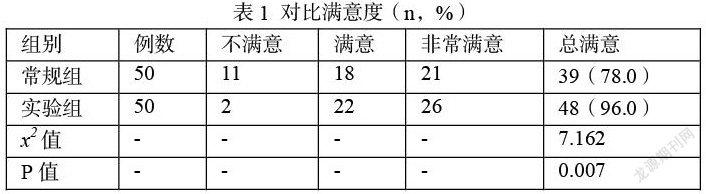
摘要:目的:探讨在医院门诊开展护理工作时,以细节护理模式实施护理干预的价值。方法:病例选自在2020.04-2021.04时间内,在我院门诊处就医的门诊患者100例,回顾性分析患者临床资料,以奇偶法分组。在常规组中提供常规护理,在实验组中提供细节护理,统计护理质量。结果:实验组护理总满意度比常规组高(P<0.05)。结论:通过以细节护理模式展开护理干预,可有效增加患者满意度,适宜推广。
关键词:门诊;细节护理;满意度
[Abstract] Objective: To explore the value of detail nursing model in nursing intervention in outpatient department. Methods: 100 cases of outpatients in our hospital from April 2020 to April 2021 were selected. The clinical data of the patients were retrospectively analyzed and divided into odd and even groups. Routine nursing was provided in the routine group, and detailed nursing was provided in the experimental group. Results: the total satisfaction of the experimental group was higher than that of the conventional group (P < 0.05). Conclusion: nursing intervention based on detail nursing mode can effectively increase patients' satisfaction and is suitable for promotion.
[Key words] outpatient service; Detail nursing; Satisfaction
門诊作为医院的一个重要部分,其具有就诊时间不同、病情程度不同、流动性大等特点,且护理工作类型较多,通常情况下患者容易出现一些不良情绪,如焦虑不安、紧张等[1]。若未针对门诊患者实施门诊护理,不仅会对患者就诊带来影响,也有可能会导致出现护患纠纷,因此医院需重视门诊护理服务,对降低护患纠纷发生及提升整体护理质量起着积极意义[2]。本研究目的是为了分析将细节护理应用在门诊护理中的价值,现展开分析汇总:
1.资料与方法
1.1病例资料
本组病例对象为100例门诊患者,组间分组方法为奇偶法。在常规组纳入病例中,均龄值是(40.75±11.24)岁,男女各26例与24例;在实验组纳入病例中,平均年龄为(41.27±10.89)岁,男28例,女12例。对2组临床资料以统计学分析,显示P>0.05,组间差异较小,满足研究要求。
1.2方法
常规组提供常规护理,根据患者的就诊号码,叮嘱门诊患者在候诊区等待叫号,并向其进行简单的健康宣教以及告知患者复诊时间等。实验组则……
登录APP查看全文
猜你喜欢
工会博览(2023年3期)2023-04-06 15:52:34
小康(2021年7期)2021-03-15 05:29:03
活力(2019年19期)2020-01-06 07:34:38
杂文月刊(2019年15期)2019-09-26 00:53:54
汽车观察(2019年2期)2019-03-15 06:00:58
消费导刊(2017年20期)2018-01-03 06:27:54
中国卫生质量管理(2014年4期)2014-02-28 17:42:10
太原城市职业技术学院学报(2014年11期)2014-02-27 07:39:10
江苏卫生事业管理(2013年5期)2013-03-11 17:02:10
中国市场(2004年8期)2004-09-23 10:56:06