
体质量管理对肥胖型多囊卵巢综合征女性的内分泌激素水平和辅助生育结局的影响
2021-11-19 17:41:03林慧刘肖梁清妹蔡柳洪
新医学
2021年11期
林慧?刘肖?梁清妹?蔡柳洪
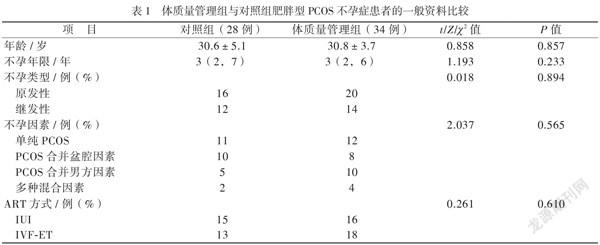
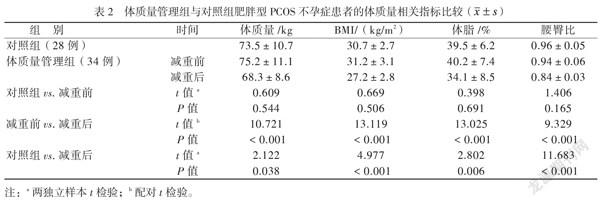
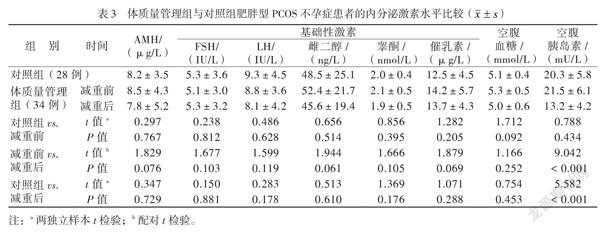
【摘要】目的 探讨体质量管理对肥胖型多囊卵巢综合征(PCOS)不孕症女性的内分泌激素水平和辅助生育结局的影响。方法 收集62例进行辅助生殖技术(ART)治疗的肥胖型PCOS不孕症患者的临床资料,选择接受常规辅助生育治疗的28例患者为对照组,在常规辅助生育治疗的基础上接受定期体质量管理的34例患者为体质量管理组。比较2组患者的内分泌激素水平和辅助生育结局。结果 减重后,体质量管理组肥胖型PCOS患者的体质量、BMI、体脂、腰臀均较减重前以及对照组降低(P均< 0.05)。減重后,体质量管理组肥胖型PCOS患者的空腹胰岛素[(13.2 ± 4.2)mU/L]均较减重前[(21.5 ± 6.1)mU/L]以及对照组[(20.3 ± 5.8)mU/L]降低(P < 0.001)。体质量管理组的人工授精累积临床妊娠率(25% vs. 13%)和首次胚胎移植后的临床妊娠率(61% vs. 39%)略高于对照组,但组间比较差异均无统计学意义(P均> 0.05)。结论 体质量管理可以有效降低肥胖型PCOS不孕症患者的BMI、空腹胰岛素水平,可能潜在地改善其辅助生育的妊娠结局。
【关键词】体质量管理;肥胖;多囊卵巢综合征;性激素;胰岛素;辅助生育
Effect of weight loss on endocrine hormonal levels and assisted reproductive outcomes of obese PCOS women Lin Hui, Liu Xiao, Liang Qingmei, Cai Liuhong. Reproductive Center, the Third Affiliated Hospital of Sun Yat-sen University, Guangzhou 510630, China Corresponding author, Cai Liuhong, E-mail: 446870080@qq.com
【Abstract】Objective To investigate the effect of weight loss on the endocrine hormonal levels and assisted reproductive outcomes of women with obese polycystic ovarian syndrome (PCOS). Methods Clinical data of 62 obese women with PCOS receiving assisted reproductive techniques (ART) were collected. All women were divided into the control (n = 28) and weight loss groups (n = 34). In the control group, routine ART was given, and routine ART combined with regular weight loss interventions were delivered in the weight loss group. The endocrine hormonal levels and assisted reproductive outcomes were statistically compared between two groups. Results After weight loss, body weight, body mass index (BMI), body fat and waist-to-hip ratio of obese PCOS women were significantly reduced compared with those before weight loss and those in the control group (all P < 0.05). In the obese PCOS women, the fasting insulin level after weight loss was (13.2±4.2) mU/L, significantly lower compared with (21.5±6.1) mU/L before weight loss and (20.3±5.8) mU/L in the control group (both P < 0.001). The accumulated clinical pregnancy rates after intrauterine insemination (25.0% vs. 13.3%) and clinical pregnancy rates after the first embryo transfer (61.1% vs. 38.5%) in the weight loss group were slightly higher than those in the control group without statistical significance (both P > 0.05). Conclusion Weight loss can significantly reduce the BMI and fasting insulin level, and might potentially improve assisted reproductive outcomes in obese PCOS women.
【Key words】Weight loss; Obese; Polycystic ovarian syndrome; Sex hormone; Insulin; Assisted reproduction
多囊卵巢综合征(PCOS)是育龄妇女最常见的内分泌紊乱疾病之一[1-2]。PCOS患者还可以表现为各种代谢异常,如糖脂代谢异常,远期风险包括心血管、内膜恶变等均增加。生殖障碍是PCOS患者就诊的重要原因之一,辅助生殖技术(ART)如宫腔内人工授精(IUI)和体外受精-胚胎移植(IVF-ET)是针对PCOS患者解决其生育需求的重要手段[3]。PCOS患者中超过50%表现为超重和肥胖症,尤其以腹型肥胖为主[4]。肥胖型PCOS不仅负面影响了女性的外观、自尊和生活质量,而且还增加PCOS患者代谢综合征、生殖障碍以及其他远期并发症的风险。因此控制体质量是针对肥胖型PCOS患者最基本也是最重要的治疗措施[5-6]。本研究纳入了接受ART治疗的肥胖型PCOS不孕妇女,对其进行体质量管理后,观察其内分泌激素水平和辅助生育结局的改变,以期明确利用体质量管理来达到改善肥胖型PCOS患者代谢紊乱和生殖障碍的目的。……
登录APP查看全文
猜你喜欢
现代临床医学(2024年1期)2024-01-30 12:40:24
中国生殖健康(2020年4期)2021-01-18 02:58:00
中国生殖健康(2019年2期)2019-08-23 08:12:10
中国生殖健康(2018年4期)2018-11-06 07:12:08
中国实用医药(2016年27期)2016-11-30 13:10:16
中国现代医生(2016年26期)2016-11-28 01:40:42
中国中药杂志(2016年20期)2016-11-19 12:22:17
中国民族民间医药·上半月(2016年10期)2016-11-19 10:33:39
中国卫生标准管理(2015年1期)2016-01-14 03:41:27
湖南中医药大学学报(2015年1期)2016-01-06 01:06:39
