老年全面惊厥性癫痫持续状态的临床研究
2021-12-20 07:38:44沈丛萍宁金环刘肇绩郑维红刘赞华
中国现代医生
2021年27期
沈丛萍 宁金环 刘肇绩 郑维红 刘赞华


[關键词] 老年;全面惊厥性癫痫持续状态;病因;预后
[中图分类号] R742.1 [文献标识码] B [文章编号] 1673-9701(2021)27-0110-04
Clinical study of generalized convulsive status epilepticus in the elderly
SHEN Congping1 NING Jinhuan1 LIU Zhaoji2 ZHENG Weihong2 LIU Zanhua1
1.Department of Neurology, Gaochun People′s Hospital of Nanjing City, Nanjing 211300, China; 2.Department of Neurology, Zhongshan Hospital Affiliated to Xiamen University, Xiamen 361004, China
[Abstract] Objective To determine the clinical characteristics, etiology, therapeutic effects and prognosis of elderly patients with generalized convulsive status epilepticus. Methods A total of 231 patients with generalized convulsive status epilepticus admitted to the Neurology Department in Gaochun People′s Hospital of Nanjing city and Zhongshan Hospital Affiliated to Xiamen University from October 2007 to December 2020 were selected. Taking the age of 60 years old as the boundary, ≥60 years old were the elderly group; <60 years old were the middle adolescent group(hereinafter referred to as the control group). The clinical features (etiology, predisposing factors, EEG, MRI examination), clinical efficacy and adverse reactions of the elderly group and the control group with generalized convulsive status epilepticus were analyzed and compared. Results Elderly patients with generalized convulsive status epilepticus had the highest incidence among the population between the ages of 70 to 79. Elderly patients were more prone to develop the generalized convulsive status epilepticus at the first seizure (χ2=4.111, P=0.029). The most common cause in the elderly group was cerebrovascular disease (χ2=4.589, P=0.026) and dementia (χ2=7.632, P=0.006), and it was relatively common induced by infection (χ2=10.157,P=0.001). There was no significant difference in the efficacy of elderly patients between the benzodiazepines treatment group and the sodium valproate treatment group(P>0.05), and there was also no significant difference compared with the control group(P>0.05). However, the mRS score (0.67±0.14) points at discharge in the elderly group was higher than that of (0.28±0.09) points in the control group, with significant difference (t=2.074, P=0.039). The death rate in the elderly group at discharge was higher than that in the control group, with statistically significant difference(χ2=4.074,P=0.046). Conclusion In the elderly population, patients without epilepticus are more likely to develop generalized convulsive status epilepticus, and the most common etiology in elderly patients is caused by cerebrovascular disease and dementia. There is no difference in the efficacy of treatment with benzodiazepines and sodium valproate among all age groups. Elderly patients with generalized convulsive status epilepticus have a poor prognosis and a higher mortality rate.
[Key words] Elderly; Generalized convulsive status epilepticus; Etiology; Prognosis
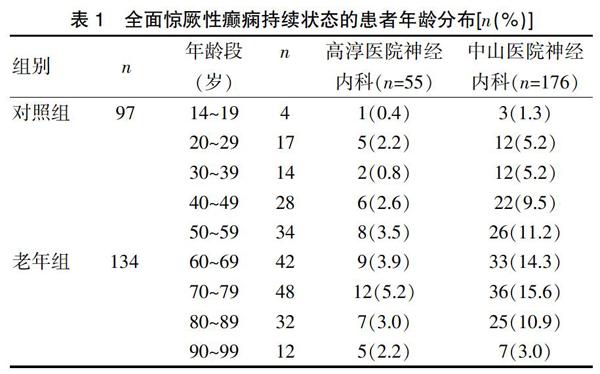
随着全球人口老年化,老年人口进行性增长,结合老年人群容易合并痴呆、大脑疾病和脑血管病等,其增长的同时伴随着癫痫的发病率上升[1]。全面惊厥性癫痫持续状态(Generalized convulsive status epilepticus,GCSE)是神经内科最常见的急症之一。高龄和疾病特殊性使得老年患者的治疗更复杂,预后更差[2]。但目前关于老年全面惊厥性癫痫持续状态的相关临床研究较少。本研究系统性回顾分析2007年10月至2020年12月在南京市高淳人民医院和厦门大学附属中山医院神经内科住院治疗的231例老年性全面惊厥性癫痫持续状态患者的病因、临床特点、治疗效果以及预后,比较老年患者和中青少年患者两组之间的临床差异,有助于了解全面惊厥性癫痫持续状态老年患者的临床特异性,现报道如下。
1 资料与方法
1.1一般资料
收集2007年10月至2020年12月在南京市高淳人民医院和厦门大学附属中山医院神经内科住院治疗的全面惊厥性癫痫持续状态患者共231例。以年龄60岁为界,≥60岁为老年组;<60岁为中青少年组(以下统一称为对照组);其中老年组患者共134例,对照组共97例。癫痫持续状态根据采用苯二氮?类或丙戊酸钠治疗分为苯二氮?类治疗组和丙戊酸钠治疗组;其中老年组中苯二氮?类治疗56例,丙戊酸钠治疗78例;对照组中苯二氮?类治疗45例,丙戊酸钠治疗52例。
1.2 纳入及排除标准
1.2.1 纳入标准 ①符合全面惊厥性癫痫持续状态的诊断标准[3-4];②发病年龄大于14岁;③癫痫持续状态首选安定10~20 mg静脉推注后症状不缓解,根据后续治疗续用苯二氮?类药物或丙戊酸钠治疗分为苯二氮?类治疗组和丙戊酸钠治疗组;④获得南京市高淳人民医院和厦门大学附属中山医院医学伦理委员会批准支持。
登录APP查看全文
猜你喜欢
现代畜牧科技(2021年5期)2021-07-20 08:07:32
基层中医药(2021年9期)2021-06-05 07:14:22
基层中医药(2020年2期)2020-07-27 02:45:56
中医眼耳鼻喉杂志(2019年3期)2019-04-13 05:26:50
小布老虎(2017年1期)2017-07-18 10:57:27
今日健康(2016年12期)2016-11-17 11:51:51
今日健康(2016年12期)2016-11-17 11:50:41
中国实用医药(2016年24期)2016-10-17 06:10:10
中国实用医药(2016年24期)2016-10-17 05:39:30
中国实用医药(2016年24期)2016-10-17 05:15:48