
白屈菜红碱纳米粒的制备及体外抗黑色素瘤活性评价
2021-12-30 01:08:58杨锦韩伟张永萍陈晓兰李哲刘杰吴静澜
中国药房
2021年24期
杨锦 韩伟 张永萍 陈晓兰 李哲 刘杰 吴静澜




中圖分类号 R283.6;R979.1 文献标志码 A 文章编号 1001-0408(2021)24-2980-07
DOI 10.6039/j.issn.1001-0408.2021.24.07
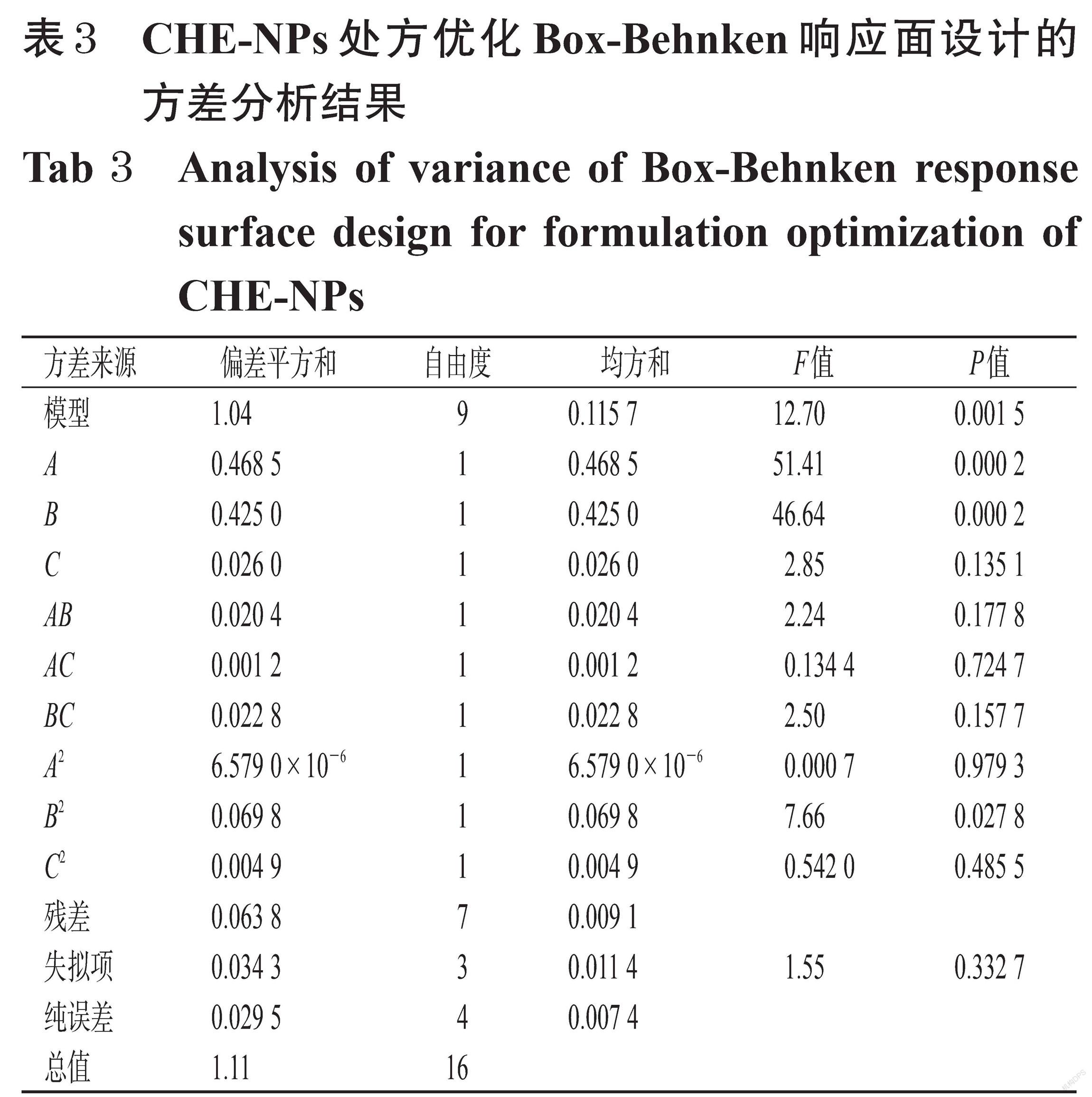
摘 要 目的:制备白屈菜红碱纳米粒(CHE-NPs),对其处方进行优化,并评价其体外释药行为及对黑色素瘤的抑制作用。方法:以甲氧基聚乙二醇-聚乳酸-羟基乙酸共聚物(mPEG-PLGA)为载体材料,采用纳米沉淀法制备CHE-NPs,采用高效液相色谱法和透析袋法测定包封率、载药量。以二者的总评归一(OD)值为因变量,以CHE投药量、mPEG-PLGA质量浓度、泊洛沙姆188(F68)浓度为自变量,采用Box-Behnken响应面设计优化CHE-NPs处方。检测最优处方所制CHE-NPs的粒径和Zeta电位,考察其体外释药特征,比较CHE原料药和CHE-NPs对小鼠B16黑色素瘤细胞存活率的影响并计算二者的半数抑制浓度。结果:最优处方为CHE投药量2 mg、mPEG-PLGA质量浓度13 mg/mL、F68浓度1.8%。以此所制CHE-NPs的平均包封率为(80.18±1.11)%,平均载药量为(11.36±0.28)%,平均OD值为0.96±0.04[与OD预测值(0.90)的相对偏差为6.67%],粒径为(113.1±1.40)nm,Zeta电位为(-21.6±0.29)mV,多分散性指数为0.07±0.01(n=3)。CHE对照品、CHE-NPs在孵育8 h时的累积释放率分别为90.87%、68.68%,后者的体外释药行为符合Weibull动力学模型。CHE-NPs对B16黑色素瘤细胞的抑制作用显著强于CHE原料药,CHE-NPs和CHE原料药的24 h半数抑制浓度分别为69.35、107.36 μg/mL。结论:所制CHE-NPs具有缓释作用和较强的载药能力,同时增强了CHE对黑色素瘤的体外抑制作用。
关键词 白屈菜红碱;黑色素瘤;抑瘤作用;甲氧基聚乙二醇-聚乳酸-羟基乙酸共聚物;纳米粒;Box-Behnken响应面设计
Preparation of Chelerythrine Nanoparticles and Evaluation of Anti-melanoma Activity in vitro
YANG Jin1,HAN Wei1,ZHANG Yongping1,CHEN Xiaolan1,LI Zhe2,3,LIU Jie1,WU Jinglan1(1. College of Pharmacy, Guizhou University of Traditional Chinese Medicine, Guiyang 550025, China; 2. College of Basic Medicine, Guizhou University of Traditional Chinese Medicine, Guiyang 550025, China; 3. Innovation Research and Development Center of Veterinary Traditional Chinese Medicine Preparations, Guizhou University of Traditional Chinese Medicine, Guiyang 550025, China)
ABSTRACT OBJECTIVE: To prepare chelerythrine nanoparticles (CHE-NPs), optimize their formulation, and evaluate its drug release behavior in vitro and its inhibitory effect on melanoma. METHODS: Using methoxy polyethylene glycol-poly(lactic-co- glycolic acid) (mPEG-PLGA) as carrier, CHE-NPs were prepared by the nano-precipitation method. HPLC method and dialysis bag method were used to determine entrapment efficiency and drug loading. The formulation of CHE-NPs was optimized by Box-Behnken response surface design using overall desirability (OD) of them as dependent variables, CHE dosage, mPEG-PLGA concentration and poloxamer 188 (F68) concentration as independent variables. The particle size and Zeta potential of CHE-NPs prepared by the optimal formulation were detected; the characteristics of drug release in vitro were investigated; the effects of CHE and CHE-NPs on survival rate of mice B16 melanoma cells were compared, and median inhibition concentrations (IC50) of them were calculated. RESULTS: The optimal formulation included CHE of 2 mg, mPEG-PLGA of 13 mg/mL, F68 of 1.8%. Average entrapment efficiency rate of CHE-NPs prepared by the optimal formulation was (80.18±1.11)%, average drug loading was (11.36±0.28)%, average OD value was 0.96±0.04 [the relative deviation from predicted value (0.90) of OD was 6.67%]; particle size was (113.1±1.40) nm, and Zeta potential was (-21.6±0.29) mV; polydispersity index was 0.07±0.01 (n=3);accumulative release rates of CHE control and CHE-NPs were 90.87% and 68.68% within 8 h, and drug release behavior in vitro of the latter was in accordance with Weibull kinetic model. Inhibitory effect of CHE-NPs on B16 melanoma cells was significantly stronger than that of CHE; the 24 h IC50 of CHE-NPs and CHE were 69.35 and 107.36 μg/mL, respectively. CONCLUSIONS: The prepared CHE-NPs show good sustained-effect and high capacity of drug loading, and strengthen the inhibitory effect of CHE on melanoma.
KEYWORDS Chelerythrine; Melanoma; Anti-tumor effect; Methoxy polyethylene glycolpolylactic acid-hydroxyacetic acid copolymer; Nanoparticles; Box-Behnken response surface design
基金项目:国家苗药工程技术研究中心组建项目(No.2014FU-125Q09);贵州省科技厅学术新苗培养及创新探索专项项目(No.黔科合平台人才〔2018〕5766号-13);地方病与少数民族性疾病教育部重点实验室(贵州医科大学)开放课题基金资助项目(No.黔教合KY字〔2019〕047)
登录APP查看全文
