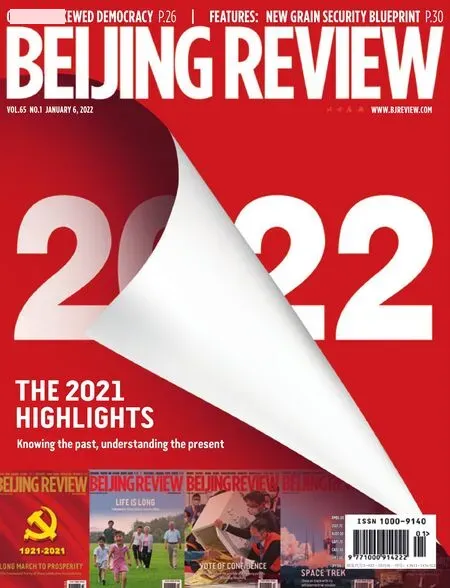
TOP 10 CHINA BUSINESS NEWS STORIES OF 2021
2022-04-13 12:25:08
Beijing Review
2022年1期

Robust Economic Growth
Chinas GDP expanded 9.8 percent year on year in the first three quarters, putting the average growth for the past two-year period at 5.2 percent. In October, the International Monetary Fund forecast an 8-percent annual growth for the Chinese economy.
More direct and targeted policies were rolled out to help market entities overcome challenges including COVID-19, rising commodity prices, and power outages. Tax and fee cuts exceeded 910 billion yuan ($142 billion) during the January-November period.
Despite the impact of the pandemic on the global economy, Chinas total imports and exports expanded 22 percent year on year to 35.39 trillion yuan ($5.56 trillion) in the first 11 months, surpassing the 2020 total.
Bumper Harvest
Grain output reached a new record of nearly 683 billion kg, a year-on-year increase of more than 13.3 billion kg, or 2 percent, with grain output exceeding 650 billion kg for seven consecutive years.
The increase was a result of the growing planting area, as the government took measures to protect arable land by developing winter fallow fields and increasing support for grain producers. Total grain planting area stood at 106 million hectares in 2021, up more than 860,000 hectares or 0.7 percent compared with the previous year.

National Emissions Trading Kickoff
The national carbon market made debut on July 16, marking a significant step in helping the country reduce its carbon footprint and meet emission targets.
Carbon emissions from more than 2,000 power companies involved in the first trading group are estimated to exceed 4 billion tons per year, making the market the worlds largest in the amount of greenhouse gas emissions covered.
Chinas national carbon trading market was launched in 2017, following the 2011 launch of pilot operations across seven provincial-level regions. The pilot procedures aim to explore market-based mechanisms to control greenhouse gas emissions.

New Stock Exchange
The Beijing Stock Exchange (BSE) started trading on November 15, indicating a major step in Chinas efforts to deepen capital market reform and support innovation-driven small and medium-sized enterprises.
The bourses first-month turnover reached 47.9 billion yuan ($7.52 billion), with the listing of 82 companies.
The BSE adopts the registration-based initial public offering system featuring lower listing thresholds, diverse evaluation standards and a shorter approval time compared with the main boards of the Shanghai and Shenzhen stock exchanges.

Monopoly Crackdown
The State Council unveiled an antitrust guideline for the platform economy on February 7, to ensure fair market competition and promote the innovative and healthy development of the sector.
The draft amendment to the Anti-Monopoly Law was submitted to the Standing Committee of the National Peoples Congress, the top legislature, for review on October 19, followed by the inauguration of the national anti-monopoly bureau in Beijing on November 18.
Throughout the year, the national market regulator imposed more than 20 billion yuan($3.14 billion) in fines on several big names, including Alibaba Group, Baidu Inc. and Tencent Holdings Ltd., over anti-monopoly violations.

Regional Integration Push
Central authorities distributed plans for constructing the GuangdongMacao In-Depth Cooperation Zone in Hengqin and further developing the Qianhai Shenzhen-Hong Kong Modern Service Industry Cooperation Zone, both in Guangdong Province, on September 5 and 6, respectively. The blueprints are set to inject strong impetus into the next stage of highquality development of the Guangdong-Hong Kong-Macao Greater Bay Area.
On October 20, the government delivered a master plan for the development of the Chengdu-Chongqing economic circle in west China. The economic circle is yet another important regional development strategy, succeeding the Beijing-Tianjin-Hebei region, the Yangtze River Delta and the Greater Bay Area.

Boosting Consumption
The First China International Consumer Products Expo(CICPE) took place in Hainans provincial capital of Haikou from May 7 to 10. The event focused on high-end consumer products, attracting the participation of more than 1,300 brands from 69 countries and regions. Over 80 percent of exhibitors expressed their desire to participate in the second CICPE.
It is a new platform to demonstrate Chinas willingness to share its market opportunities with the rest of the world and contribute to global economic recovery.

CPTPP and DEPA Membership Bid
Chinas formal application on September 16 to join the Comprehensive and Progressive Agreement for Trans-Pacific Partnership, or the CPTPP, underscores the countrys commitment to higher-level opening up as well as its resolve to make greater contributions to the world economy.
On November 1, the country applied to join the Digital Economy Partnership Agreement, or DEPA, highlighting the nations drive to expand its opening up, promote international cooperation in the digital economy and facilitate cross-border digital trade.

Box-Office Champion
China stayed on as the top box-office market worldwide for the second straight year, with total revenue exceeding 45 billion yuan ($7.07 billion) as of December 11.
Eight of the top 10 earners were domestic productions. Topping the yearly chart was the war epic The Battle at Lake Changjin, also the highest-grossing film in Chinas history, raking in approximately 5.76 billion yuan ($904 million) since September 30. Set during the War to Resist U.S. Aggression and Aid Korea (1950-53), also known as the Korean War, it depicts the brave fight put up by the Chinese Peoples Volunteers soldiers during a key campaign at Lake Changjin, or the Chosin Reservoir, in freezing temperatures.

Universal Beijing Resort
Universal Beijing Resort, currently the worlds largest Universal retreat in scale, opened its gates to the public on September 20. The 4-square-km resort is the fifth Universal Studios theme park globally, the third in Asia, and the first in China.
As a major foreign-investment project in Beijings service industry, it is expected to boost the establishment of the city as an international consumption hub and strengthen the confidence of Chinas culture and tourism industry amid the COVID-19 pandemic.

登录APP查看全文