
不同时程亚低温治疗对重型颅脑损伤患者免疫功能及预后的影响
2024-05-20 04:38:42林洁曾繁林刘欣朱秋平朱宏泉
中国医学创新
2024年11期
林洁 曾繁林 刘欣 朱秋平 朱宏泉
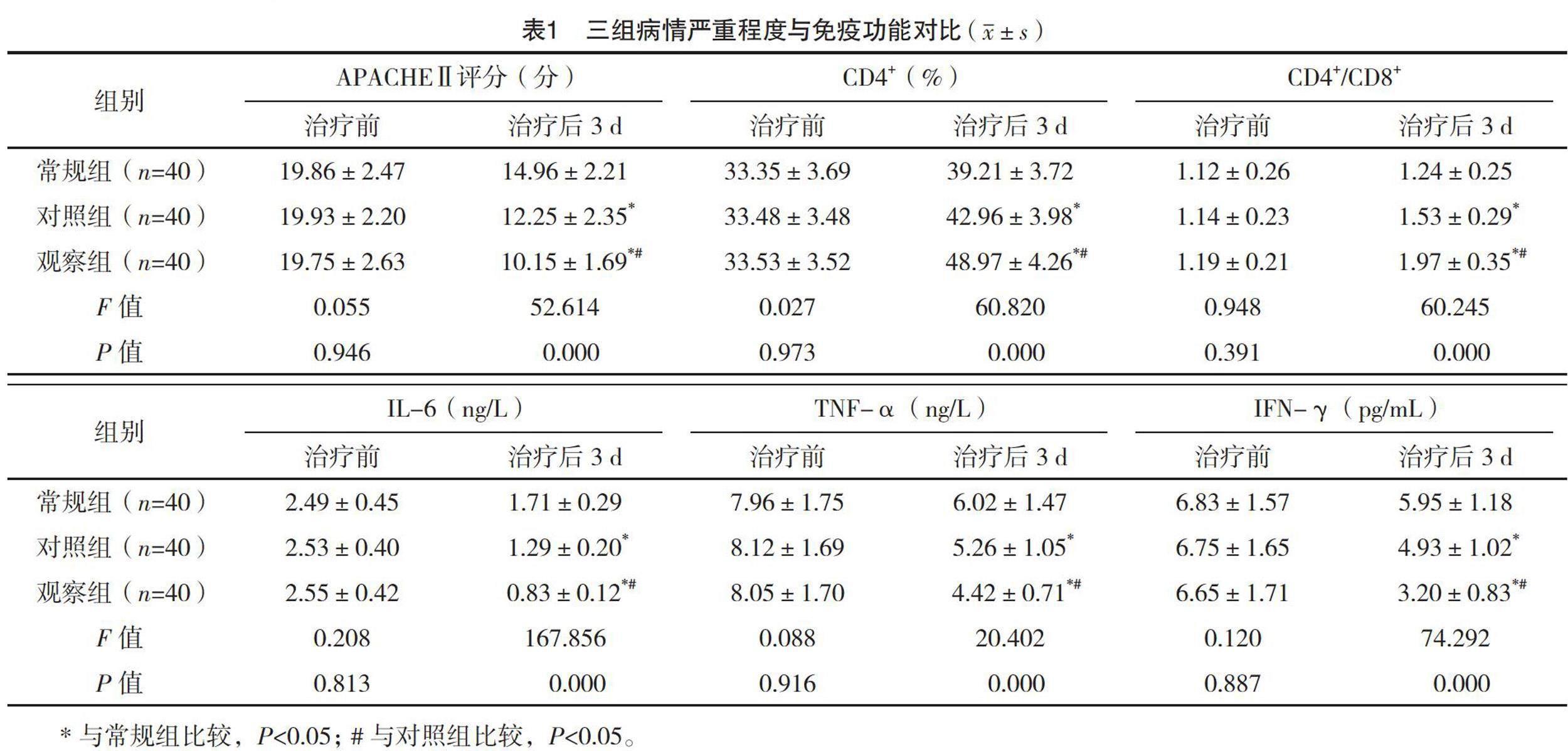
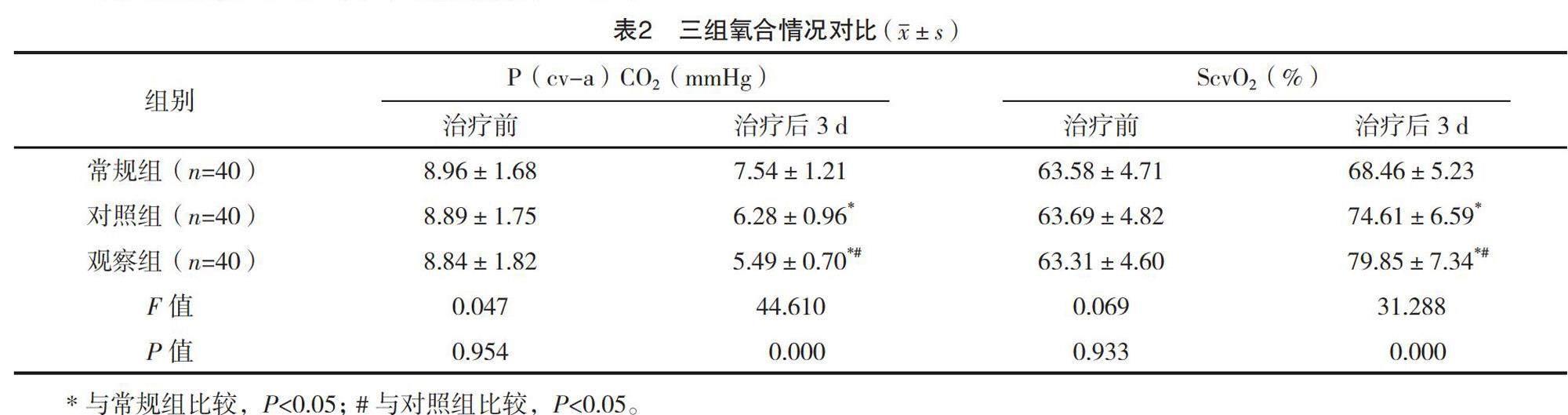

【摘要】 目的:分析對比不同时程亚低温治疗在重型颅脑损伤(STBI)患者中的效果。方法:选取2020年7月—2023年3月赣南医学院第一附属医院收治的120例STBI患者,按随机数字表法分为三组,各40例。常规组给予脱水、降颅压、去骨瓣减压术基础治疗,对照组在其基础上加以短时程(治疗2 d)亚低温治疗,观察组在常规组基础上加以长时程(治疗5 d)亚低温治疗。对比三组病情严重程度、免疫功能、氧合情况、并发症发生情况及预后。结果:治疗前,三组急性生理学和慢性健康状况评
价Ⅱ(APACHEⅡ)评分、CD4+、CD4+/CD8+、白介素-6(IL-6)、肿瘤坏死因子-α(TNF-α)、γ干扰素(IFN-γ)、中心静脉血氧饱和度(ScvO2),动-静脉二氧化碳分压差[P(cv-a)CO2]相比,差异均无统计学意义(P>0.05);治疗后,观察组APACHEⅡ评分、IL-6、TNF-α、IFN-γ、P(cv-a)CO2均低于对照组与常规组,CD4+、CD4+/CD8+、ScvO2均高于对照组与常规组,差异均有统计学意义(P<0.05);观察组、对照组并发症发生率、28 d死亡率均低于常规组,差异均有统计学意义(P<0.05);对照组、观察组并发症发生率、28 d死亡率相比,差异均无统计学意义(P>0.05)。结论:长时程亚低温治疗STBI患者效果更佳,可有效控制病情,改善其免疫功能,且并发症发生率与28 d死亡率更低,改善患者预后。
【关键词】 重型颅脑损伤 亚低温 免疫功能
Effect of Different Durations Mild Hypothermia on Immune Function and Prognosis in Patients with Severe Traumatic Brain Injury/LIN Jie, ZENG Fanlin, LIU Xin, ZHU Qiuping, ZHU Hongquan. //Medical Innovation of China, 2024, 21(11): 0-057
[Abstract] Objective: To analyze and compare the effectiveness of different durations mild hypothermia in the treatment of patients with severe traumatic brain injury (STBI). Method: A total of 120 patients with STBI admitted to First Affiliated Hospital of Gannan Medical College from July 2020 to March 2023 were selected, and divided into three groups by random number table method, with 40 patients in each group. The conventional group received basic treatment of dehydration, intracranial pressure reduction, and decompressive craniectomy, while the control group received short-term (2 d treatment) mild hypothermia treatment, the observation group received long-term (5 d treatment) mild hypothermia treatment on the basis of the conventional group. The severity of the condition, immune function, oxygenation status, occurrence of complications and prognosis among the three groups were compared. Result: Before treatment, acute physiological and chronic health evaluation Ⅱ (APACHEⅡ) scores, CD4+, CD4+/CD8+, interleukin-6 (IL-6), and tumor necrosis factor-α (TNF-α), interferon-γ (IFN-γ), central venous oxygen saturation (ScvO2), arterial venous carbon dioxide partial pressure difference [P (cv-a) CO2] of the three groups were cpmpared, the differences were not statistically significant (P>0.05); after treatment, APACHEⅡ score, IL-6, TNF-α, IFN-γ and P (cv-a) CO2 in the observation group were lower than those in the control group and the conventional group, while CD4+, CD4+/CD8+, ScvO2 were higher than those in the control group and the conventional group, the differences were statistically significant (P<0.05). The incidence of complications and 28 d
mortality rate in the observation group and control group were lower than those in the conventional group, the differences were statistically significant (P<0.05). There were no statistically significant differences in the incidence of complications and 28 d mortality between the control group and the observation group (P>0.05). Conclusion: Long-term mild hypothermia treatment has a better effect on STBI patients, can effectively control the condition, improve their immune function, and have a lower incidence of complications and 28 d mortality rate, improving patient prognosis.
[Key words] Severe traumatic brain injury Mild hypothermia Immune function
First-author's address: Department of Critical Care Medicine, First Affiliated Hospital of Gannan Medical College, Ganzhou 341000, China
doi:10.3969/j.issn.1674-4985.2024.11.012
重型顱脑损伤(STBI)是由外界直接暴力造成的脑部严重损伤,在临床具有较高的患病率[1-2]。近年,因城市化进程的加速,STBI的患病人数急剧增长。脱水、降颅压、去骨瓣减压术等为既往临床治疗STBI的重要手段,虽然近年我国的医疗技术迅猛发展,使得STBI的死亡率明显降低,但该病的致残率仍然处于较高水平[3-4]。因此,选择一种快速有效的措施以降低该病的致残率,改善患者预后至关重要。亚低温治疗是运用降温设备或药物等降温措施,促使患者核心温度下降进入睡眠状态,从而达到治疗疾病的方法,具有操作简便、花费少等优势[5-6]。现阶……
登录APP查看全文
