鹰潭地区婴幼儿社区获得性肺炎的病原学特征及血清降钙素原、维生素A、维生素D水平分析
2024-06-21 08:07:59江军浪揭帮中杨霞
中国医学创新
2024年15期
江军浪 揭帮中 杨霞
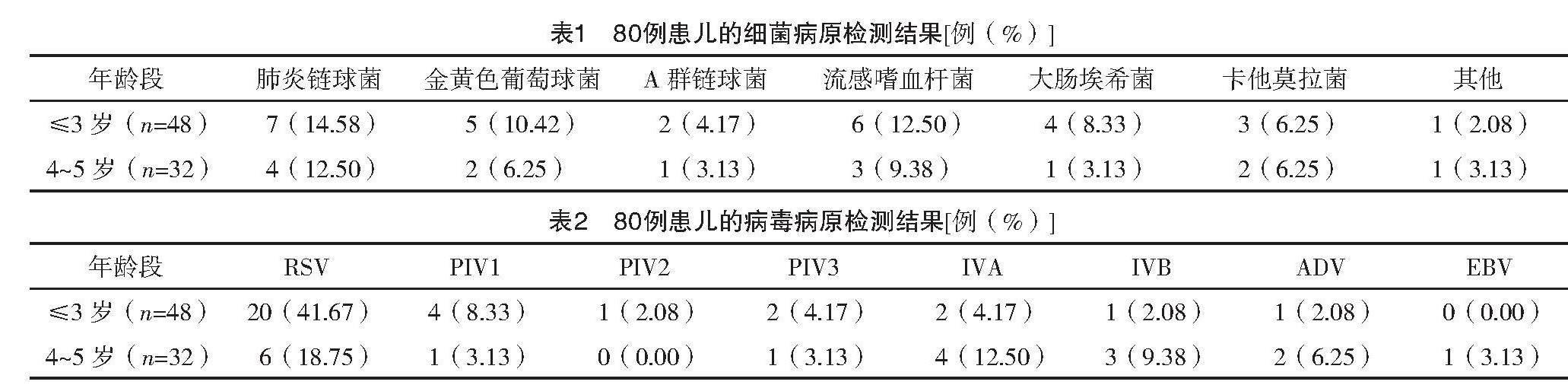
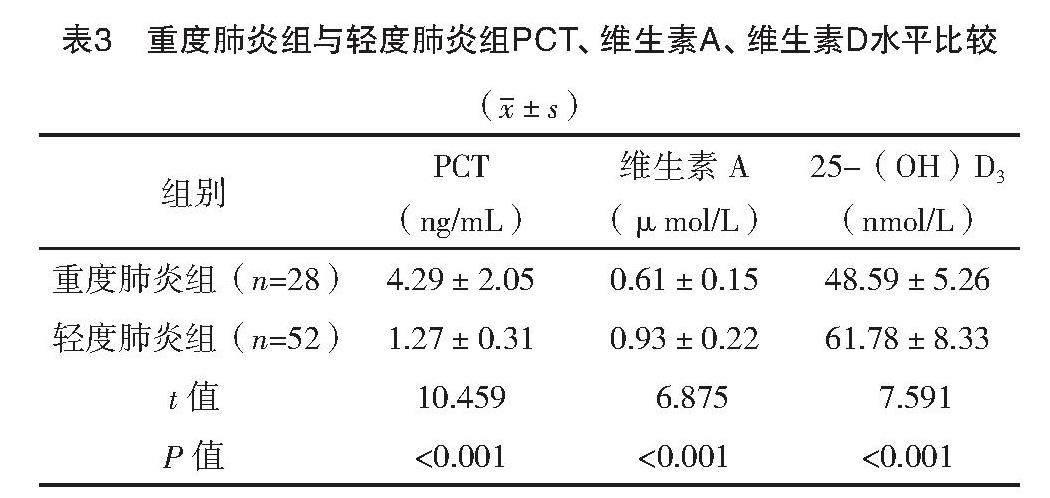
【摘要】 目的:分析鹰潭地区婴幼儿社区获得性肺炎的病原学特征及血清降钙素原(PCT)、维生素A、维生素D水平。方法:回顾性纳入2020年6月—2023年6月贵溪市人民医院收治的80例社区获得性肺炎患儿病例资料进行研究。采集所有患儿痰标本,均进行细菌鉴定、病毒检测,分析其病原学特征,依据患儿病情严重程度将其分为重度肺炎组(n=28)与轻度肺炎组(n=52),比较两组患儿的血清PCT、维生素A、维生素D水平。结果:80例患儿细菌检出阳性42例,占比52.50%,各年龄段患儿均以肺炎链球菌最为常见,共11例,占细菌检出阳性的26.19%,流感嗜血杆菌次之,共9例,占细菌检出阳性的21.43%。80例患儿病毒检出阳性49例,占比61.25%,其中最常见的病毒病原为呼吸道合胞病毒(RSV),共26例,占病毒检出阳性的53.06%;流感病毒A(IVA)共检出6例,占病毒检出阳性的12.24%;副流感病毒1型(PIV1)共检出5例,占病毒检出阳性的10.20%。在≤3岁年龄段患儿中RSV检出率最高(41.67%),其次为PIV1(8.33%);在4~5岁年龄段患儿中RSV检出率最高(18.75%),其次为IVA(12.50%)。重度肺炎组PCT水平高于轻度肺炎组,差异有统计学意义(P<0.05);重度肺炎组维生素A、25-二羟维生素D3[25-(OH)D3]水平均低于轻度肺炎组,差异均有统计学意义(P<0.05)。结论:肺炎链球菌与RSV分别为鹰潭地区婴幼儿社区获得性肺炎的第一细菌病原体与病毒病原体,血清PCT、维生素A、维生素D水平检测可以辅助临床判断社区获得性肺炎患儿病情严重程度。
【关键词】 社区获得性肺炎 病原学特征 降钙素原 维生素A 维生素D
Etiological Characteristics of Community-acquired Pneumonia and Levels of Serum Procalcitonin, Vitamin A and Vitamin D in Infants in Yingtan/JIANG Junlang, JIE Bangzhong, YANG Xia. //Medical Innovation of China, 2024, 21(15): -161
[Abstract] Objective: To analyze etiological characteristics of community-acquired pneumonia and levels of serum procalcitonin (PCT), vitamin A and vitamin D in infants in Yingtan. Method: A retrospective collection was performed on case data of 80 infants with community-acquired pneumonia in Guixi People's Hospital between June 2020 and June 2023. The sputum samples were collected from all infants for bacterial identification and viral test. The etiological characteristics were analyzed. According to disease severity, infants were divided into severe pneumonia group (n=28) and mild pneumonia group (n=52). The levels of serum PCT, vitamin A and vitamin D in the two groups were compared. Result: Among the 80 infants, there were 42 cases (52.50%) with bacteria, mainly on Streptococcus pneumoniae (11 cases, 26.19%) and Haemophilus influenzae (9 cases, 21.43%). Among the 80 infants, there were 49 cases (61.25%) with viruses, mainly on respiratory syncytial virus (RSV, 26 cases, 53.06%), influenza virus A (IVA, 6 cases, 12.24%) and type 1 parainfluenza virus (PIV1, 5 cases, 10.20%). In infants with age of ≤3 years, detection rate of RSV was the highest (41.67%), followed by PIV1 (8.33%). In infants with age of 4-5 years, detection rate of RSV was the highest (18.75%), followed by IVA (12.50%). PCT level in severe pneumonia group was higher than that in mild pneumonia group (P<0.05), while levels of vitamin A and 25-(OH) D3 were lower than those in mild pneumonia group (P<0.05). Conclusion: Streptococcus pneumoniae and RSV are the first bacterial pathogen and viral pathogen of community-acquired pneumonia in infants in Yingtan, respectively. Serum PCT, vitamin A and vitamin D can be applied to clinically determine the severity of community-acquired pneumonia.
[Key words] Community-acquired pneumonia Etiological characteristic Procalcitonin Vitamin A Vitamin D
First-author's address: Department of Pediatrics, Guixi People's Hospital, Guixi 335400, China
doi:10.3969/j.issn.1674-4985.2024.15.037
社区获得性肺炎是一种常见于婴幼儿的感染性疾病,其主要由细菌、病毒、支原体等病原感染引起,在我国5岁以下儿童死亡原因中位列首位[1]。社区获得性肺炎患儿病因复杂,不同病原感染会导致治疗方式不同,如若不能及时控制病情则易导致患儿发展至重症肺炎,重症肺炎是导致患儿死亡的直接原因,因此了解该地区病原学特征对抗生素的合理选用及后续治疗极为重要[2]。……
登录APP查看全文
猜你喜欢
中国实用医药(2016年28期)2016-12-07 07:29:40
中外医学研究(2016年26期)2016-11-30 02:44:00
中国实用医药(2016年24期)2016-10-17 04:27:23
中国实用医药(2016年24期)2016-10-17 04:15:03
中国实用医药(2016年24期)2016-10-17 03:21:57
中国实用医药(2016年19期)2016-08-05 21:48:50
中国实用医药(2016年16期)2016-07-26 21:29:20
中国实用医药(2016年14期)2016-05-20 04:03:00
中国实用医药(2016年12期)2016-05-04 09:22:06
中国实用医药(2016年6期)2016-03-17 11:12:31