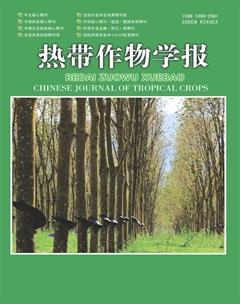
中国橡胶树棒孢霉落叶病疫情调查及发生规律初探
2015-10-21 16:47:39李博勋刘先宝蔡吉苗黄贵修
热带作物学报
2015年11期
关键词:疫情
李博勋 刘先宝 蔡吉苗 黄贵修


摘 要 2011~2013年,项目组对云南、海南、广东和广西等橡胶主产区的棒孢霉落叶病(CLFD)疫情进行调查并对其发生规律进行了初步分析。结果发现:总共调查的81个监测点中,约有92%的监测点发现了该病的为害,且疫情逐年加重,以海南省的大丰农场、西庆苗圃、十月田苗圃和保显农场,云南省的勐醒农场、蚂蝗堡农场和坝撒农场以及广东省的红十月农场等监测点的发病率最高,病情严重。主栽品种田间调查发现,文昌11、云研277-5、云研77-4和热研7-33-97等品种的抗/耐性水平较高,而RRIM600、PR107、GT1和红星1等品种的抗/耐病性水平较差。全年病害消长动态调查发现,该病一般3~4月出现病情,8~9月病情急剧上升,10~11月达到全年最高峰,后逐步下降。多年的调查结果发现,棒孢霉落叶病的发病率和病情指数呈逐年加重趋势,且主栽品种中很少有品种(品系)表现出耐病或抗病性。
关键词 橡胶树;棒孢霉落叶病;疫情;发生规律
中图分类号 S436 文献识别码 A
Abstract During 2011-2013, the authors carried out the investigation and the occurrence regularity of Corynespora leaf all diseases(CDD)in the main producing areas of Guangxi, Hainan, Guangdong and Yunnan. According to the results of a total of 81 monitoring points, about 92% of the monitoring sites were found the disease, and the epidemic has been increasing year by year, Especially in Dafeng Farm, Xiqing Nursery, and Baoxian Farm in Hainan Province, Mengxing Farm, Leech Fort Farm and dam scattered farms in Yunnan Province, and Red October Farm in Guangdong Province with high incidence. Main germplasms resistance evaluation in the fields found that Wenchang 11, Yunyan 277-5, Yunyan 77-4 and Reyan 7-33-97 were resistant, and RRIM600, PR107, GT1 and Hongxing-1 were susceptible. The dynamic survey of the disease showed that the disease occured during March to April, risen sharply during August to September and the highest peak appeared during October to November in the whole year and no good disease resistant germplasms were found in field.
Key words Rubber tree; Corynespora leaf fall diseases; Monitoring; Occurrence regularity
doi 10.3969/j.issn.1000-2561.2015.11.023
天然橡胶是全球四大战略性物质资源之一,同时又是关系国计民生的大宗工业原料和可再生的绿色资源,在国民经济建设和国家安全建设中占有重要的地位。中国于1904年引入橡胶树,至今已有100多年历史。据初步统计,截止2013年底,中国已跃居世界第三大植胶国,其天然橡胶产量达87万t,仅次于泰国、印度尼西亚和越南,位居世界第四[1-2]。而橡胶植保问题,始终是制约天然橡胶产量和产业健康发展的限制因素之一。近30 a来,橡胶树棒孢霉落叶病(Corynespora leaf fall diseases,CLFD)一直是南亚、东南亚和中非橡胶树上最具破坏性的叶部病害[3-4]。……
登录APP查看全文
猜你喜欢
北京测绘(2022年5期)2022-11-22 06:57:43
音乐天地(音乐创作版)(2022年1期)2022-04-26 13:51:10
今日农业(2021年3期)2021-03-19 08:38:00
今日农业(2021年1期)2021-03-19 08:35:42
小学生学习指导(中年级)(2020年12期)2021-01-08 02:50:02
人大建设(2020年5期)2020-09-25 08:56:22
快乐作文(1.2年级)(2020年8期)2020-09-10 07:22:44
北极光(2020年1期)2020-07-24 09:04:04
安徽医学(2020年6期)2020-07-17 12:18:48
文苑(2020年4期)2020-05-30 12:35:48