两岸语言规划问题阐微
2016-05-30 23:39:30周荐严世焕
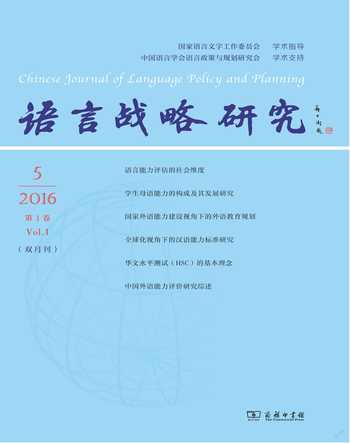
语言战略研究
2016年5期
关键词:词汇
周荐 严世焕
提 要 语言规划在语言生活的方方面面均有着力点,在一种语言而被人为分开的各个区域间更有巨大的运作空间。就中国的海峡两岸而言,语言的各个元素在语言规划中都不能遗漏,但词汇无疑是重点。
关键词 海峡两岸;语言规划;词汇
Abstract Language planning focuses are prevalent in all aspects of the practical use of language, and language planning and policy can play a greater role for a pluricentric language as a result of a political rift. When it comes to languages in Mainland China and Taiwan, all linguistic institutions should be concerned and the vocabulary is an apparent necessity in language planning. In this study, taking the two predominant dictionaries as an example, we endeavor to examine the discrepancies seen in the two polities with the aim of revealing the socio-political realities accounting for the inclusion and exclusion of certain vocabulary in the Modern Chinese Dictionary in Mainland China (Xiandai Hanyu Cidian, 1996, 3rd edition) and the New Version Dictionary of Media Language in Taiwan (Xinbian Guoyu Ribao Cidian, 2000 edition). In conclusion, we argue that various types of discrepancies pose an obvious obstacle in the relationship between the Mainland and Taiwan, therefore, a collaborative planning effort seems necessary in order to facilitate communication between the two polities.
Key words across Taiwan Strait; language planning; vocabulary
一
语言规划,作为一门学问,涉及的内容十分繁杂,它所面对的不仅是语言,还有文字;不仅是本国本地区范围内用作人们交际交流的语言文字,还有各民族自己的语言文字;不仅是共通性的语言文字,还有族群个体性(如方言)的语言文字;不仅是本国的语言文字,还有境外的语言文字;不仅是传承的语言文字,还有非传承性而规范的语言文字;等等。进行语言规划,要做三项工作。第一项工作就是要盘点“家底”,即对本国语言文字的现状有一个清醒的认识和了解。只有对自己的“家底”有一个充分的了解,才能开始下一步工作(郭龙生 2008)。第二项工作就是要通盘考虑将拟进行的规划。规划要适应新的形势适时调整,但这并不意味着规划是短视的而不是长线的。第三项工作,规划不但要有足够的体量,更要有大局意识、全局意识(李宇明 2005)。
语言里的各个要素都要规划。比如语音,《现代汉语词典》(商务印书馆;下略作《现汉》)从1965年的试用本直到2002年的第4版都曾收有一个“覅”字,读音fiào,与普通话唇齿音不能与-i-介音相拼合的规律不符。到第5版,在词典中存在达37年之久的“覅”字被删除了。可见做好规划的重要性。……
登录APP查看全文
猜你喜欢
国际医药卫生导报(2021年12期)2021-07-06 12:35:40
国际医药卫生导报(2021年12期)2021-07-06 12:35:36
中华胰腺病杂志(2021年1期)2021-02-26 11:28:36
山东医药(2020年34期)2020-12-09 01:22:24
中华胰腺病杂志(2019年4期)2019-08-29 08:52:20
山东医药(2017年35期)2017-10-10 02:45:28
山东医药(2017年33期)2017-10-09 12:31:41
文理导航·趣味课堂(2016年3期)2016-04-26 15:42:10
山东医药(2014年48期)2014-12-02 04:34:34
山东医药(2014年34期)2014-12-02 04:33:52