抗抑郁药结合认知行为疗法对产后抑郁症的影响
2016-11-30 07:38:28叶凤珍陈远岭张金
中国医药导报
2016年25期
叶凤珍++++++陈远岭++++++张金霞++++++丛戎++++++惠李++++++丁智慧
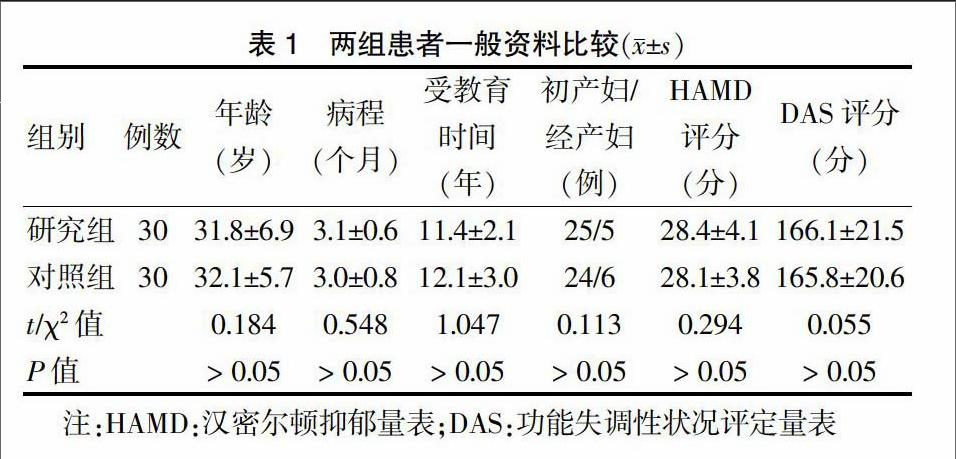
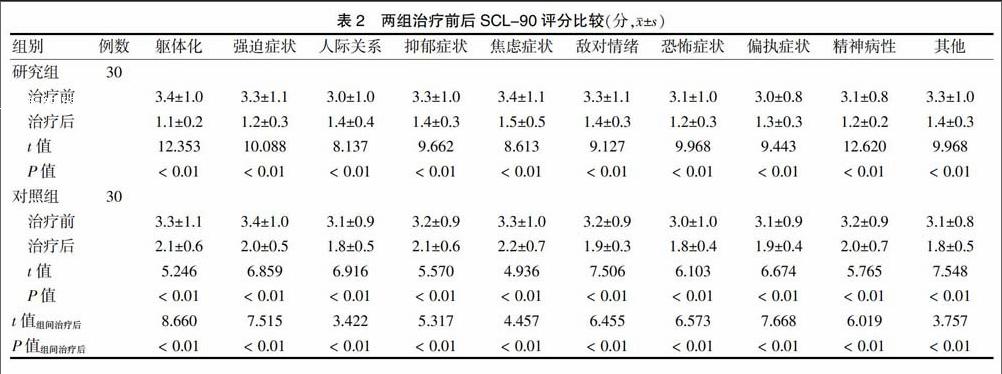
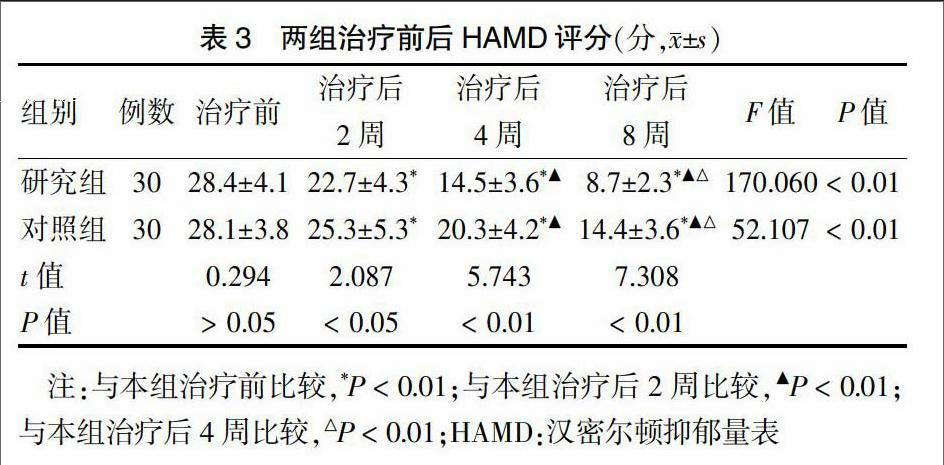
[摘要] 目的 探讨抗抑郁药结合认知行为疗法治疗产后抑郁症的临床效果。 方法 选择2014年12月~2015年12月于浙江省温州医科大学附属康宁医院诊断为产后抑郁的患者60例为研究对象,按照入院单双号分为研究组和对照组,每组各30例。两组患者均给予抗抑郁药治疗,研究组在此基础上给予认知行为疗法治疗。比较两组的临床疗效。 结果 治疗后两组SCL-90评分各维度得分均显著低于治疗前,差异有高度统计学意义(P < 0.01);治疗后研究组患者SCL-90评分均显著低于对照组,差异有高度统计学意义(P < 0.01)。两组治疗后HAMD评分均显著下降,与干预前比较差异有高度统计学意义(P < 0.01);治疗后2、4周及8周,研究组HAMD评分显著低于对照组,差异有统计学意义(P < 0.05或P < 0.01)。治疗后研究组DAS评分显著低于治疗前,差异有高度统计学意义(P < 0.01);治疗后研究组DAS评分显著低于对照组,差异有高度统计学意义(P < 0.01)。研究组显效率、有效率均显著高于对照组,差异均有统计学意义(P < 0.05或P < 0.01)。 结论 抗抑郁药结合认知行为疗法对产后抑郁症患者具有显著的临床疗效,值得临床推荐。
[关键词] 抗抑郁药;认知行为;疗法;产后抑郁症
[中图分类号] R749.4 [文献标识码] A [文章编号] 1674-4721(2016)09(a)-0042-04
[Abstract] Objective To discuss effect of antidepressants combined with cognitive behavior therapy on postpartum depression. Methods Sixty cases with postpartum depression from December 2014 to December 2015 in Corelle Hospital, Wenzhou Medical University were selected as research objects, and they were divided into study group and control group according to even and odd-numbered admission, with 30 cases in each group. Patients of the two groups were treated with antidepressants, and the study group was treated with cognitive behavior therapy in addition. Clinical efficacy of two groups was compared. Results After treatment, each dimension score of SCL-90 of two groups was lower than that before treatment, the difference was statistically significant (P < 0.01); each dimension score of SCL-90 of study group after treatment was lower than that of the control group, the difference was statistically significant (P < 0.01). HAMD scores of two group after treatment were lower than those before treatment, the differences were statistically significant(P < 0.01); HAMD score of the study group was lower than that of the control group 2 weeks, 4 weeks and 8 weeks after treatment, the differences were statistically significant (P < 0.01). DAS score of study group after treatment was lower than that before treatment, the difference was statistically significant (P < 0.05 or P < 0.01). DAS score of study group after treatment was lower than control group, the difference was statistically significant (P < 0.01). Significant effective rate and general effective rate of study group were higher than those of the control group, the differences were statistically significant (P < 0.05 or P < 0.01). Conclusion Antidepressants combined with cognitive behavior therapy for postpartum depression can improve clinical efficacy, worthy of clinical promotion.
[Key words] Antidepressants; Cognitive behavior; Therapy; Postpartum depression
抑郁症是一种常见的、严重的精神疾病,以心境低落为重要特征,伴有焦虑、激越、无价值感、自杀观念、精神运动性迟滞和各种躯体症状和生理功能障碍[1]。抑郁症素有“隐性杀手”之称,其自杀的掩蔽性、完整性和成功性等特点常常使人防不胜防。该症已成为危害个人、社会的一个严重的卫生问题[2]。根据WHO的预测,到2020年抑郁症/自杀将位居中国总疾病负担的首位。产后抑郁是临床上一种特殊类型抑郁症,通常指产后6周内发生的、可持续整个产褥期或更长时间的一种常见的精神障碍[3]。因此,及时了解产后抑郁症的发生情况,应用科学的方法治疗显得尤为重要。本研究采用抗抑郁药联合认知行为疗法治疗产后抑郁症,取得了较好的效果。现将结果报道如下:
1 资料与方法
1.1 一般资料
选择2014年12月~2015年12月在温州医科大学附属康宁医院(以下简称“我院”)诊断为产后抑郁的患者60例为研究对象。……
登录APP查看全文