
胸腹腔镜微创手术与传统开胸手术对食管癌患者术后肺功能、炎症因子水平的影响
2017-01-03 23:39:42曾新敏王晖章志龙
中国当代医药
2016年29期
曾新敏++++++王晖++++++章志龙++++++胡火利++++++徐兴华++++++陈华
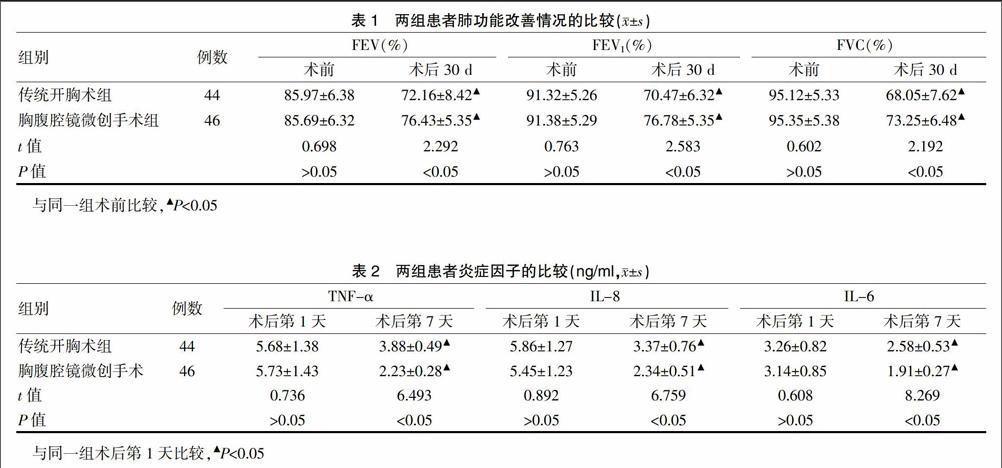
[摘要]目的 探讨胸腹腔镜微创手术与传统开胸手术对食管癌患者术后肺功能、炎症因子水平的影响。方法 将2012年8月~2015年12月于我院确诊为食管癌行手术治疗的90例患者纳入研究,依据手术方案分为传统开胸术组(n=44)及胸腹腔镜微创手术组(n=46)。观察两组患者术前及术后30 d用力肺活量占预计值比例(FEV%)、第一秒用力呼气量占预计值比例(FEV1%)、用力呼气量占预计值比例(FVC%)等指标改善情况,观察两组术后第1天及第7天时TNF-α、IL-8、IL-6等炎症因子变化情况。结果 术后30 d,传统开胸组FEV%、FEV1%、FVC%水平分别为(72.16±8.42)%、(70.47±6.32)%、(68.05±7.62)%,胸腹腔镜微创手术组则分别为(76.43±5.35)%、(76.78±5.35)%、(73.25±6.48)%,两组FEV%、FEV1%、FVC%较术前均下降,但胸腹腔镜微创手术组改善更显著(P<0.05);术后第7天传统开胸组TNF-α、IL-8、IL-6水平分别为(3.88±0.49)、(3.37±0.76)、(2.58±0.53)ng/ml,胸腹腔镜微创手术组则分别为(2.23±0.28)、(2.34±0.51)、(1.91±0.27)ng/ml,两组TNF-α、IL-8、IL-6术后第1天均降低,但胸腹腔镜微创手术组改善更显著(P<0.05)。结论 胸腹腔镜微创手术与传统开胸术相比,具有创伤小的优势,可更好地预防肺功能损伤,值得推广。
[关键词]胸腹腔镜微创手术;传统开胸手术;食管癌;肺功能;炎症因子
[中图分类号] R735.1 [文献标识码] A [文章编号] 1674-4721(2016)10(b)-0079-04
[Abstract]Objective To investigate the effect of minimally invasive laparoscopic surgery and traditional thoracotomy on pulmonary function and inflammatory factors after operation in patients with esophageal cancer.Methods Patients with esophageal cancer diagnosed and underwent surgical treatment in our hospital from August 2012 to December 2015 were enrolled in the study and divided into conventional thoracotomy group (n=44) and laparoscopic minimally invasive surgery group (n=46) according to the operation plan.Improvement of forced vital capacity accounted for the proportion of expected value (FEV%),forced expiratory volume in the first second proportion of expected value (FEV1%),forced expiratory volume accounted for the proportion of expected value (FVC%) preoperative and postoperative 30 days were compared,TNF-α,IL-8 and IL-6 levels of inflammatory cytokine on the first day and on the seventh day were observed.Results The level of FEV%、FEV1%、FEV% postoperative 30 d in the conventional thoracotomy group was (72.16±8.42)%,(70.47±6.32)%,(68.05±7.62)% respectively,and (76.43±5.35)%,(76.78±5.35)%,(73.25±6.48)% respectively in the laparoscopic minimally invasive surgery group,FEV%,FEV1%,FVC% of two groups were all decreased,but the improvement of laparoscopic minimally invasive surgery was more significant (P<0.05).The level of TNF-α,IL-8,IL-6 on the seventh day in the conventional thoracotomy group was (3.88±0.49),(3.37±0.76),(2.58±0.53)ng/ml respectively,(2.23±0.28),(2.34±0.51),(1.91±0.27)ng/ml respectively in the laparoscopic minimally invasive surgery group,TNF-α,IL-8,IL-6 of two groups were all decreased than that on the first day,but the improvement of the laparoscopic minimally invasive surgery group was more significant (P<0.05).Conclusion Compared with conventional thoracotomy,laparoscopic minimally invasive surgery has advantages of less trauma,better prevention of lung function,and it is worth popularizing.
[Key words]Minimally invasive laparoscopic surgery;Traditional thoracotomy;Esophageal cancer;Lung function;Inflammatory factors
食管癌是常见的消化道恶性肿瘤,发病率达6.45%,在所有恶性肿瘤中排名第5位,具有较高的死亡率[1]。对于癌症早期患者而言,手术是主要的治疗方案,传统开胸手术虽能切除病灶,提高患者生存率,但存在创伤大、恢复慢的弊端。近年来,随着手术方案的不断优化,胸腹腔镜微创术的应用日渐普遍。胸腹腔镜微创术不但具有创伤小、恢复快的特点,且可取得不低于传统开胸术的疗效,已逐渐成为食管癌治疗的首选[2-3],尤其对于早期食管癌常进行内镜下切除治疗[4]。肺部并发症的预防一直是胸腔手术后临床研究的热点,而手术诱发的炎症反应是其最重要的因素,本文对两种手术方案的疗效差异进行较深入的探讨。……
登录APP查看全文
猜你喜欢
现代仪器与医疗(2016年6期)2017-01-12 18:26:01
中国当代医药(2016年30期)2017-01-07 00:51:21
中国实用医药(2016年30期)2016-12-28 22:58:34
中国实用医药(2016年30期)2016-12-28 11:49:52
中国现代医生(2016年27期)2016-12-21 16:42:20
上海医药(2016年22期)2016-12-13 11:48:07
中外医学研究(2016年26期)2016-11-30 04:26:06
中外医学研究(2016年28期)2016-11-28 12:13:30
中国医学创新(2016年30期)2016-11-28 00:47:41
中国实用医药(2016年20期)2016-08-11 21:28:51
