
协同护理对脑梗死后偏瘫患者肢体功能及心理状况的影响
2017-02-27 18:12:57陈晓玲
中国当代医药
2016年33期
陈晓玲
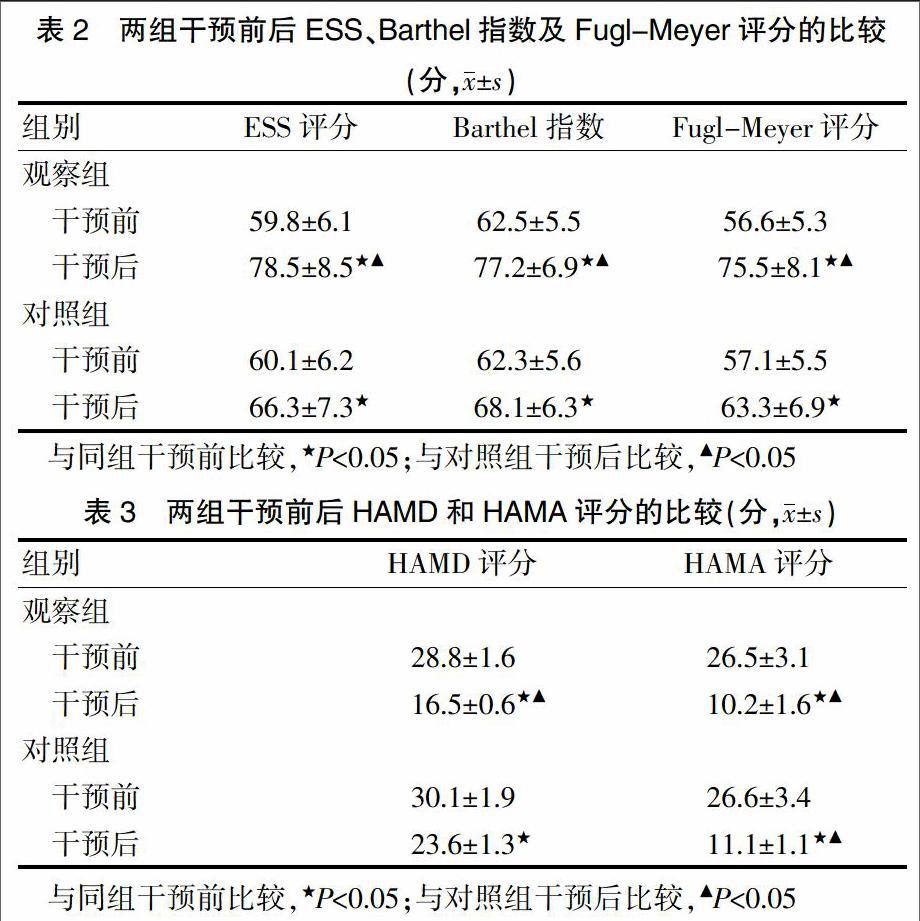
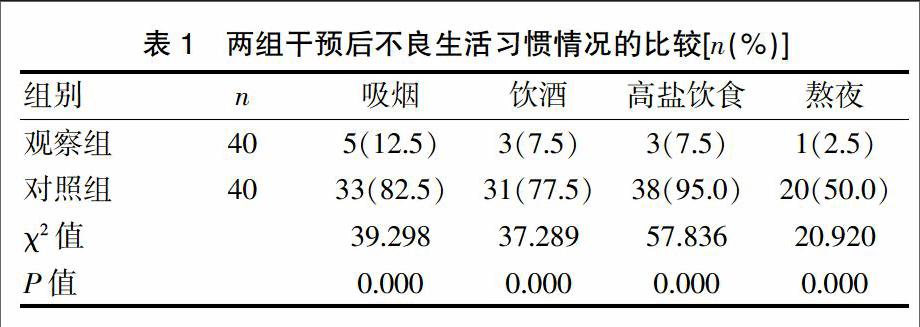
[摘要]目的 探讨协同护理对脑梗死后偏瘫患者肢体功能及心理状况的影响。方法 选择2013年1月~2015年3月我院收治的脑梗死后偏瘫患者80例,按照随机数字法分为两组,各40例,观察组实施协调护理,对照组实施常规护理,比较两组患者干预后的不良生活习惯改善情况,统计两组干预前后的欧洲脑卒中评分(ESS)、改良Barthel指数及Fugl-Meyer运动功能评分变化及焦虑、抑郁变化情况。结果 干预后,观察组仍然吸烟、饮酒、高盐饮食及熬夜的比例显著低于对照组(P<0.01),干预后,观察组的ESS、Barthel指数及Fugl-Meyer评分均低于干预前及对照组干预后(P<0.05),干预后,观察组的HAMD和HAMA评分均低于干预前及对照组干预后(P<0.05)。结论 协同护理干预能有效改善脑梗死后偏瘫患者的不良生活习惯,提高康复治疗效果,减少发病后焦虑、抑郁心理。
[關键词]协同护理;脑梗死;偏瘫;肢体功能;心理状况
[中图分类号] R473.74 [文献标识码] A [文章编号] 1674-4721(2016)11(c)-0189-04
[Abstract]Objective To investigate the influence of collaborative nursing on limb function and psychological status in patients with hemiplegia after cerebral infarction.Methods 80 cases with hemiplegia after cerebral infarction treated by our hospital from January 2013 to March 2015 were randomly divided into two groups according to the random number method,and each group had 40 cases.The observation group were given collaborative nursing,while the control group was given routine nursing.The improvement of bad life habits after intervention in patients between two groups was compared.European stroke score (ESS),improved Barthel index and change of Fugl-Meyer motor function and change of anxiety and depression was counted respectively.Results After intervention,the ratio of still smoking,drinking,high-salt eating and staying up in the observation group were lower than those of control group (P<0.01),after intervention,ESS,Barthel index and Fugl-Meyer score in the observation group were lower than pre-intervention and post-intervention of control group (P<0.05).After the intervention,the HAMD and HAMA score in the observation group were lower than pre-intervention and post-intervention of control group (P<0.05).Conclusion Collaborative nursing can effectively improve the bad habits with hemiplegia after cerebral infarction,and improve the treatment effect,reduce the incidence of anxiety and depression.
[Key words]Collaborative nursing;Cerebral infarction;Hemiplegia;Limb function;Mental status
目前国内针对脑梗死后偏瘫患者护理多关注于其住院期间护理,出院后康复期间的护理干预与康复治疗多数被忽视,未能有效开展患者的自我护理与家庭康复协同护理[1]。以上不足不仅未能有效促使患者的功能恢复,同时加大了医院临床护理工作难度,未能有效利用人力资源[2]。协同护理模式(collaborative care model,CCM)是近年来提出的一种护理新理念,其理论与工作基础为责任制护理,在充分发挥患者自我护理能力同时,积极鼓励患者、患者家属参与到患者发病后的康复护理中,从而更有效地、创造性地利用已有人力物力资源,提高工作效率[3]。针对脑梗死后偏瘫患者,其不仅保证了患者出院后得到持续的卫生保健,更利于发病后机体功能的康复,且能有效利用现有医疗资源,尤其适用于我国目前国情[4]。本研究通过对脑梗死后偏瘫患者实施协同护理,并分析其对肢体功能及患者心理状况的影响,现报道如下。……
登录APP查看全文
