
不同水生植物人工浮岛对生活污水的净化效果
2017-08-13 14:11:03何海成李青青崔建平
安徽农业科学
2017年3期
何海成 李青青 崔建平


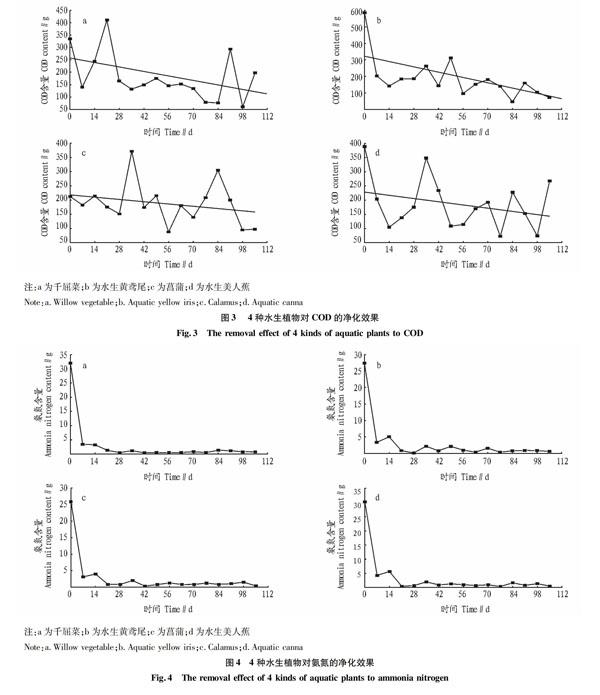
摘要[目的]研究水生植物人工浮岛对生活污水水体的净化效果。[方法]利用人工浮岛技术种植水生植物,通过建立模拟的静态污水池,研究千屈菜、水生黄鸢尾、菖蒲、水生美人蕉对污水中化学需氧量(COD)、氨氮和总磷的净化效果。[结果]污水池中,千屈菜长势最好,所有植株开花;水生黄鸢尾和香蒲的株高变化明显,且不断有新芽冒出,长成完整的植株;水生美人蕉长势最差,根系生长不明显,只有少数植株开花,叶子呈黄色。4种植物对COD的净化主要在生殖生长阶段,对氨氮和总磷的净化主要在营养生长阶段。4种植物的优选顺序依次为千屈菜、水生黄鸢尾(菖蒲)、水生美人蕉。[结论]该研究可为优选水生植物和地面水的净化修复研究提供数据支持。
关键词 水生植物;生活污水;COD;氨氮;总磷
中图分类号 X52 文献标识码 A 文章编号 0517-6611(2017)03-0068-04
Abstract[Objective] To study the purification effect of aquatic plant by an artificial floating island method on domestic sewage. [Method] Cultivating aquatic plant by artificial floating island, through establishing simulated static sewage tank, the removal effects of willow vegetables, aquatic yellow iris, calamus, aquatic canna on COD, ammonia nitrogen, TP were studied. [Result] In sewage pond, willow vegetables grow best, all plants bloom;plant height of aquatic yellow iris, calamus changed obviously;aquatic canna grow worst, root growth was not obvious, only a few plants flowering, with yellow leaves. For COD, the purification of plants was mainly in the reproductive stage, and for ammonia nitrogen and total phosphorus, it was mainly in the vegetative growth stage. The optimal order of four plants was as following, willow vegetables, aquatic yellow iris(calamus), aquatic canna. [Conclusion] This study can benefit to the optimization of the aquatic plants and the further research on purification of surface water.
Key words Aquatic plant;Domestic sewage;COD;Ammonia nitrogen;Total phosphorus
水生植物修復技術是一项用于清除环境中有毒有害污染物的绿色修复技术,是通过植物的根系吸附、吸收、富集和降解去除水中污染物以达到修复污水的目的,具有效率高、成本低、环境扰动小、易于操作的优点。同时,该技术还可以打造城市水体生态景观与生态环境相协调,是一种具有广阔发展前景的环境治理技术[1]。
人工浮岛具有效率高、投资少、运转费用低、可实现原位修复和控制污染物等特点,近年来得到广泛关注[2]。利用人工浮岛作为载体种植水生植物可用来修复污水。同时筛选适合当地生长且有一定观赏价值的植物种植在人工浮岛上,具有美化环境和净化污水双重功能[3-5]。……
登录APP查看全文
