不同中医证型高血压患者心率变异性及其影响因素分析
2017-09-07 10:27:12刘志军金华苏莉莉郑龙飞刘双芳曹强
中国中医药信息杂志
2017年9期
刘志军 金华 苏莉莉 郑龙飞 刘双芳 曹强
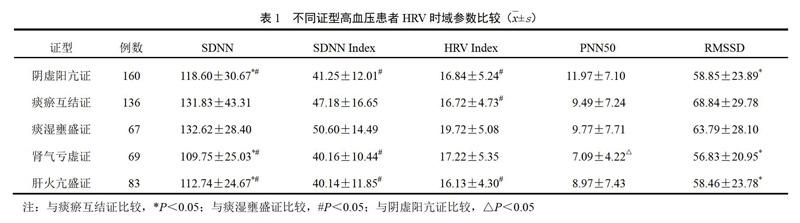
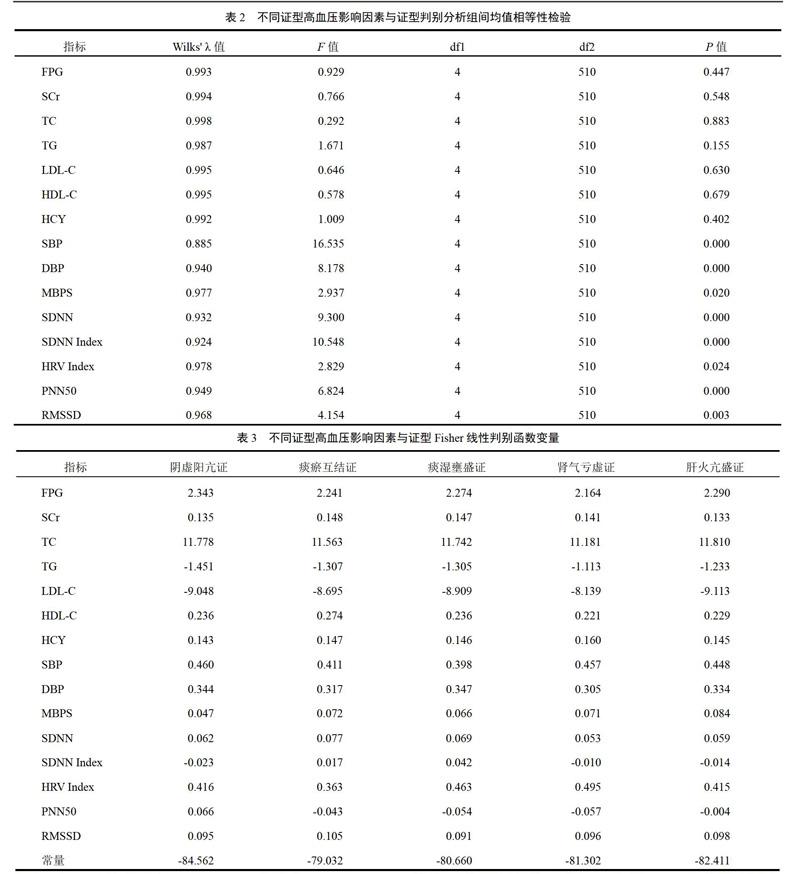
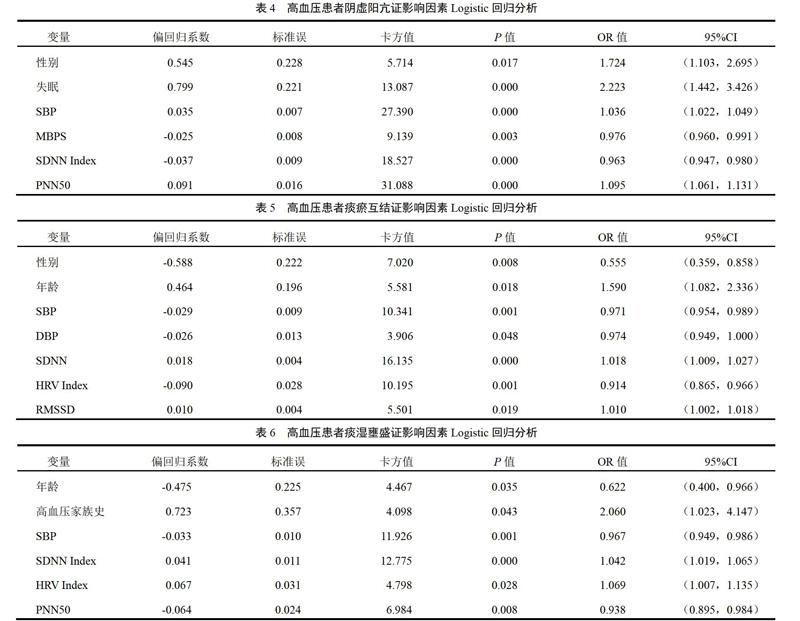
摘要:目的 調查高血压患者证型分布情况,分析心率变异性(HRV)时域参数特征与影响因素的相关性。方法 纳入高血压患者515例,进行辨证分型,记录患者的人口学资料、实验室指标、危险因素及临床症状,并分析其相关性,采用24 h动态心电图记录HRV时域参数,比较不同中医证型HRV的5项时域参数[全程NN间期标准差(SDNN)、每5分钟SDNN的平均值(SDNN Index)、HRV指数(HRV Index)、相邻NN间期之差(PNN50)、全部相邻NN间期之差的均方根(RMSSD)]差异。结果 515例患者中,阴虚阳亢证、痰瘀互结证、肝火亢盛证、肾气亏虚证、痰湿壅盛证分别为160、136、83、69、67例。阴虚阳亢证、肾气亏虚证、肝火亢盛证SDNN较痰瘀互结证、痰湿壅盛证明显降低(P<0.05);阴虚阳亢证、肝火亢盛证SDNN Index、HRV Index较痰湿壅盛证明显降低(P<0.05);肾气亏虚证SDNN Index较痰湿壅盛证明显降低(P<0.05);肾气亏虚证PNN50较阴虚阳亢证明显降低(P<0.05);阴虚阳亢证、肾气亏虚证、肝火亢盛证RMSSD较痰瘀互结证明显降低(P<0.05)。判别分析显示,收缩压、舒张压、血压晨峰值(MBPS)、SDNN、SDNN Index、HRV Index、PNN50、RMSSD与辨证分型的诊断判别具有相关性。二分类Logistic回归分析显示,性别(女性),失眠,收缩压升高,血压晨峰程度越大,SDNN Index、PNN50降低与阴虚阳亢证呈正相关;性别(女性),高龄,收缩压与舒张压升高,SDNN、HRV Index、RMSSD降低与痰瘀互结证呈正相关;高龄,高血压家族史,收缩压升高,SDNN Index、HRV Index、PNN50降低与痰湿壅盛证呈正相关。结论 阴虚阳亢证、肝火亢盛证、肾气亏虚证高血压患者HRV时域参数明显降低,自主神经功能受损较重,阴虚阳亢证、痰瘀互结证、痰湿壅盛证与引发高血压患者心脑血管事件的影响因素关系较为密切。
关键词:高血压;中医证型;心率变异性;影响因素
DOI:10.3969/j.issn.1005-5304.2017.09.005
中图分类号:R259.441 文献标识码:A 文章编号:1005-5304(2017)09-0015-06
Analysis on Heart Rate Variability and Its Influencing Factors of Hypertensive Patients from Different TCM Syndrome LIU Zhi-jun1, JIN Hua2,3, SU Li-li2, ZHENG Long-fei2, LIU Shuang-fang2, CAO Qiang2, HAN Yan-ping1 (1. Affiliated Hospital of Gansu University of Chinese Medicine, Lanzhou 730000, China; 2. Gansu University of Chinese Medicine, Lanzhou 730020, China; 3. Gansu Province Key Laboratory of Traditional Chinese Medicine Prescription Excavation and Innovation and Transformation, Lanzhou 730020, China)
Abstract: Objective To investigate the syndrome type distribution of hypertensive patients; To analyze the correlation of characteristics of HRV time domain parameters and its influence factors. Methods Totally 515 cases of hypertensive patients were included and were put under syndrome type distribution. Demographic information, laboratory test parameters, risk factors and clinical symptoms were collected for correlation analysis. HRV time domain parameters were recorded by using 24 h ambulatory electrocardiogram. The differences in SDNN, SDNN Index, HRV Index, PNN50, and RMSSD of different TCM syndrome types were compared. Results Among 515 patients: 160 cases with hyperactivity of yang due to yin deficiency syndrome, 136 cases with turbid phlegm and blood stasis syndrome, 83 cases with overabundant liver-fire syndrome, 69 cases with deficiency of kidney qi, and 67 cases with abundant phlegm-dampness syndrome. By comparing different TCM syndromes, the level of SDNN was significantly reduced in the hyperactivity of yang due to yin deficiency syndrome, overabundant liver-fire syndrome,
基金项目:甘肃省中医药管理局科研项目(GZK-2013-41);甘肃省高等学校科学研究创新团队项目(2017)
通讯作者:金华,E-mail:lanzhoujinhua@126.com
deficiency of kidney qi syndrome compared with turbid phlegm and blood stasis syndrome, abundant phlegm-dampness syndrome (P<0.05); SDNN Index and HRV Index decreased significantly in the hyperactivity of yang due to yin deficiency and overabundant liver-fire syndrome compared with abundant phlegm-dampness syndrome (P<0.05). SDNN Index decreased significantly in the deficiency of kidney qi compared with abundant phlegm-dampness syndrome (P<0.05). The level of PNN50 was significantly reduced in the deficiency of kidney qi compared with hyperactivity of yang due to yin deficiency syndrome (P<0.05). RMSSD decreased significantly in the hyperactivity of yang due to yin deficiency syndrome, deficiency of kindney qi syndrome, overabundant liver-fire syndrome compared with turbid phlegm and blood stasis syndrome (P<0.05). Discriminant analysis showed that SBP, DBP, MBPS, SDNN, SDNN Index, HRV Index, PNN50, RMSSD were correlated with the diagnosis of five syndrome types. Logistic regression analysis showed that the factors including gender (female), insomnia, elevated systolic blood pressure, MBPS, decreased SDNN Index and PNN50 were positively correlated to hyperactivity of yang due to yin deficiency; other factors including gender (female), advanced age, elevated blood pressure, decreased SDNN, HRV Index and RMSSD were positively correlated with turbid phlegm and blood stasis syndrome. And the study also showed that advanced age, family history of hypertension, elevated blood pressure, decreased SDNN Index, HRV Index and PNN50 were positively correlated to abundant phlegm-dampness syndrome. Conclusion HRV time domain parameters can be significantly reduced in the hyperactivity of yang due to yin deficiency, overabundant liver-fire syndrome, and deficiency of kidney qi syndrome. The autonomic nerve function is damaged seriously. Hyperactivity of yang due to yin deficiency syndrome, abundant phlegm-dampness syndrome turbid phlegm and blood stasis syndrome are closely related to the influencing factors that lead to cardiovascular and cerebrovascular events.
Key words: hypertension; TCM syndrome types; heart rate variability; influencing factors
高血壓病是引起心脑血管疾病终点事件的首要危险因素。心脏自主神经系统调节在高血压的进程中具有重要作用[1]。心率变异性(heart rate variability,HRV)作为临床检测自主神经系统调节是否平衡的主要无创指标,在评价心血管疾病自主神经受损程度方面具有重要价值[2]。本研究对515例不同中医证型高血压患者HRV及其相关影响因素进行分析,以期为中医药治疗高血压及改善自主神经功能提供依据。
1 资料与方法
1.1 一般资料
纳入2014年6月-2016年12月甘肃中医药大学附属医院心血管科住院患者515例。年龄32~79岁,平均年龄(61.18±8.70)岁;……
登录APP查看全文
猜你喜欢
西部医学(2021年10期)2021-10-28 08:25:50
中老年保健(2021年5期)2021-08-24 07:07:16
中国生殖健康(2020年6期)2020-02-01 06:29:06
基层中医药(2018年4期)2018-08-29 01:25:58
基层中医药(2018年6期)2018-08-29 01:20:14
中国科技博览(2016年18期)2016-10-19 06:39:44
中国市场(2016年36期)2016-10-19 03:54:01
中国市场(2016年35期)2016-10-19 02:30:10
商(2016年27期)2016-10-17 07:09:07
商(2016年27期)2016-10-17 04:40:12