负重离心收缩诱导人体肱二头肌延迟性肌肉酸痛模型的实验研究
2018-09-10 05:57:01李武艾坤蒋全睿刘小卫唐锦忠曾莉华李江山
湖南中医药大学学报
2018年3期
李武 艾坤 蒋全睿 刘小卫 唐锦忠 曾莉华 李江山
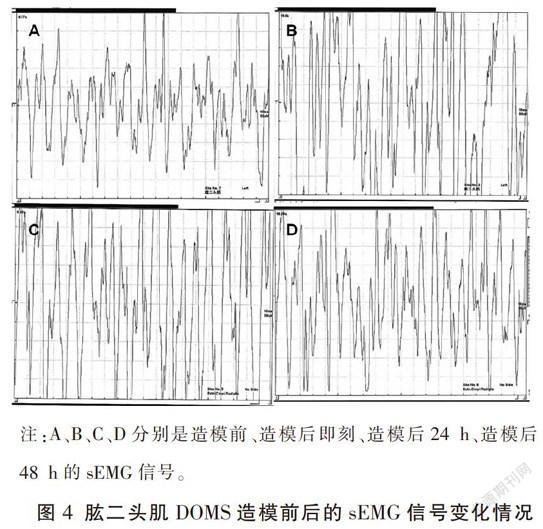
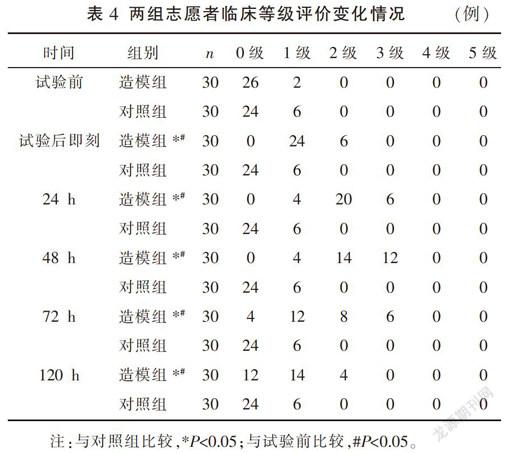
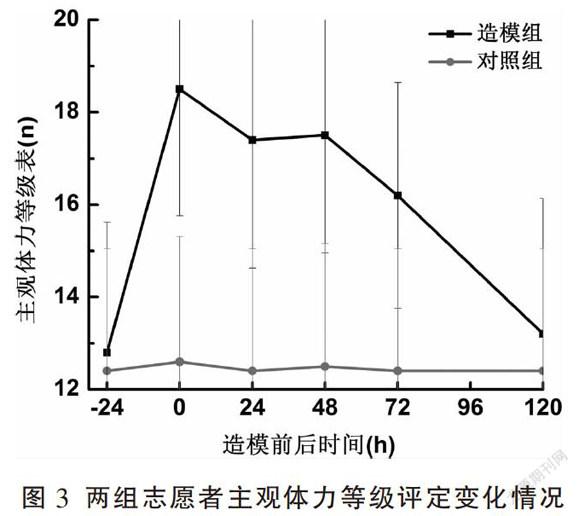
〔摘要〕 目的 觀察利用负重状态下离心收缩的方式是否诱导人体肱二头肌延迟性肌肉酸痛症(DOMS)模型。方法 实验对象从在校大学生中招募志愿者60名,随机分为造模组和对照组,两组各30例;造模组做负重状态下离心收缩运动两组,每组25个,每个动作操作时间20秒,对照组不做任何处理,通过观察志愿者的血清磷酸肌酸激酶(CK)、主观酸痛阈、主观体力等级评定量表(RPE)、DOMS临床评价(CEC)等级来评价模型是否成功。结果 造模组与对照组比较,试验后24 h和48 h主观酸痛阈低于对照组,试验后72 h CK高于对照组,试验后即刻、24 h、48 h、72 h RPE明显高于对照组,试验后即刻、24 h、48 h、72 h、120 h CEC高于对照组,差异均有统计学意义(P<0.05)。造模组试验后与试验前比较,试验后24 h、48 h和72 h主观酸痛阈明显低于试验前,试验后48 h、72 h和120 h CK高于试验前,试验后即刻、24 h、48 h、72 h RPE明显高于试验前,试验后即刻、24 h、48 h、72 h、120 h CEC高于试验前,差异均有统计学意义(P<0.05)。结论 负重状态下离心收缩可以诱导肱二头肌DOMS模型,各项指标变化符合文献记载。
〔关键词〕 延迟性肌肉酸痛;肱二头肌疲劳模型;离心收缩;磷酸肌酸激酶;主观酸痛阈
〔中图分类号〕R24 〔文献标志码〕B 〔文章编号〕doi:10.3969/j.issn.1674-070X.2018.03.024
Experimental Study on Human Biceps Delayed Onset Muscle Soreness Model Induced by Centrifugal Elbow Flexion
LI Wu1, AI Kun1, JIANG Quanrui1, LIU Xiaowei1, TANG Jinzhong2, ZENG Lihua3, LI Jiangshan1,2*
(1. Hunan University of Chinese Medicine, Changsha, Hunan 410208, China; 2. Acupuncture & Tuina and Rehabilitation Department, the First Affiliated Hospital of Hunan University of Chinese Medicine, Changsha, Hunan 410007, China; 3. Rehabilitation Department, the First People's Hospital of Chenzhou City, Chenzhou, Hunan 423000, China)
〔Abstract〕 Objective To observe the method of eccentric contraction weight-bearing on inducing human biceps DOMS model. Methods Subjects, 60 volunteers, were recruited from college students, randomly divided into the model group and control group, 30 cases in each group. The model group was given two groups of movement of centrifugal contraction on weight-bearing, each group contains 25 movements, 20 seconds each movement. The control group was not taken any special movement. The serum creatine kinase (CK), subjective pain threshold, the rate of perceived exertion (RPE) and the volunteers of clinical evaluation criteria (CEC) were observed to evaluate the model. Results Camparing model group with control group, subjective pain threshold in the model group was lower than in the control group after test for 24 hours and 48 hours; CK in the model group was higher than the control group after test for 72 hours; RPE in the model group was higher than the control group at ending the test and after test for 24 hours, 48 hours and 72 hours; CEC in the model group was higher than the control group at ending of the test, after test for 24 hours, 48 hours, 72 hours and 120 hours; the differences were statistically significant (P<0.05). After test for 24 hours, 48 hours and 72 hours, subjective pain threshold in model group was lower than before test; after test for 48 hours, 72 hours and 120 hours, CK was higher than before test; at ending of the test and after test for 24 hours, 48 hours and 72 hours, RPE was higher than before test; at ending of the test and after test for 24 hours, 48 hours, 72 hours and 120 hours, CEC was higher than before test; the differences were statistically significant (P<0.05). Conclusion The method of eccentric contraction during weight-bearing could be used for establishing human biceps DOMS model, and the changes of various indicators are in accordance with the literature.
〔Keywords〕 delayed onset muscle soreness; biceps fatigue model; centrifugal contraction; creatine kinase; subjective pain threshold
延迟性肌肉酸痛(delayed onset muscle soreness,DOMS)是指肌体承受了达到一定训练强度,或者是某种时间周期内的非习惯性运动,或者是训练强度突然增加,运动负荷超量之后8~24 h发生的、能够持续5~7 d的一种独特的肌肉疲劳或损伤的现象[1]。推拿是一种缓解DOMS症状的常用方法,但可靠的临床对比研究较少,并且推拿治疗DOMS的机制还不清楚。推拿要想在DOMS治疗上有所突破,对诱导DOMS的人体模型研究至关重要[2]。通过查阅文献,以人体肱二头肌为对象研究疲劳比较多见,本研究团队欲从人体肱二头肌着手,开始研究推拿改善DOMS的机制,通过对肱二头肌DOMS模型的研究,为下一步推拿手法治疗DOMS的研究打下基础。……
登录APP查看全文