普外科Ⅰ类手术术后切口感染相关因素分析
2019-04-21 08:51:52邱秀芳
中外医学研究
2019年29期
邱秀芳

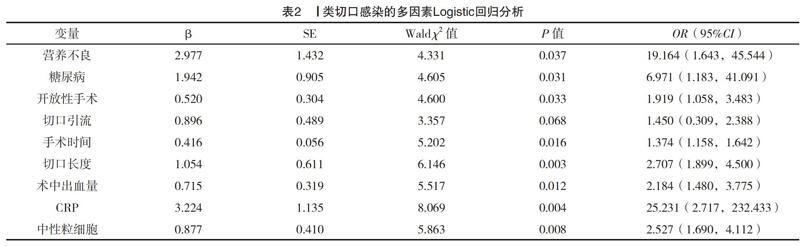
【摘要】 目的:分析普外科Ⅰ类手术术后切口感染相关因素,以期为今后临床防控提供参考。方法:回顾性抽取笔者所以院普外科2016年6月-2019年6月实施的2 840例Ⅰ类手术患者的初治资料,根据术后切口是否有感染现象,将其分为感染组与对照组,并进行切口感染的单因素及多因素分析。结果:本组患者中,术后46例(1.62%)发生切口感染。与对照组相比,感染组患者中有营养不良、糖尿病、开放性手术、切口引流者占比显著高,且手术时间、切口长度明显长,术中出血量显著高,术后6 h的C反应蛋白(CRP)、中性粒细胞水平显著高,差异均有统计学意义(P<0.05)。Logistic回归分析得出营养不良、糖尿病、开放性手术、手术时间、切口长度、术中出血量,以及术后6 h的CRP、中性粒细胞水平是普外科Ⅰ类手术术后切口感染的独立危险因素(P<0.05)。结论:营养不良、糖尿病、手术操作、炎症反应等均与普外科Ⅰ类手术术后切口感染相关,临床应对此类患者给予重点关注,并针对性实施防控措施。
【关键词】 Ⅰ类手术 切口感染 危险因素
doi:10.14033/j.cnki.cfmr.2019.29.013 文献标识码 B 文章编号 1674-6805(2019)29-00-03
[Abstract] Objective: To analyze the related factors of incision infection after general surgery type Ⅰ operation, so as to provide reference for clinical prevention and control in the future. Method: The initial treatment data of 2 840 patients undergoing type Ⅰ surgery in the hospital from June 2016 to June 2019 were retrospectively analyzed. According to the occurrence of incision infection, the patients were divided into the infected group and the control group. Univariate and multivariate analyses of incision infection were performed. Result: In this study, incision infection occurred in 46 patients (1.62%). Compared with the control group, the proportions of patients with malnutrition, diabetes, open surgery and incision drainage were significantly higher,surgical time and length of the incision were significantly longer, the intraoperative blood loss was significantly more, levels of C reactive protein (CRP) and neutrophil at 6 h after surgery were significantly higher in the infected group (P<0.05). Logistic regression analysis showed that malnutrition, diabetes, open surgery, surgical time, length of incision, intraoperative blood loss and levels of CRP and neutrophil at 6 h after surgery were independent risk factors for incision infection after type Ⅰ surgery (P<0.05). Conclusion: Malnutrition, diabetes mellitus, surgical procedures and inflammatory reactions are all related to wound infection after general surgery type I operation. Clinically, we should pay more attention to these patients and implement preventive and control measures accordingly.
[Key words] Type Ⅰ surgery Incision infection Risk factors
First-authors address: The Third Affiliated Peoples Hospital of Fujian University of Traditional Chinese Medicine, Minhou 350108, China
切口達到Ⅰ期愈合、未有感染是评估普外科手术理想与否的重要指标[1]。然而在临床实际中,手术切口感染时有发生,特别是近年来各地区各医院Ⅰ类切口手术量居高不下,一旦手术切口发生感染,轻则延缓切口愈合进度、延长治疗时间及增加治疗费用,重则导致患者出现心理问题、影响预后及促发医患纠纷[2-3]。为此,本研究回顾性分析医院普外科近3年来开展的Ⅰ类手术相关资料,以期明确术后切口感染相关因素,以期为今后临床防控提供参考。
1 资料与方法
1.1 一般资料
回顾性抽取笔者所在医院普外科2016年6月-2019年6月实施的2 840例Ⅰ类手术患者的初治资料,性别不限,年龄≥3周岁;手术明确为Ⅰ类切口,涉及甲状腺手术、乳腺手术、疝修补术、开颅术等。患者或其家属签署手术知情同……
登录APP查看全文
猜你喜欢
中国当代医药(2016年30期)2017-01-07 00:45:41
中国实用医药(2016年29期)2016-12-26 10:10:31
中国实用医药(2016年23期)2016-12-26 09:59:59
今日健康(2016年12期)2016-11-17 14:41:50
今日健康(2016年12期)2016-11-17 13:12:34
今日健康(2016年12期)2016-11-17 12:29:29
科技资讯(2016年19期)2016-11-15 10:33:36
中国实用医药(2016年26期)2016-11-07 12:22:33
中国实用医药(2016年24期)2016-10-17 05:32:48
中国实用医药(2016年21期)2016-08-19 15:24:06