针刀治疗膝骨性关节炎的临床效果
2019-05-04 13:51:38洪汉青张彩荣陈德春花志娟王佩阮志忠
中国医药导报
2019年9期
洪汉青 张彩荣 陈德春 花志娟 王佩 阮志忠
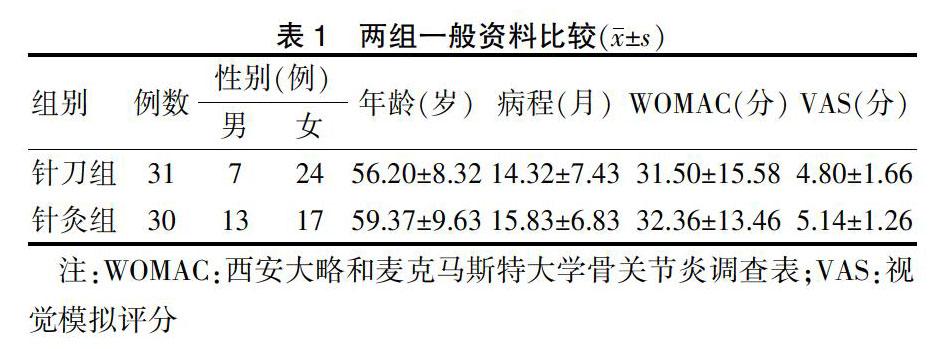

[摘要] 目的 观察针刀疗法对膝骨性关节炎患者的临床疗效,评价针刀治疗膝骨性关节炎的有效性和安全性。方法 将2017年10月~2018年4月于南京中医药大学附属南京市中医院及南京市雨花台区岱山社区卫生服务中心收治的61例膝骨性关节炎患者按随机数字表法分为针刀组(31例)和针灸组(30例)。针刀组选取膝关节周围阳性反应点进行针刀治疗,每周1次,共治疗3次;针灸组常规取穴,每天1次,每周治疗5次,共治疗3周。患者入组时和治疗结束后分别测量西安大略和麦克马斯特大学骨关节炎调查量表(WOMAC)问卷、视觉模拟评分(VAS)和关节液中一氧化氮(NO)、白细胞介素1β(IL-1β)、转化生长因子(TGF-β1)水平。 结果 两组患者各30例完成療程,其中针刀组脱落1例。WOMAC评分方面,两组在治疗1、3周和治疗后1个月均明显降低(P < 0.05或P < 0.01),针刀组治疗3周和治疗后1个月相比针灸组更优(P < 0.05)。VAS评分方面,针刀组在治疗1周、3周、治疗后1个月均明显降低(P < 0.01),针灸组在治疗3周、治疗后1个月均明显降低(P < 0.05),针刀组在治疗1、3周相比针灸组更优(P < 0.05或P < 0.01)。两组治疗3周关节液中NO、IL-1β水平均升高(P < 0.05),TGF-β1水平均下降,且针刀组优于针灸组(P < 0.05)。针刀组总有效率高于针灸组(P < 0.05)。 结论 针刀治疗膝骨性关节炎具有较好的效果,其作用机制可能与调节关节液中NO、IL-1β、TGF-β1水平有关。
[关键词] 针刀;膝骨性关节炎;针灸;疗效;作用机制
[中图分类号] R684.3 [文献标识码] A [文章编号] 1673-7210(2019)03(c)-0162-05
[Abstract] Objective To observe the clinical effect of needle-knife therapy for patients with knee osteoarthritis, and to evaluate the effectiveness and safety of needle-knife in the treatment of knee osteoarthritis. Methods From October 2017 to April 2018, 61 patients with knee osteoarthritis admitted to Nanjing Hospital of Traditional Chinese Medicine Affiliated to Nanjing University of Chinese Medicine and Daishan Community Health Service Center of Yuhuatai District in Nanjing City were randomly divided into the needle-knife group (31 cases) and the acupuncture group (30 cases) by random number table method. In the needle-knife group, the positive reaction points around the knee joint were selected for needle-knife treatment, once a week, totally for 3 times; in the acupuncture group, routine acupoints were selected for acupuncture treatment, once a day, 5 times each week, totally for 3 weeks. The Western Ontario and McMaster University Osteoarthritis Survey Scale (WOMAC) questionnaire, visual analogue scale (VAS), the levels of nitric oxide (NO), interleukin 1β (IL-1β), transforming growth factor (TGF-β1) in joint fluid were measured at the time of enrollment and the end of treatment. Results In the two groups, 30 patients completed the course of treatment, one patient in the needle-knife group fell off. In terms of WOMAC score, the needle-knife group and the acupuncture group were both significantly decreased at the first week, the 3rd week, and one month after treatment (P < 0.05 or P < 0.01). The needle-knife group was better than the acupuncture group at the 3rd week and one month after treatment (P < 0.05). In terms of VAS score, the needle-knife group was significantly decreased at the first week, the 3rd week, and one month after treatment (P < 0.01), the acupuncture group was significantly decreased at the 3rd week of treatment and one month after treatment (P < 0.05). The needle-knife group was superior to the acupuncture group at the first week and the 3rd week of treatment (P < 0.05 or P < 0.01). At the 3rd week of treatment, the levels of NO and IL-1β in joint fluid of both groups increased (P < 0.05), the level of TGF-β1 decreased (P < 0.05), and the needle-knife group was superior to the acupuncture group (P < 0.05). In terms of total efficiency, the needle-knife group was superior to the acupuncture group (P < 0.05). Conclusion Needle-knife therapy has a good curative effect on the knee osteoarthritis, and the mechanism may be related to its regulation of the levels of NO, IL-1β and TGF-β1 in the joint fluid.
[Key words] Needle-knife; Knee osteoarthritis; Acupuncture; Effect; Mechanism of action
膝骨性关节炎(KOA)是一种常见的膝关节疾病,主要表现为膝关节疼痛、肿胀、功能障碍,甚至可导致患者失去行走能力,对患者带来了严重的危害[1]。研究表明,我国60岁以上老年人膝关节炎的人数已达1500万[2],并呈不断增加的趋势。因此,积极防治KOA具有重要的临床意義。中医治疗KOA具有操作简便、副作用小、患者容易接受等特点。其中针刀是一种中医结合现代医学理论而形成的新型疗法,研究显示其治疗KOA具有一定疗效。然而,针刀治疗KOA的潜在机制尚需进一步探讨,如对一氧化氮(NO)、白细胞介素1β(IL-1β)、转化生长因子(TGF-β1)水平等影响,目前研究鲜见。……
登录APP查看全文
猜你喜欢
中华养生保健(2020年1期)2020-11-16 00:47:38
中国中医急症(2019年10期)2019-05-21 07:20:30
TMR Integrative Medicine(2018年4期)2018-12-26 07:14:02
中国医药指南(2017年3期)2017-11-13 02:57:31
农家科技下旬刊(2016年9期)2016-12-15 08:33:09
中国中药杂志(2016年20期)2016-11-19 12:24:52
人间(2016年26期)2016-11-03 17:51:57
中国实用医药(2016年24期)2016-10-17 04:45:48
中国中医药现代远程教育(2014年15期)2014-03-01 04:28:00
军事体育学报(2014年3期)2014-02-27 16:00:33