
分散液液微萃取技术及其在食品和环境农药残留检测中的运用
2019-10-21 08:41:06王进魏丹丹王嵩陈庆李沫寒
现代食品·上
2019年8期
关键词:检测
王进 魏丹丹 王嵩 陈庆 李沫寒
摘 要:随着经济的发展以及科学技术水平的提高,样品处理技术不断发展与完善,分散液液微萃取是一种新型的样品前处理技术,这一技术将萃取与浓缩有机地结合在一起,在诸多方面发挥了优势,主要表现在方便快捷、处理成本低、效率高及环境友好等。随着人们生活水平与健康安全意识的提升,食品与环境农药残留问题日益被重视,农药残留检测愈发受到人们的青睐。本文针对分散液液微萃取技术及其在食品和环境农药残留检测中的运用进行研究与分析。
关键词:分散液液微萃取;农药残留;检测;食品与环境
Abstract:With the development of economy and the improvement of science and technology, sample processing technology is continuously developed and perfected. Dispersive liquid-liquid micro-extraction is a new type of sample pre-treatment technology, which combines extraction and concentration organically. The aspects have played an important role, mainly in the convenience and convenience, low processing cost, high efficiency and environmental friendliness. With the improvement of peoples living standards and health and safety awareness, the problem of pesticide residues in food and environment has been paid more and more attention, and pesticide residue detection has become more and more popular. This paper studied and analyzed the application of dispersed liquid-liquid microextraction technology and its application in food and environmental pesticide residue detection.
Key words:Dispersive liquid microextraction; Pesticide residue; Detection; Food and environment
中图分类号:O658.2
1 分散液液微萃取技术(DLLME)原理
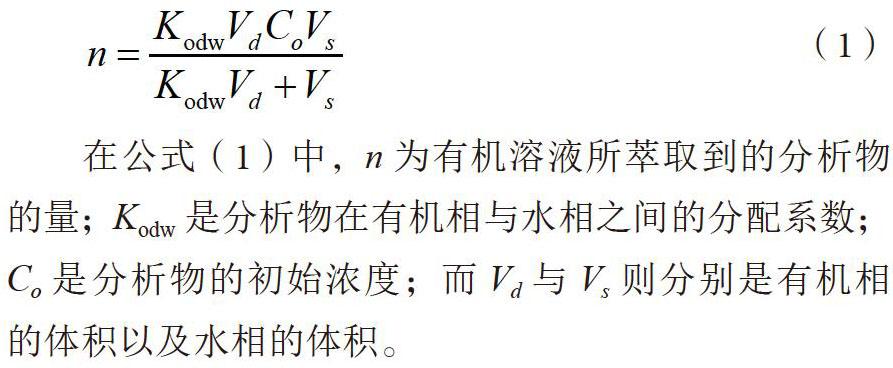
受分散剂的影响,萃取剂会逐渐形成有机液滴,这些液滴具有分散、细小的特点,并随着时间的推移在水样中均匀分散开,进而形成水/分散剂/萃取剂乳浊液体系。同时,在这一过程之中,目标分析物会被萃取至有机相中,并逐渐与萃取剂之间形成一定的萃取平衡。当整个系统处于平衡状态之下,便可以计算出有机溶液之中所萃取到的分析物的量,具体公式如式(1)。
(1)
在公式(1)中,n为有机溶液所萃取到的分析物的量;Kodw是分析物在有机相与水相之间的分配系数;Co是分析物的初始浓度;而Vd与Vs则分别是有机相的体积以及水相的体积。
一般情况下,DLLME在亲脂性较高或中等的分析物中应用的较多,高度亲水的中性分析物中并不适用。同时,当分析物具有一定酸碱性时,可以通过控制样品溶液的pH值,保证分析物呈非离子化状态,这样一来,便可以对其分配系数进行有效提高。……
登录APP查看全文
猜你喜欢
中国设备工程(2022年12期)2022-07-11 04:33:00
海峡科技与产业(2016年3期)2016-05-17 04:32:12
