施用中药渣堆肥对土地整治区新改土土壤细菌多样性及群落结构的影响
2020-01-21 15:21:52罗友进廖敦秀韩国辉胡佳羽张慧余端李燕谢永红
南方农业学报
2020年10期
罗友进 廖敦秀 韩国辉 胡佳羽 张慧 余端 李燕 谢永红
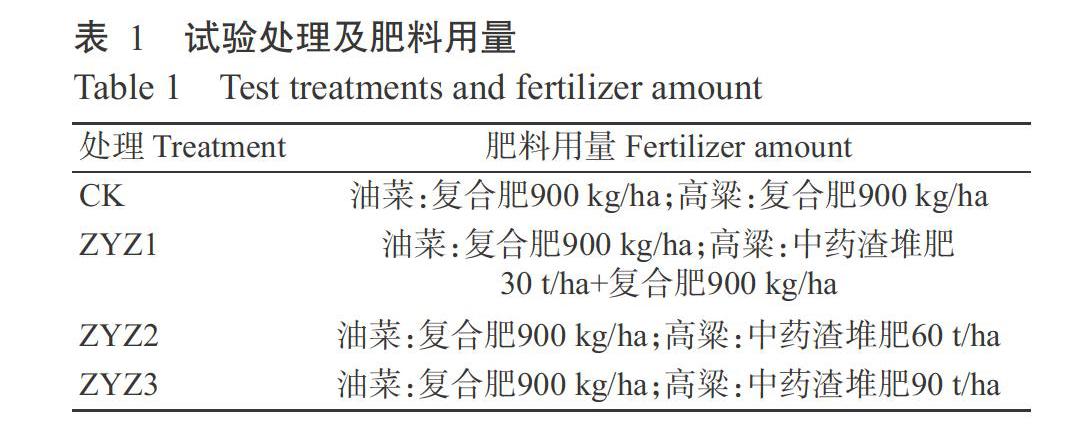
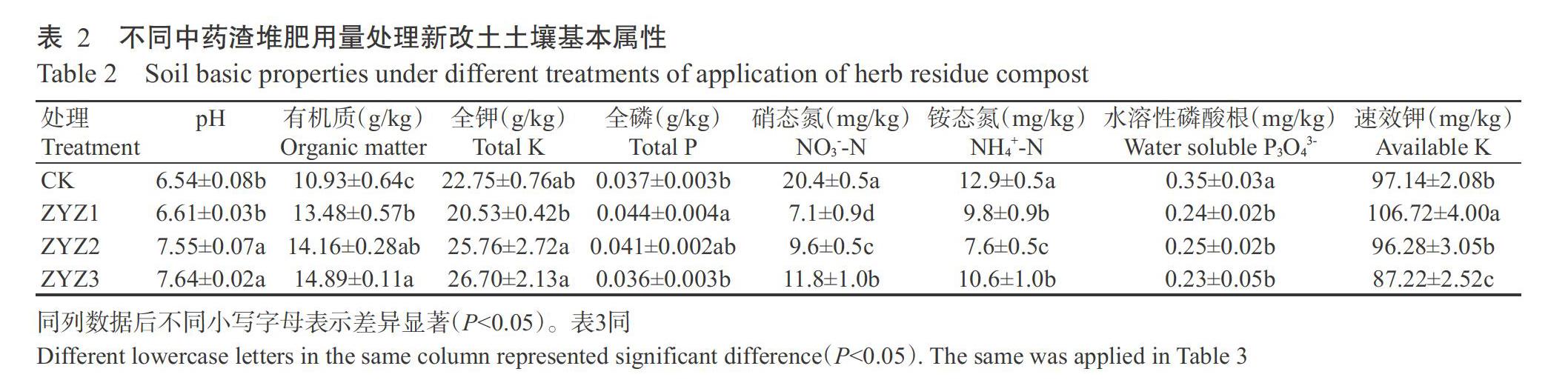

摘要:【目的】探討施用中药渣堆肥对土地整治区新改土土壤细菌多样性及群落结构的影响,为土地整治区新改土的培肥及中药渣的资源化利用提供科学依据。【方法】采用Illumina MiSeq平台高通量测序技术,在高粱—油菜轮作模式下,设4种中药渣堆肥用量处理,分别为复合肥900 kg/ha(CK)、中药渣堆肥30 t/ha+复合肥900 kg/ha(ZYZ1)、中药渣堆肥60 t/ha(ZYZ2)和中药渣堆肥90 t/ha(ZYZ3),高粱收获后采集0~20 cm土层样品,测定土壤基本理化性质,进行土壤细菌16S rRNA测序,并分析土壤细菌多样性、群落构成及相对丰度,并进行土壤理化性质与细菌群落多样性的相关分析。【结果】与CK相比,随着中药渣堆肥用量的增加,土壤pH和有机质含量逐渐升高,土壤全钾含量先降低后升高,土壤全磷和速效钾含量先升高后降低;各中药渣堆肥处理的土壤铵态氮、硝态氮和水溶性磷酸根含量均显著低于CK(P<0.05)。基于16S rRNA的高通量测序共获得119108个有效序列,得到7759个OTUs。施用中药渣堆肥会改变新改土土壤细菌群落组成,增加了5~6个土壤细菌菌门数量;提高了绿弯菌门(Chloroflexi)和酸杆菌门(Acidobacteria)的相对丰度,增幅分别为7.1%~16.7%和5.4%~10.6%;降低了变形菌门(Proteobacteria)的相对丰度,降幅为8.4%~21.2%。多样性分析结果表明,随着中药渣堆肥用量的增加,土壤细菌多样性表现出先增加后减少的变化趋势。聚类分析结果表明,4个处理归为2类,即CK和ZYZ3、ZYZ1和ZYZ2。冗余分析结果表明,土壤细菌群落主要受pH、NO3--N和有效钾含量的影响,同时有机质、全钾、P3O43-和NH4+-N也对其有一定影响。【结论】施用中药渣堆肥能提升土地整治区土壤肥力,改善其细菌群落组成,但要合理控制其施用量,以施用30 t/ha中药渣堆肥+复合肥900 kg/ha与施用60 t/ha中药渣堆肥为佳。
关键词: 新改土;土地整治区;中药渣堆肥;细菌多样性;细菌群落结构
中图分类号: S156;S154 文献标志码: A 文章编号:2095-1191(2020)10-2394-07
Effects of herb residue compost on soil bacterial diversity and community structure of new reconstructed soil in restoration area
LUO You-jin1, LIAO Dun-xiu2, HAN Guo-hui1, HU Jia-yu1, ZHANG Hui2,
YU Duan2, LI Yan2*, XIE Yong-hong1
(1Fruit Research Institute, Chongqing Academy of Agricultural Sciences, Chongqing 401329, China; 2Institute of Environment and Resources in Agriculture, Chongqing Academy of Agricultural Sciences,Chongqing 401329, China)
Abstract:【Objective】The experiment was conducted to explore the effects of herb residue compost on soil bacterial diversity and community structure in land reconstructed area in order to provide scientific basis for the fertilization of newly reconstructed soil and utilization of herb residue compost. 【Method】The illumina platform MiSeq high-throughput sequencing technology was used to sequence facility soil bacteria 16s rRNA from four treatments [chemical fertilizer 900 kg/ha(CK), herb residue compost 30 t/ha and chemical fertilizer 900 kg/ha(ZYZ1), herb residue compost 60 t/ha(ZYZ2) and herb residue compost 90 t/ha(ZYZ3)] in sorghum-rape rotation system after sorghum harvested, and the soil basic physical and chemical properties of 0-20 cm soil layer was detected by traditional chemical methods. The diversity, structure and relative abundance of soil bacteria and the correlation between soil bacteria community composition and soil basic properties was analyzed. 【Result】The results showed that the soil organic matter content and pH was increased with herb residue compost application increased compared with CK, soil total potassium content was increased first and then decreased, soil total phosphorus content and available potassium content were decreased first and then increased, and the contents of soil ammonium nitrogen, nitrate nitrogen and water-soluble phosphate were significantly decreased in herb re-sidue compost application treatments(P<0.05). A total of 7759 operational taxonomic units(OTUs) and 119108 effective sequences were detected based on 16S rRNA high-throughput sequencing. Herb residue compost application could change soil bacterial composition, increase the number of five to six bacterial phyla. It also increased the relative abundance of Chloroflexi and Acidobacteria increased by 7.1%-16.7% and 5.4%-10.6% respectively, but that of Proteobacteria decreased by 8.4%-21.2%. Diversity analysis indicated that, soil bacterial diversity increased and then decreased with the increasing of herb residue compost application amounts. Hierarchical clustering results showed that the four treatments was clustered into two groups, CK and ZYZ3,ZYZ2 and ZYZ1. Redundancy analysis also showed that soil bacterial community was mainly affected by pH,NO3--N and available potassium,and also affected by organic matter,total potassium, P3O43- and NH4+-N. 【Conclusion】In general, the soil fertility and bacterial community of land restoration area can be improved by application of herb residue compost, but the application amount should be controlled. The optimal amount is herb residue compost 30 t/ha+chemical fertilizer 900 kg/ha and herb residue compost 60 t/ha.
Key words: newly reconstructed soil; land restoration area; herb residue compost; bacterial diversity; bacterial community
Foundation item: National Key Research and Development Program of China(2018YFD0800606); Incentive and Guidance Special Project of Chongqing Research Institutes(CSTC2018JXJl80033,CSTC2017JXJl80020);Major Innovation Project for Agriculture Science and Technology of Chongqing Academy of Agricultural Sciences(NKY2017 AB002)
0 引言
【研究意义】土地整治以增加耕地面积,提升粮食产能为主要目的,是目前土地利用管理的重要手段之一(Yan et al.,2015),但其更多关注新增耕地数量,而对新增耕地质量关注较少。土地整治工程多采用挖高填低、表土剥离及有机肥培肥等方式,在优化生产和维持农田景观功能的同时,会对农田生态,尤其是土壤生态(微生物群落等)造成大幅干扰(王军等,2011)。土壤微生物在维持土壤生态功能中扮演着重要角色(Nannipieri et al.,2003),其中细菌在土壤微生物数量中占有绝对优势,决定着土壤微生物总量的分布,影响着有机物的分解和转化(Zimmerman,2010)。……
登录APP查看全文