2种贝龄合浦珠母贝数量性状的相关与通径分析
2020-01-21 15:36:41陈健白丽蓉罗会喻达辉
南方农业学报
2020年10期
陈健 白丽蓉 罗会 喻达辉


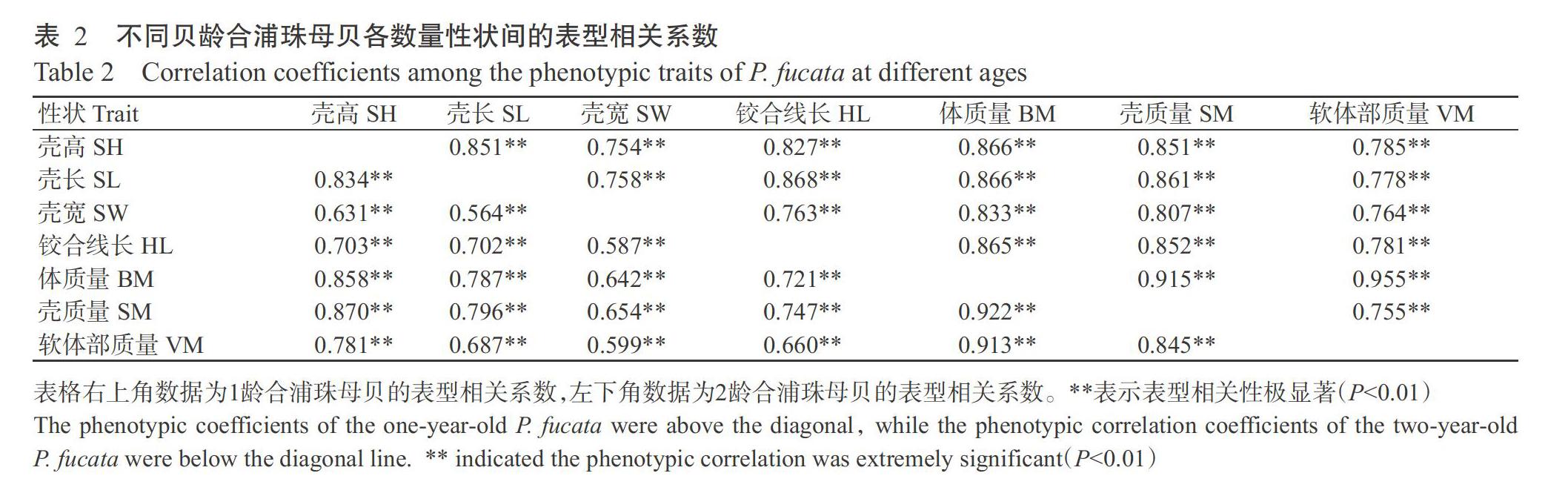
摘要:【目的】明確不同贝龄合浦珠母贝(Pinctada fucata)壳形态性状(壳高、壳长、壳宽和铰合线长)与产量性状(体质量、软体部质量和壳质量)间的相关性,筛选出对合浦珠母贝产量性状的影响因素及其决定程度,为产量性状的选育提供理论依据。【方法】随机选取形态较完整的1龄合浦珠母贝184只和2龄合浦珠母贝191只,分别测量其壳形态性状[壳高(SH)、壳长(SL)、壳宽(SW)和铰合线长(VL)]及产量性状[体质量(BM)、软体部质量(VM)和壳质量(SM)]后,使用SPSS 24.0进行相关分析和通径分析,并通过线性逐步回归分析建立多元线性回归方程。【结果】1龄合浦珠母贝壳形态性状变异系数在12.19%~15.15%,产量性状变异系数在30.90%~39.27%;2龄合浦珠母贝壳形态性状变异系数在8.90%~10.26%,产量性状变异系数在23.09%~29.23%。2种贝龄合浦珠母贝数量性状间的表型相关性均达极显著水平(P<0.01),各性状间的相关系数范围为0.564~0.955。1龄和2龄合浦珠母贝中进入最终多元回归方程的4个壳形态性状对其体质量的总决定系数(R2)分别为0.864和0.778;对合浦珠母贝体质量直接影响最大的壳形态性状在1龄贝中为壳宽、在2龄贝中为壳高,对应的通径系数分别为0.286和0.536;在壳形态性状对体质量的单独决定作用中,1龄贝以壳宽对其体质量的单独决定作用最大,2龄贝则是壳高对其体质量的决定作用最大,对应的决定系数分别为0.082和0.287。【结论】开展合浦珠母贝人工选育或留种时应根据不同贝龄进行相应性状的挑选,以体质量为选育目标时,在1龄个体中要首先考虑壳宽性状,在2龄个体中则应考虑壳高性状。
关键词: 合浦珠母贝;贝龄;数量性状;通径分析;决定系数
中图分类号: S968.316.1 文献标志码: A 文章编号:2095-1191(2020)10-2557-08
Correlation and path analysis of quantitative traits of pearl oyster Pinctada fucata at two different ages
CHEN Jian1,2, BAI Li-rong2, LUO Hui2, YU Da-hui1,2*
(1College of Animal Science and Technology, Guangxi University, Nanning 530004, China; 2Ocean College, Beibu Gulf University/ Guangxi Key Laboratory of Beibu Gulf Marine Biodiversity Conservation, Qinzhou,
Guangxi 535011, China)
Abstract:【Objective】The correlation between morphological traits (shell height, shell length, shell width and hinge length) and yield traits (body mass, visceral mass, and shell mass) of pearl oyster Pinctada fucata of different ages were determined. The factors affecting the yield traits and degree of determination of P. fucata were screened out, which provi-ded theoretical basis for the breeding of yield traits. 【Method】Morphological traits [shell height(SH), shell length(SL), shell width(SW), and hinge length(HL)] and mass traits [body mass(BM), visceral mass(VM), and shell mass(SM)]were measured from 184 one-year-old individuals and 191 two-year-old individuals, respectively. SPSS 24.0 was used for correlation analysis and path analysis, and multiple linear regression equation was established by linear stepwise regression analysis. 【Result】The variation coefficients of morphological traits and mass traits of one-year-old pearl oyster were 12.19%-15.15% and 30.90%-39.27%, respectively. However, those of two-year-old pearl oyster were 8.90%-10.26% and 23.09%-29.23%. Phenotypic correlation among quantitative traits of P. fucata at different years reached extremely significance(P<0.01), with the correlation coefficients ranging from 0.564 to 0.955. The total determination coefficient (R2) of the four shell morphological traits to the body weight of age one and age two P. fucata were 0.864 and 0.778, respectively. Path analysis showed that the living body mass was the most largely affected by shell width at age one but by shell height at age two, with path coefficients of 0.286 and 0.536, respectively. Among the independent determination of shell morphological traits on body weight, shell width had the greatest effect on its body weight in one-year-old individuals, while the shell height had the greatest effect on the body weight in two-year-old individuals, with the corresponding coefficients of determination were 0.082 and 0.287, respectively. 【Conclusion】When carrying out selective breeding or seed retention of P. fucata, the corresponding traits should be selected according to different shell ages. When taking body mass as the target of selection and breeding, shell width traits should be taken as the first selected character in one-year-old indivi-duals, and shell height traits should be the first choice in the two-age individuals.
Key words: Pinctada fucata; shell ages; quantity traits; path analysis; decision coefficient
Foundation item: National Key Research and Development Program of China(2018YFD0901406); The General Project of National Natural Science Foundation of China(31873042); Guangxi Natural Science Foundation(2018GXNSFAA138197); Guangxi Key Research and Development Project (2018AB52002)
0 引言
【研究意义】合浦珠母贝(Pinctada fucata)是培育海水珍珠的最主要贝类,具有极高的经济价值(王爱民和石耀华,2003),在我国主要分布于广东、广西、海南及台湾等地区(王如才和王昭萍,2008;Nagai,2013)。近年来,受种质退化等因素的影响,合浦珠母贝养殖生长缓慢、病害严重、插核育珠后死亡率高,导致珍珠产量及质量严重下滑,养殖经济效益明显下降(He et al.,2008)。开展合浦珠母贝遗传改良及培育优良新品种是解决我国珍珠贝养殖问题的主要途径,而性状选择是良种选育的核心(汤娇雯等,2009;Gjedrem et al.,2012),尤其是生物体数量性状间的相互关系对珍珠贝遗传育种研究具有重要意义(盛志廉和吴常信,1999;Li et al.,2016)。……
登录APP查看全文