瑞芬太尼联合丙泊酚用于无痛胃肠镜麻醉的效果
2020-04-16 13:02:32韩雷
中国当代医药
2020年7期
韩雷

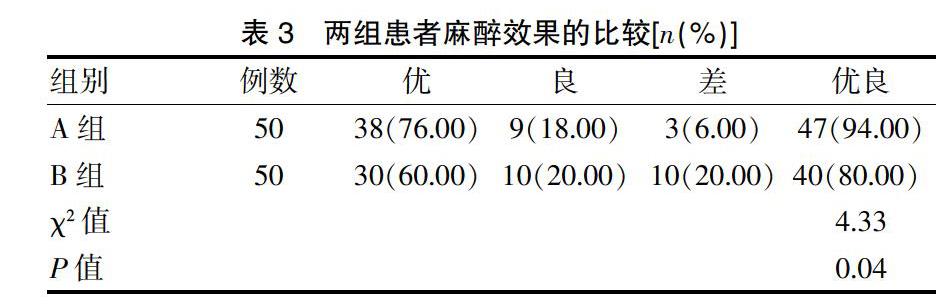
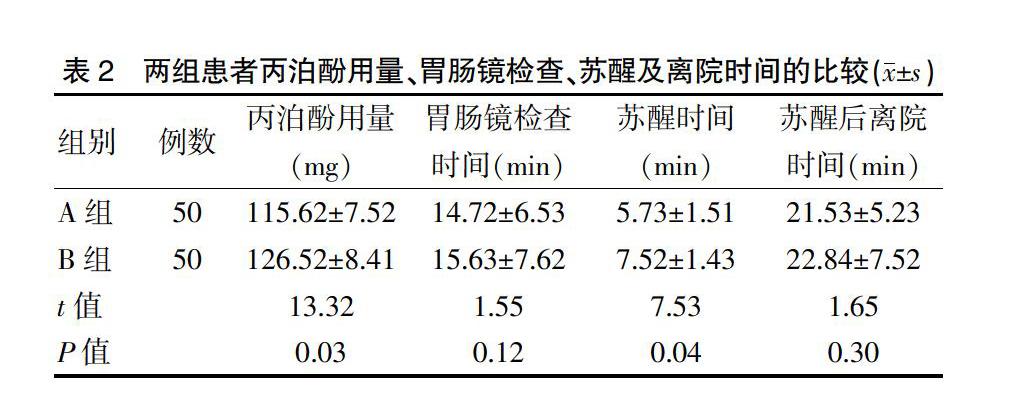
[摘要]目的 觀察瑞芬太尼联合丙泊酚用于无痛胃肠镜麻醉的临床效果。方法 选取2017年10月~2018年8月在我院行无痛胃肠镜检查及治疗患者100例,按照随机数字表法分为两组,每组各50例。A组(实验组)给予瑞芬太尼0.3~0.5 μg/kg联合丙泊酚麻醉,B组(对照组)给予丙泊酚1.5~2.0 mg/kg完成操作。观察对比两组的平均动脉压,心率、丙泊酚用量、胃肠镜检查时间、苏醒时间、麻醉效果及两组不良反应发生情况。结果 两组患者平均动脉压和心率的比较,差异无统计学意义(P>0.05);A组患者丙泊酚用量少于B组,差异有统计学意义(P<0.05);A组患者苏醒时间短于B组,差异有统计学意义(P<0.05);两组患者胃肠镜检查、患者清醒后离院时间比较,差异无统计学意义(P>0.05);A组患者麻醉效果优良率高于B组,差异有统计学意义(P<0.05);A组患者术中呼吸抑制发生率低于B组,差异有统计学意义(P<0.05);两组患者术后恶心呕吐、眩晕的发生率比较,差异无统计学意义(P>0.05)。结论 瑞芬太尼联合丙泊酚用于无痛胃肠镜麻醉患者减少了丙泊酚的用量,患者苏醒时间缩短,不良反应较少,临床使用安全有效。
[关键词]瑞芬太尼;无痛胃肠镜;丙泊酚用量;不良反应
[中图分类号] R574 [文献标识码] A [文章编号] 1674-4721(2020)3(a)-0151-04
Effect of Remifentanil combined with Propofol on painless gastroscopy anesthesia
HAN Lei
Department of Anesthesiology, Beijing Hospital of Integrated Traditional Chinese and Western Medicine, Beijing 100039, China
[Abstract] Objective To observe the clinical effect of Remifentanil combined with Propofol on painless gastroscopy anesthesia. Methods A total of 100 patients who underwent painless gastroenteroscopy and treatment in our hospital from October 2017 to August 2018 were selected. According to the random numer table method, they were divided into two groups with 50 patients in each group. Group A (experimental group) was anesthetized with Remifentanil 0.3-0.5 μg/kg combined with Propofol. Group B (control group) was given Propofol 1.5-2.0 mg/kg to complete the operation. The mean arterial pressure, heart rate, Propofol dosage, gastroenteroscopy time, waking time, anesthetic effect, and adverse reactions of the two groups were observed and compared. Results There were no significant differences in mean arterial pressure and heart rate between the two groups (P>0.05). Propofol dosage in group A was less than that in group B, with statistically significant difference (P<0.05). The recovery time of patients in group A was shorter than that in group B, the difference was statistically significant (P<0.05). There was no significant difference between the two groups in gastrointestinal endoscopy and the time of patients leaving hospital after awake (P>0.05). The excellent rate of anesthesia effect in group A was higher than that in group B, the difference was statistically significant (P<0.05). The occurrence rate of respiratory depression in group A was lower than that in group B, the difference was statistically significant (P<0.05). There was no significant difference in the occurrence rate of postoperative nausea, vomiting, vertigo between the two groups (P>0.05). Conclusion Remifentanil combined with Propofol for painless gastrointestinal endoscopy anesthesia reduces the dosage of Propofol, shortens the recovery time of patients, has fewer adverse reactions, and is safe and effective in clinical use.
[Key words] Remifentanil; Painless gastroenteroscopy; Propofol dosage; Adverse reactions
胃肠镜检查治疗术,是诊断和治疗消化道疾病的一种重要手段,临床应用广泛。但由于胃肠镜诊疗为一种侵入性操作,患者会有一些不适感及疼痛,甚至不能耐受[1]。为了让患者舒适安静地接受检查和治疗,临床通常在浅麻醉或镇静状态下完成,因此无痛技术在胃肠镜中被广泛的应用[2]。临床常用丙泊酚静脉麻醉行胃肠镜检查治疗术,临床实践显示,單纯使用丙泊酚有时不能获得良好的效果,需要合并镇痛镇静药物以达到良好的松弛效果,消除咽部的防御反射,减少呛咳、躁动等不良反应[3],为胃肠镜的检查治疗提供充分的保障,使患者更舒适、安全地接受操作。胃肠……
登录APP查看全文