中青年患者轻度颅脑损伤后形成慢性硬膜下血肿的危险因素
2020-06-08 10:52:33尹胜汪洋董永飞鲍得俊魏祥品
医学信息
2020年9期
关键词:危险因素
尹胜 汪洋 董永飞 鲍得俊 魏祥品
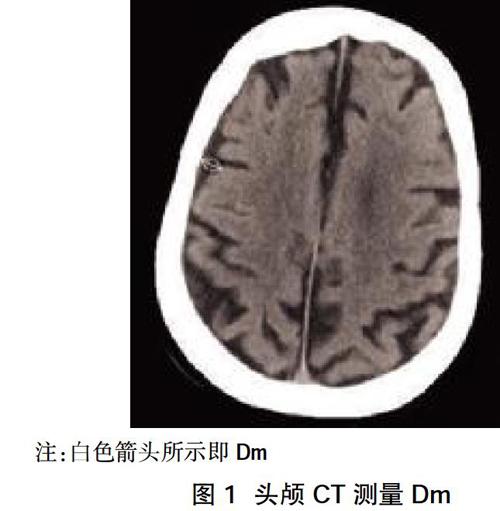
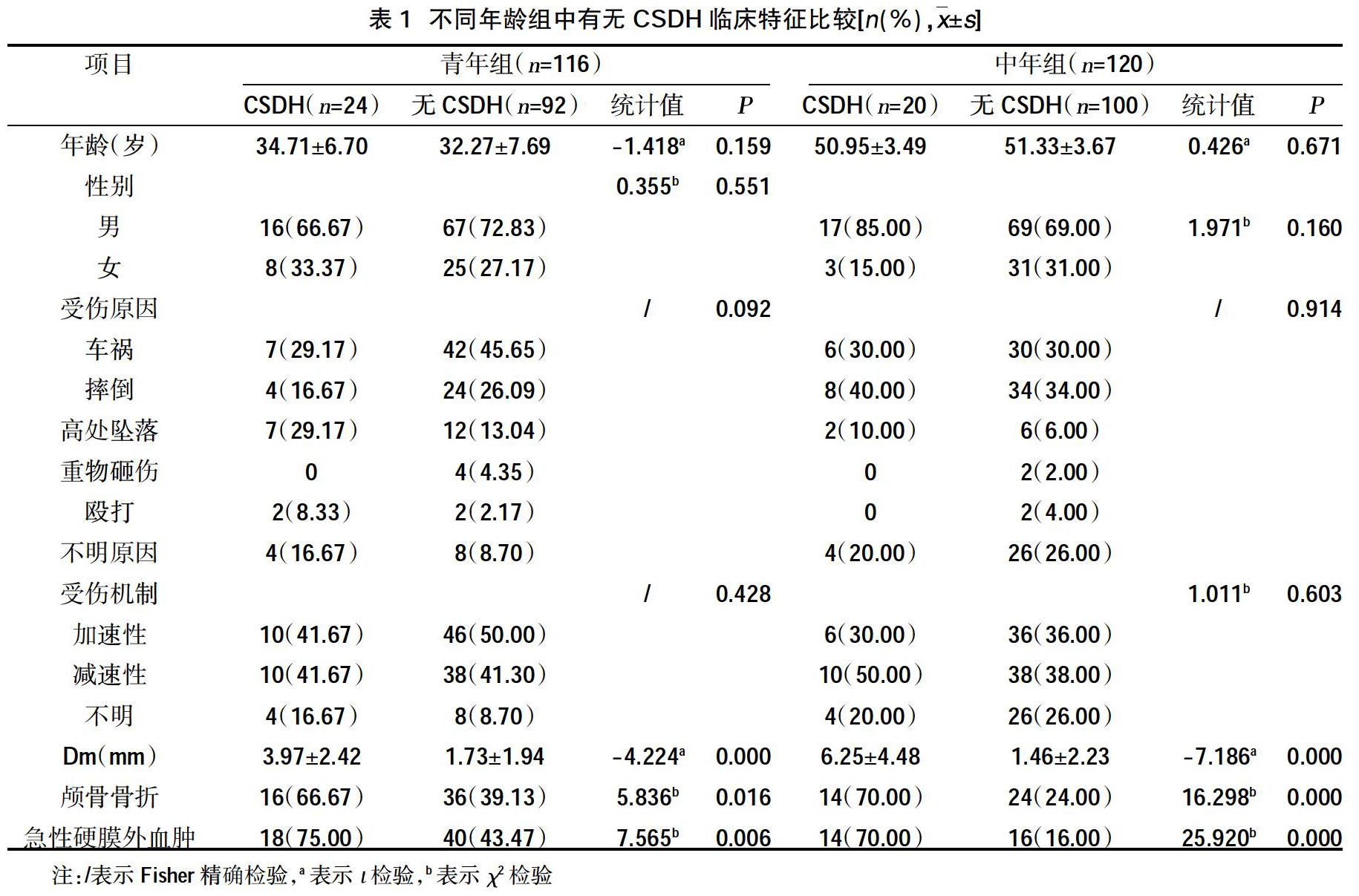

摘要:目的 探討中青年患者轻度颅脑损伤后形成慢性硬膜下血肿的危险因素。方法 回顾性分析2018年1月~2019年5月安徽省立医院收治的轻度颅脑损伤患者236例,根据年龄分为青年组(18~44岁)116例和中年组(45~60岁)120例,另根据头颅CT复查结果将两个年龄组患者进一步分成CSDH患者和无CSDH患者,分析年龄组中CSDH患者和无CSDH患者各临床指标与慢性硬膜下血肿形成的关系,并采用Logistic回归分析不同年龄组创伤后CSDH形成的因素,采用ROC曲线分析脑实质距颅骨最大距离(Dm)预测CSDH形成的准确性。结果 青年组CSDH患者与无CSDH患者的Dm、蛛网膜囊肿、颅骨骨折及急性硬膜外血肿占比比较,差异有统计学意义(P<0.05);中年组CSDH患者与无CSDH患者的Dm、蛛网膜囊肿、颅骨骨折及急性硬膜外血肿、高血压、糖尿病、抗凝/抗血小板治疗占比、吸烟饮酒量比较,差异有统计学意义(P<0.05)。多因素Logistic回归分析显示,Dm、颅骨骨折及蛛网膜囊肿是青年患者创伤后CSDH形成的独立危险因素;Dm、颅骨骨折、高血压及抗凝/抗血小板治疗是中年患者创伤后CSDH形成的独立危险因素。ROC曲线分析显示,青年组曲线下面积为0.780,最佳截断值为3.5 mm,预测CSDH形成敏感度为58.33%,特异性为86.96%;中年组ROC曲线下面积为0.855,最佳截断值为2.6 mm,预测CSDH形成敏感度为90.00%,特异性为80.00%。结论 青年患者创伤后形成慢性硬膜下血肿的独立危险因素是脑实质与颅骨间的最大距离、颅骨骨折及蛛网膜囊肿;中年患者独立危险因素是脑实质与颅骨间的最大距离、颅骨骨折、抗凝/抗血小板治疗及高血压。同时青年患者硬膜外血肿,中年患者硬膜外血肿、蛛网膜囊肿、糖尿病、饮酒及吸烟亦与创伤后慢性硬膜下血肿的形成有相关性,有以上临床特征者应加强临床随访。
关键词:颅脑损伤;慢性硬膜下血肿;危险因素
中图分类号:R651.1 文献标识码:A DOI:10.3969/j.issn.1006-1959.2020.09.019
文章编号:1006-1959(2020)09-0062-05
Risk Factors for the Formation of Chronic Subdural Hematoma in Young
and Middle-aged Patients with Mild Head Injury
YIN Sheng,WANG Yang,DONG Yong-fei,BAO De-jun,WEI Xiang-pin
(Department of Neurosurgery,Provincial Hospital Affiliated to Anhui Medical University,Hefei 230036,Anhui,China)
Abstract:Objective To explore the risk factors of chronic subdural hematoma in young and middle-aged patients after mild head injury.Methods A retrospective analysis of 236 patients with mild craniocerebral injury admitted to Anhui Provincial Hospital from January 2018 to May 2019 was divided into youth group (18 to 44 years old) 116 cases and 120 patients in the middle-aged group (45 to 60 years old) ,which were further divided into CSDH patients and patients without CSDH according to the results of head CT review.The relationship between the clinical indicators and the formation of SCDH in the two age groups were analyzed.The logistical regression was used to further evaluate the statistically significant indicators in different age groups, and the ROC curve was used to analyze the accuracy of predicting the formation of CSDH by the maximum distance(Dm) of the brain parenchyma from the skull.Results The proportions of Dm, arachnoid cyst, skull fracture and acute epidural hematoma in CSDH patients and those without CSDH were statistically significant(P<0.05); The difference in Dm, arachnoid cyst, skull fracture and acute epidural hematoma, hypertension, diabetes, anticoagulation/antiplatelet therapy, smoking and alcohol consumption between CSDH patients and patients without CSDH in the middle-aged group was statistically significant(P<0.05).Multivariate Logistic regression analysis showed that Dm, skull fractures and arachnoid cysts were independent risk factors for the formation of post-traumatic CSDH in young patients; Middle-aged patients independent risk factors for the formation of post-trauma CSDH included Dm, skull fracture, hypertension and anticoagulation/antiplate therapy.ROC curve analysis showed that the area under the curve of the youth group was 0.780, and the best cut-off value was 3.5 mm. The sensitivity of CSDH formation was 58.33% and the specificity was 86.96%.The area under the ROC curve of the middle-aged group was 0.855, and the optimal cutoff value was 2.6 mm. The sensitivity of CSDH formation was predicted to be 90.00%, and the specificity was 80.00%.Conclusion The independent risk factors for chronic subdural hematoma after trauma in young patients are the maximum distance between brain parenchyma and skull, skull fracture and arachnoid cyst; the independent risk factors for middle-aged patients are the maximum distance between brain parenchyma and skull, skull fracture, anticoagulant/antiplatelet therapy and hypertension. At the same time, young patients with epidural hematoma, middle-aged patients with epidural hematoma, arachnoid cyst, diabetes, drinking and smoking are also associated with the formation of chronic subdural hematoma after trauma. Those with above clinical features should strengthen clinical follow-up.
Key words:Head injury;Chronic subdural hematoma;Risk factors
外伤性颅脑损伤(traumatic brain injury,TBI)是神经外科主要急重症之一,其中轻型占据大部分,因其临床症状轻微,甚至无明显症状[1],常被忽视,尤其是中青年人。輕度颅脑损伤是神经外科常见疾病之一,也是慢性硬膜下血肿(chronic subdural hematoma,CSDH)的重要诱因,大多数CSDH患者有外伤病史[2],多数患者病程进展缓慢,早期常无明显症状,或仅有轻微头痛,未能及时就诊,逐渐进展可出现记忆减退、偏瘫、意识障碍甚至脑疝[2]。本文旨在探讨中青年患者轻度颅脑损伤后形成CSDH的危险因素,为临床诊疗提供依据,现报道如下。
1资料与方法
1.1一般资料 回顾性分析2018年1月~2019年5月安徽省立医院神经外科因有头颅CT有阳性表现的轻度颅脑外伤入院的中青年患者236例。……
登录APP查看全文
猜你喜欢
中外医学研究(2016年28期)2016-11-28 12:51:05
中外医学研究(2016年28期)2016-11-28 12:48:47
中国现代医生(2016年26期)2016-11-28 01:53:18
中国医学创新(2016年30期)2016-11-28 00:19:10
今日健康(2016年12期)2016-11-17 14:41:50
今日健康(2016年12期)2016-11-17 13:12:34
今日健康(2016年12期)2016-11-17 12:29:29
科技资讯(2016年19期)2016-11-15 10:33:36
中国实用医药(2016年24期)2016-10-17 05:32:48
养生保健指南(2016年4期)2016-03-22 12:25:57