
甲基苯丙胺使用障碍者风险决策行为的事件相关电位研究
2020-08-21 08:52:27朱春燕孙继军
中国现代医生
2020年17期
关键词:认知
朱春燕 孙继军
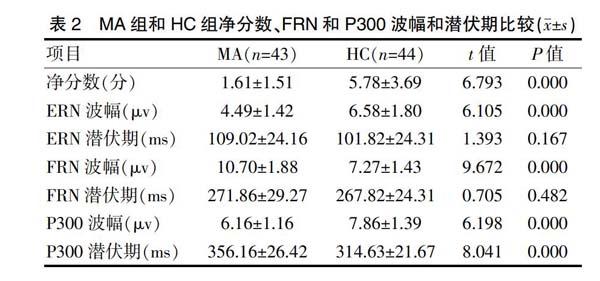
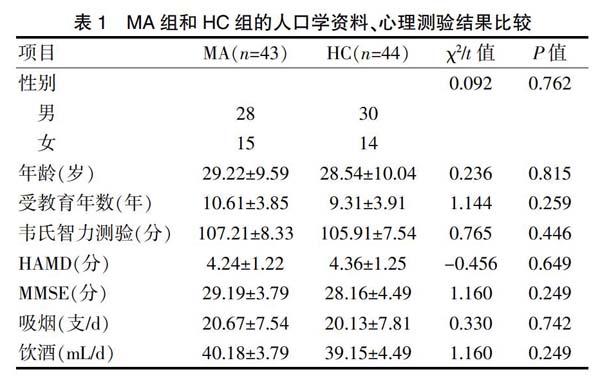
[摘要] 目的 探讨甲基苯丙胺使用障碍者风险决策行为的事件相关电位特点,从风险决策行为角度来了解甲基苯丙胺使用障碍的神经生物学机制。 方法 甲基苯丙胺并使用障碍组(MA组):43例,和健康对照组(HC):44例,两组分别于入组时进行中国修订版韦氏成人智力量表(WAIS-RC)、简易精神状态检查表(MMSE)、汉密尔顿抑郁量表(HAMD)评定。以及执行爱荷华赌博任务并同时进行事件相关电位数据采集。 结果 MA组爱荷华赌博任务净分数(1.61±1.51)分,低于健康对照组净分数(5.78±3.69)分,差异有统计学意义(P<0.05);MA组P300潜伏期(356.16±26.42)ms,较健康对照组(314.63±21.67)ms长、P300波幅[(6.16±1.16)μv]低于健康对照组[(7.86±1.39)μv],差异均有统计学意义;MA组ERN波幅(4.49±1.42)μv低于HC组的(6.58±1.80)μv(P<0.05),FRN波幅(10.70±1.88)μv高于健康对照组的(7.27±1.43)μv,差异有统计学意义(P<0.05)。两组ERN潜伏期、FRN潜伏期差异无统计学意义(P>0.05)。 结论 甲基苯丙胺使用障碍者存在冲动性决策行为,事件相关电位揭示了甲基苯丙胺使用障碍者存在错误评估、结果反馈能力及认知功能损害。
[關键词] 甲基苯丙胺;风险决策;认知;事件相关电位
[中图分类号] R749.2 [文献标识码] B [文章编号] 1673-9701(2020)17-0092-04
Study on event-related potentials of risk decision-making behaviors of patients with methamphetamine use disorder
ZHU Chunyan1 SUN Jijun2
1.Seventh Department of Psychiatry, Hangzhou Seventh People's Hospital,Hangzhou 310013, China; 2.Third Department of Psychology, Hangzhou Seventh People's Hospital, Hangzhou 310013, China
[Abstract] Objective To explore the characteristics of event-related potentials in risk decision-making behaviors of people with methamphetamine use disorders, and to understand the neurobiological mechanism of methamphetamine use disorders from the perspective of risk decision-making behaviors. Methods There were 43 cases in the methamphetamine use disorder group(MA group) and 44 cases in the healthy control group(HC group). The two groups were evaluated at the time of enrollment by the Chinese Revised Webster Adult Intelligence Scale(WAIS-RC), Mini-Mental State Examination Scale(MMSE), and Hamilton Depression Scale(HAMD). They also performed Iowa gambling tasks and collected event-related potential data at the same time. Results Net Iowa gambling task score(1.61±1.51) Points in the MA group was lower than that of the healthy control group(5.78±3.69) Points, and the difference was statistically significant. The P300 latency period(356.16±26.42) ms in the MA group was longer than(314.63±21.67) ms in the healthy control group, and the P300 amplitude(6.16±1.16) μv in the MA group was lower than(7.86±1.39) μv in the healthy control group, and the differences were statistically significant. The ERN amplitude(4.49±1.42) μv in the MA group was lower than(6.58±1.80) μv of the healthy control group(P<0.05). The FRN amplitude(10.70±1.88)μv in the MA group was higher than(7.27±1.43) μv of the healthy control group, and the difference was statistically significant. There was no significant difference in the ERN latency and FRN latency between the two groups(P>0.05). Conclusion There are impulsive decision-making behaviors in people with methamphetamine use disorder, and event-related potentials reveal that there is erroneous assessment, impaired ability to results feedback and cognitive function in people with methamphetamine use disorder.
[Key words] Methamphetamine; Risk decision-making; Cognition; Event-related potential
甲基苯丙胺(methamphetamine,MA)是一种苯丙胺类兴奋剂(amphetamine-type stimulants,ATS),具有极强甚至是不可逆的神经毒性[1,2],且使用者越来越年轻化,年龄在18~25岁[3],严重危害人们的健康及带来严重的社会问题。冲动性觅药是慢性成瘾者典型的行为特征,近年来,利用事件相关电位研究认知功能如注意、记忆、执行功能等已成为热点[4,5],目前从神经电生理角度了解甲基苯丙胺使用障碍者的风险决策行为的研究尚不多。本研究试图了解甲基苯丙胺使用障碍者风险决策行为的事件相关电位的情况,从神经电生理角度来揭示甲基苯丙胺成瘾者风险决策行为的机制,现报道如下。
1 资料与方法
登录APP查看全文
猜你喜欢
新教育时代·教师版(2016年35期)2016-12-07 21:01:00
新教育时代·教师版(2016年27期)2016-12-06 17:09:31
新教育时代·教师版(2016年23期)2016-12-06 06:14:16
新课程·中旬(2016年9期)2016-12-01 13:01:34
商情(2016年39期)2016-11-21 09:52:03
北方文学·下旬(2016年7期)2016-11-10 10:44:57
上海医药(2016年20期)2016-11-09 21:22:20
人间(2016年26期)2016-11-03 16:01:13
青年文学家(2016年27期)2016-11-02 17:49:32
青年文学家(2016年27期)2016-11-02 17:48:29
