
低频重复经颅磁刺激治疗亚急性期卒中后非流利性失语疗效观察
2020-08-21 08:52:27瞿砚舟钟根龙吕锦蓝丽康
中国现代医生
2020年17期
瞿砚舟 钟根龙 吕锦 蓝丽康
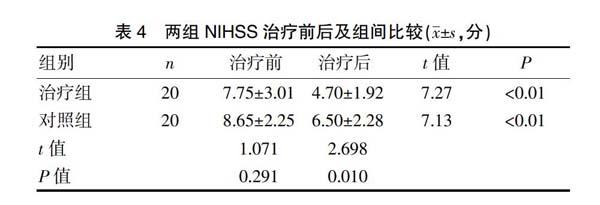
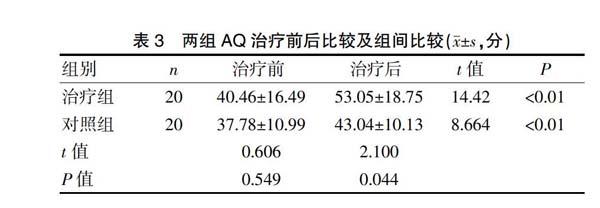
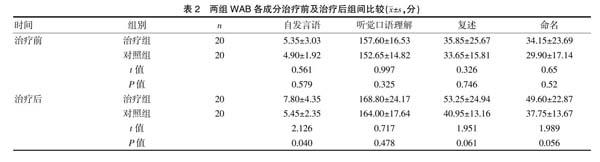
[摘要] 目的 觀察低频重复经颅磁刺激(rTMS)治疗亚急性期卒中后非流利性失语的疗效。 方法 选取我院神经科和康复科2018年8月~2019年7月收治的40例卒中后非流利性失语患者,随机分为治疗组20例和对照组20例。两组患者均进行常规的药物治疗及语言康复训练;治疗组以1 Hz低频rTMS刺激非优势半球Broca区,对照组以相同位点给予rTMS伪刺激;疗程2周。治疗前后评估西部失语症成套检验(WAB)、失语指数(AQ)及美国国立卫生研究院卒中量表(NIHSS)。 结果 治疗后,两组患者AQ、NIHSS评分均有改善,治疗组对比对照组AQ(53.05±18.75分 vs 43.04±10.13分)、NIHSS(4.70±1.92分 vs 6.50±2.28分)改善程度更高,差异有统计学意义(P<0.05)。 结论 低频重复经颅磁刺激可改善亚急性期卒中后非流利性失语患者的语言功能。
[关键词] 失语;卒中;亚急性期;重复经颅磁刺激;西部失语症成套检验;失语指数;Broca区;非优势半球
[中图分类号] R743.3;R749 [文献标识码] B [文章编号] 1673-9701(2020)17-0112-04
Observation on the efficacy of low frequency repetitive transcranial magnetic stimulation in the treatment of non-fluent aphasia after subacute stroke
QU Yanzhou ZHONG Genlong LV Jin LAN Likang
Department of Neurology,Lishui People's Hospital in Zhejiang Province,Lishui 323000,China
[Abstract] Objective To observe the efficacy of low frequency repetitive transcranial magnetic stimulation(rTMS) in the treatment of non-fluent aphasia after subacute stroke. Methods 40 patients with non-fluent aphasia after stroke who were treated in the department of neurology and the department of rehabilitation from August 2018 to July 2019 were selected and randomly divided into the treatment group(20 cases) and the control group(20 cases). Patients in both groups were given conventional medication and speech rehabilitation training. The treatment group was given stimulation on the non-dominant hemisphere Broca area with low frequency rTMS at 1 Hz. The control group was given rTMS pseudostimulation at the same site; the course of treatment was 2 weeks. Before and after treatment, the Western Aphasia Battery(WAB), Aphasia Quotient(AQ), and National Institutes of Health Stroke Scale(NIHSS) were evaluated. Results After treatment, the AQ and NIHSS scores in both groups of patients were improved. Compared with the control group, the AQ(53.05±18.75 points vs 43.04±10.13 points) and the NIHSS(4.70±1.92 points vs 6.50±2.28 points) had a higher degree of improvement, and the difference was statistically significant(P<0.05). Conclusion Low frequency repetitive transcranial magnetic stimulation can improve the language function of patients with non-fluent aphasia after subacute stroke.
[Key words] Aphasia;Stroke;Subacute period;Repetitive transcranial magnetic stimulation(rTMS);Western Aphasia Battery(WAB);Aphasia Quotient(AQ);Broca area;Non-dominant hemisphere
失语症是一种由特定大脑区域损害所导致的语言功能障碍,可表现为口语表达、听力理解、阅读、书写等方面的一种或多种功能障碍,这种损害通常由脑卒中和脑外伤引起[1]。脑卒中是我国的常见疾病,据统计约1/3的卒中患者有着不同程度及不同类型的失语,失语症严重影响着患者的生活自理能力及生活质量,同时也是评价卒中患者社会结局的重要指标之一。失语症的分类中,以非流利性失语占多数(包括运动性失语、经皮质运动性失语、完全性失语等),约占68%[2]。语言康复训練尤其是早期语言康复训练作为失语症目前的一线治疗,有着较为显著的临床效果,但多数患者仍遗留比较明显的后遗症状[3],因此探寻其他有效的失语症治疗方法十分重要。……
登录APP查看全文
猜你喜欢
音乐探索(2022年2期)2022-05-30 21:01:37
文苑(2020年4期)2020-05-30 12:35:30
小天使·一年级语数英综合(2019年8期)2019-08-27 02:23:00
小学科学(学生版)(2018年7期)2018-08-13 09:33:04
特别健康(2018年2期)2018-06-29 06:13:44
小学生作文(中高年级适用)(2018年3期)2018-04-18 01:24:47
少儿科学周刊·少年版(2015年4期)2015-07-07 21:11:17
郑州大学学报(医学版)(2015年2期)2015-02-27 14:50:46
中国卫生(2014年6期)2014-11-10 02:30:50
中国中医药现代远程教育(2014年22期)2014-03-01 04:33:14
