
低温胁迫对油菜叶片光能吸收转换利用的影响
2021-01-05 13:14:01范思静王亚男
安徽农业科学
2021年24期
范思静 王亚男
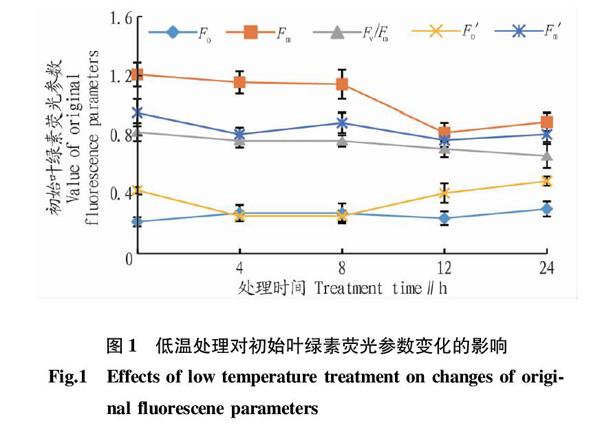
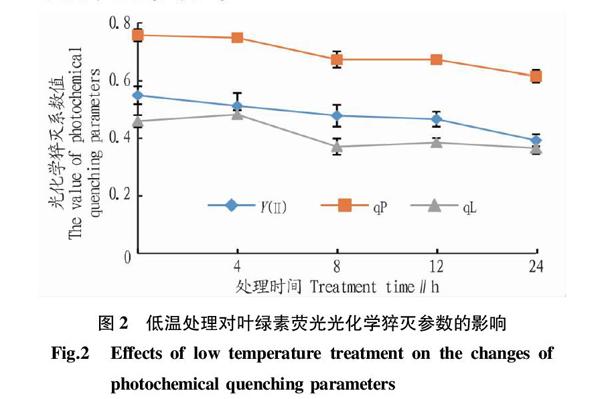
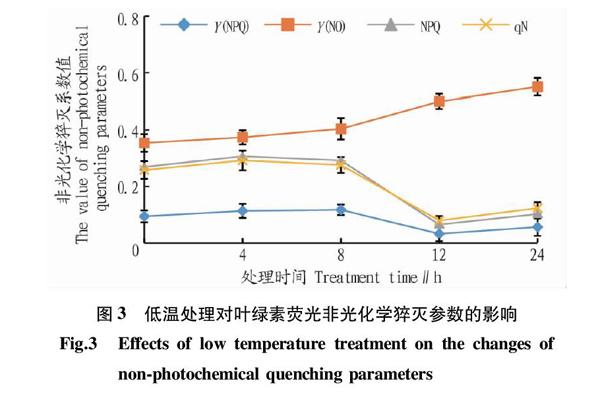
摘要 冬油菜是我国主要的油料来源,其在生长过程中常常遭受连续零下低温的胁迫。通过模拟连续低温胁迫处理,探讨低温胁迫对油菜光能吸收转换的影响。结果表明,低温处理0~8 h,对油菜叶片的光能吸收转换利用效率影响不大,低温处理8 h后,叶片的光能吸收转换利用效率明显降低,初始荧光参数Fo、Fm、Fv/Fm均明显下降,光化学猝灭系数Y(Ⅱ)、qP、qL与非光化学猝灭系数Y(NPQ)、NPQ和qN也均明显降低,而实时荧光参数Fo′、非光化学猝灭系数Y(NO)明显上升。经连续低温处理8 h以后,光合系统 Ⅱ 已经受到破坏,不能进行正常的光能吸收转换利用。
关键词 冬油菜;低温胁迫;光能吸收转换;叶绿素荧光
中图分类号 S634.3 文献标识码 A
文章编号 0517-6611(2021)24-0053-02
doi:10.3969/j.issn.0517-6611.2021.24.012
Effects of Low Temperature on Light Absorption,Conversion and Usage for Rape Leaves
FAN Si-jing,WANG Ya-nan (Anhui Jinpeiying Technology Co.,Ltd.,Hefei,Anhui 230088)
Abstract Winter rape is the main source of oil in China.It often suffers continuous low temperature stress during the growth process.In the experiment,the effects of low temperature stress on the light energy absorption,transformation and usage of rape by simulating continuous low temperature stress.As a result,the low temperature had weak effects on the changes of light energy absorption,transformation and usage at 0-8 h low temperature treatment.Nevertheless,after 8 h of low temperature treatment,the efficiency of light energy absorption conversion was significantly down-regulated,the initial fluorescence parameters Fo,Fm and Fv/Fm were significantly decreased.Similarly,the photochemical quenching coefficients (Y(Ⅱ),qP and qL) and the non-photochemical quenching coefficients (Y(NPQ),NPQ and qN) were significantly decreased too.Otherwise,the real-time fluorescence parameters Fo′ and the non-photochemical quenching coefficient Y(NO) were increased significantly.These results indicated that after 8 hours of continuous low temperature treatment,the photosynthetic system Ⅱ was damaged and could not conduct normal light energy absorption and conversion.
Key words Winter rape;Low temperature stress;Light energy absorption and conversion;Chlorophyll fluorescence
作者簡介 范思静(1991—),女,安徽宣城人,硕士,农艺师,从事品种选育与管理工作。
收稿日期 2021-04-14
油菜是我国主要的油料作物之一,种植历史悠久,我国的油菜种植区域分为冬油菜区域和春油菜区域,其中冬油菜种植主要集中于长江流域,春油菜种植主要集中于东北和西北地区[1]。但就面积和产量而言,冬油菜面积与产量均占全国油菜种植90%以上。由于冬油菜种植集中于长江流域的上、中、下游3个区,相对于长江上游地区,中、下游地区冬季温度较低,特别随着近年来极端天气的频发,中、下游地区连续零下低温的天气时有持续发生,严重影响了油菜的生长发育[2]。
光合作用是一个复杂的生理生化过程,分为原初反应、同化力形成和碳同化3个过程,包括了光物理、光化学以及生物化学转变的复杂过程[3]。……
登录APP查看全文
