
农业碳排放的驱动因素与退耦效应研究
2021-01-05 20:57:31朱通雅
安徽农业科学
2021年24期


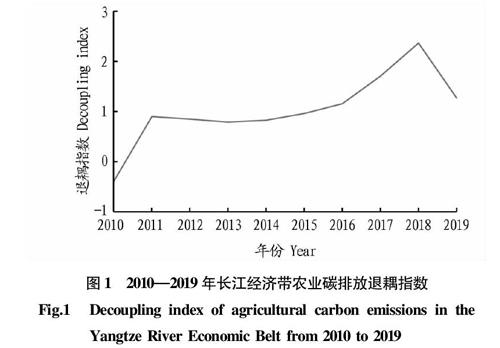

摘要 利用LMDI分解模型探讨长江经济带农业碳排放各种影响因素的贡献值,再逐年分析其碳排放增速和经济增长之间的退耦效应。结果表明,长江经济带农业碳排放在2010—2019年呈现出先缓慢增长后快速下降的趋势。农业经济发展对长江经济带农业碳排放起极大的促进作用,而农业生产效率、劳动力规模和生产结构对长江经济带农业碳排放有较为明显的抑制作用。2010—2019年退耦指数有增大的趋势,说明政府出台的节能减排政策正在被有效执行,对二氧化碳排放的抑制效果不断增强。
关键词 农业碳排放;影响因素分解;退耦指数
中图分类号 F323 文献标识码 A 文章编号 0517-6611(2021)24-0118-04
doi:10.3969/j.issn.0517-6611.2021.24.027
Research on Driving Factors and Decoupling Effects of Agricultural Carbon Emissions—Taking the Yangtze River Economic Belt as an Example
ZHU Tong-ya
(School of Economics and Management, Yangtze University, Jingzhou, Hubei 434023)
Abstract The LMDI decomposition model was used to explore the contribution value of various influencing factors of agricultural carbon emissions in the Yangtze River Economic Zone, and then the decoupling effect between the growth rate of carbon emissions and economic growth was analyzed year by year.The results showed that the agricultural carbon emissions of the Yangtze River Economic Zone showed a slow growth first and then a rapid decline from 2010 to 2019.The agricultural economy development had greatly promoted agricultural carbon emissions in the Yangtze River Economic Zone, and agricultural production efficiency, labor scale and production structure had a relatively obvious inhibitory effect on agricultural carbon emissions in the Yangtze River Economic Zone.The decoupling index had a tendency to increase from 2010 to 2019, indicating that the government's energy saving and emission reduction policies were being effectively implemented, and the effect of suppressing carbon dioxide emissions was continuously increasing.
Key words Agricultural carbon emission;Decomposition of influencing factors;Decoupling index
作者簡介 朱通雅(1995—),男,湖北当阳人,硕士研究生,研究方向:农村发展。
收稿日期 2021-07-05
人类活动所产生的温室气体排放是引起气候变化的重要原因,在现代化农业的发展模式下,农业生产活动成为温室气体的第二大来源,原因是农业生产过程中过度使用农药、化肥等农用物资以及与农业生产相关的不合理安排导致了大量的温室气体排放,进而引发了一系列环境问题,加剧了人类与自然和谐发展相冲突的矛盾。长江经济带作为我国的主要农作物产区,在我国农业发展中具有重要的战略地位。所以,分析长江经济带农业碳排放的驱动因素,研究长江经济带农业减排的成效如何,对加快长江经济带农业高质量发展、推进绿色生态文明建设具有重要的意义。
梳理文献来看……
登录APP查看全文
