右美托咪定对老年髋关节置换患者抗氧化能力及脑保护作用观察
2021-03-24 21:41:38邢玉涛刘亚宁郭涛陈桂珍秦平
中国医学创新
2021年16期
关键词:氧化应激
邢玉涛 刘亚宁 郭涛 陈桂珍 秦平

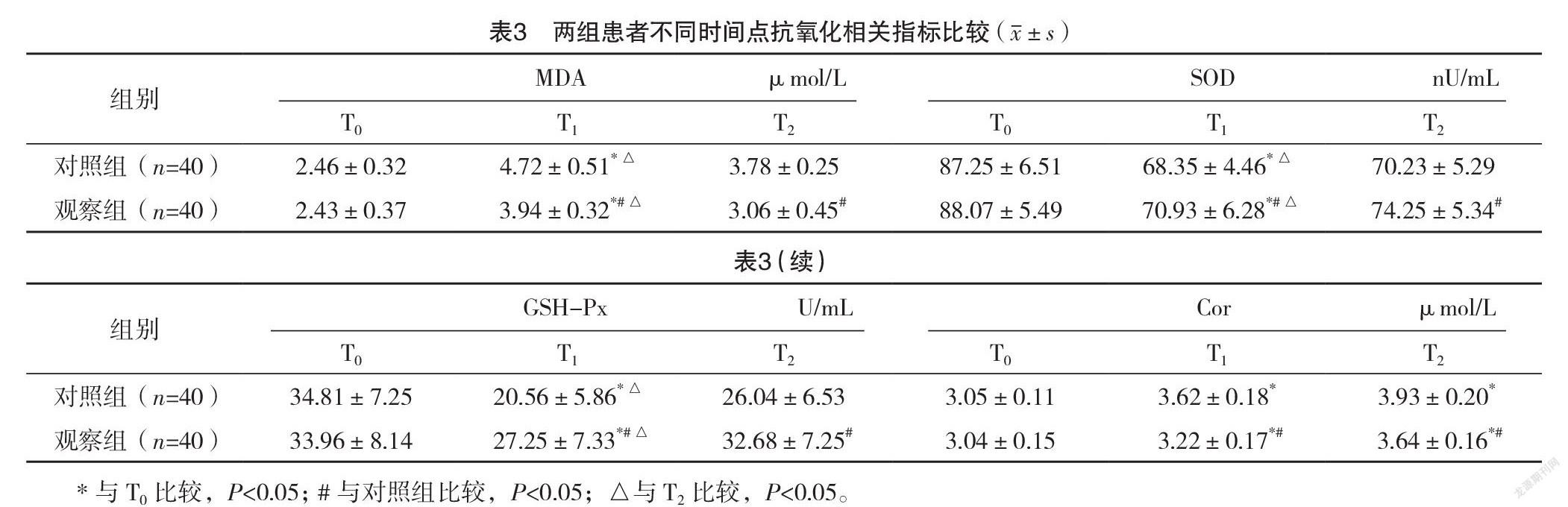
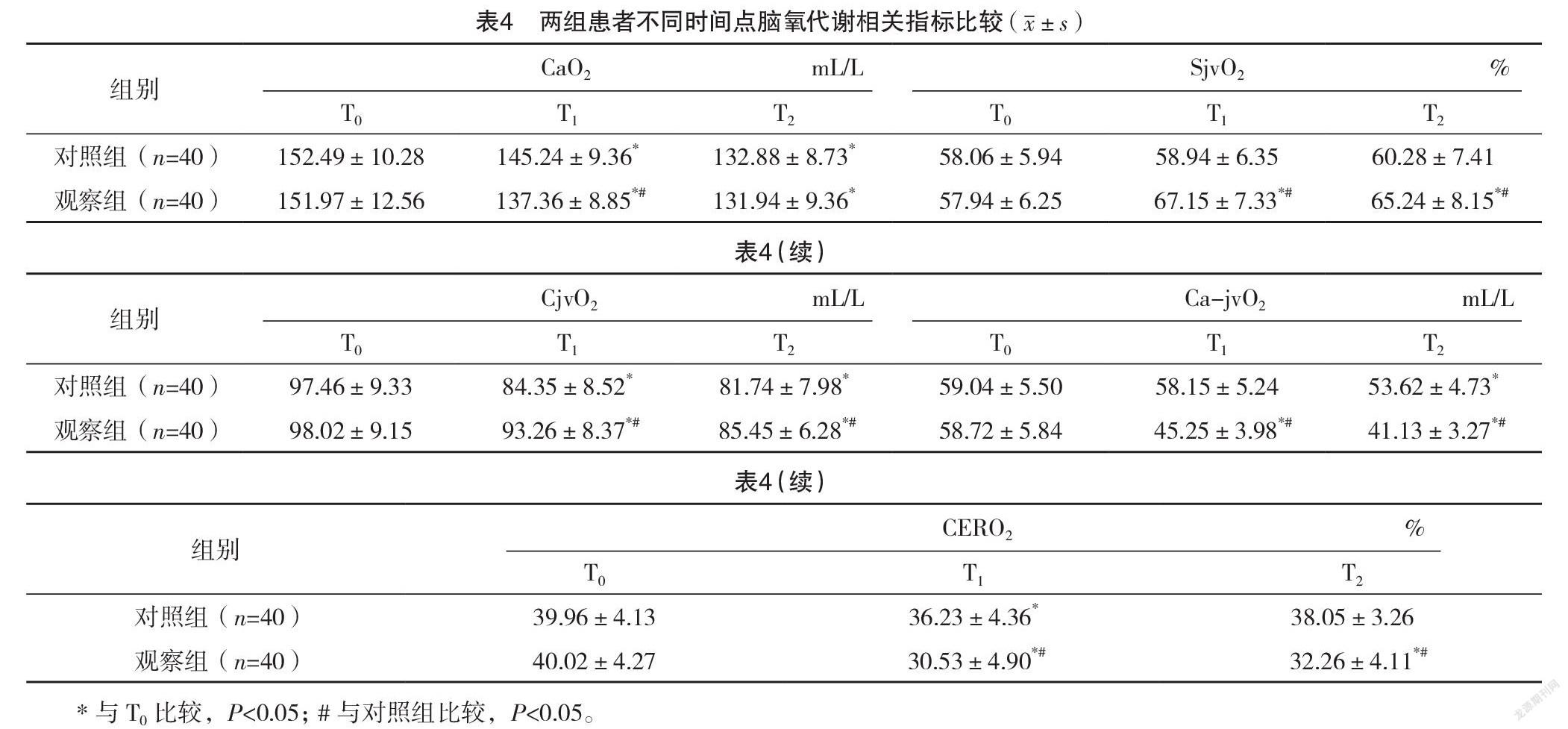
【摘要】 目的:探讨右美托咪定对老年髋关节置换术患者的抗氧化能力及脑保护作用。方法:选取2019年1月-2020年12月80例在本院接受髋关节置换的老年患者,按照随机分配的方式分为对照组和观察组,每组40例。麻醉诱导前,观察组给予右美托咪定,对照组给予等量的0.9%氯化钠溶液。比较两组患者的围手术期各项指标及麻醉前5 min(T0)、手术开始后30 min(T1)和手术结束时(T2)的血流动力学变化、抗氧化相关指标和脑氧代谢相关指标。结果:两组手术时间比较,差异无统计学意义(P>0.05),观察组疼痛消失时间、运动阻滞时间及住院时间均短于对照组,差异均有统计学意义(P<0.05)。T1时,两组HR、MAP与T0比较,差异均有统计学意义(P<0.05)。T2时,对照组HR和MAP均高于T0,且觀察组HR和MAP均低于对照组,差异均有统计学意义(P<0.05)。T0时两组患者的MDA、SOD、GSH-Px、Cor比较,差异均无统计学意义(P>0.05)。T1时两组患者的MDA、SOD、GSH-Px含量与T0、T2时比较,差异均有统计学意义(P<0.05)。T1、T2时,两组Cor含量均高于T0时,差异均有统计学意义(P<0.05)。T1、T2时,观察组SOD、GSH-Px含量均高于对照组,MDA、Cor含量均低于对照组,差异均有统计学意义(P<0.05)。T0时两组患者的CaO2、SjvO2、CjvO2、Ca-jvO2和CERO2比较,差异均无统计学意义(P>0.05)。T1时,对照组患者的CaO2、CjvO2和CERO2均低于T0时(P<0.05),观察组的CaO2、CjvO2、Ca-jvO2和CERO2均低于T0时,而SjvO2高于T0时(P<0.05)。T2时对照组CaO2、CjvO2、Ca-jvO2水平低于T0时(P<0.05),观察组CaO2、CjvO2、Ca-jvO2和CERO2低于T0时(P<0.05),SjvO2高于T0时(P<0.05)。观察组T1时CaO2、Ca-jvO2和CERO2低于对照组,而SjvO2、CjvO2高于对照组(P<0.05)。T1时,观察组CaO2、Ca-jvO2、CERO2低于对照组,SjvO2、CjvO2高于对照组,差异均有统计学意义(P<0.05)。T2时,观察组Ca-jvO2和CERO2低于对照组,SjvO2、CjvO2高于对照组,差异均有统计学意义(P<0.05)。结论:右美托咪定可有效抑制老年髋关节置换术患者的炎症氧化应激反应,改善脑氧代谢相关指标水平,具有一定的脑保护作用。
【关键词】 右美托咪定 髋关节置换 血流动力学 氧化应激 脑保护 氧代谢
Effect of Dexmedetomidine on Antioxidant Capacity and Brain Protection in Elderly Patients with Hip Replacement/XING Yutao, LIU Yaning, GUO Tao, CHEN Guizhen, QIN Ping. //Medical Innovation of China, 2021, 18(16): 00-012
[Abstract] Objective: To investigate the effects of Dexmedetomidine on antioxidant capacity and brain protection in elderly patients undergoing hip replacement. Method: A total of 80 elderly patients who received hip replacement in our hospital from January 2019 to December 2020 were selected, they were randomly divided into control group and observation group, 40 cases in each group. Before induction of anesthesia, the observation group was given Dexmedetomidine and the control group was given the same dose of 0.9% sodium chloride solution. Perioperative indicators were compared between two groups, hemodynamic changes, antioxidant related indexes and cerebral oxygen metabolism related indexes at 5 min before anesthesia (T0), 30 min after surgery (T1) and at the end of surgery (T2) were compared between two groups. Result: There was no statistically significant difference in surgery time between two groups (P>0.05). The pain disappearance time, motion block time and hospital stay of observation group were shorter than those of control group, and the differences were statistically significant (P<0.05). At T1, there were statistically significant differences in HR, MAP of two groups compared with T0 (P<0.05). At T2, HR and MAP of control group were higher than those of T0, and observation group were lower than those of control group, with statistical significance (P<0.05). There were no statistical significance in MDA, SOD, GSH-Px and Cor between two groups at T0 (P>0.05). The contents of MDA, SOD and GSH-Px of two groups at T1 were significantly different from those of T0 and T2 (P<0.05). At T1 and T2, the Cor content of both groups were higher than those of T0, with statistical significance (P<0.05). At T1 and T2, SOD and GSH-Px contents of observation group were higher than those of control group, MDA and Cor contents were lower than those of control group, with statistical significance (P<0.05). There was no statistical significance in CaO2, SjvO2, CjvO2, Ca-jvO2 and CERO2 between two groups at T0 (P>0.05). At T1, CaO2, CjvO2 and CERO2 of control group were lower than those of T0 (P<0.05), while CaO2, CjvO2, Ca-jvO2 and CERO2 of observation group were lower than those of T0, while SjvO2 was higher than that of T0 (P<0.05). The CaO2, CjvO2 and Ca-jvO2 levels of control group at T2 were lower than those of T0 (P<0.05), the CaO2, CjvO2, Ca-jvO2 and CERO2 levels of observation group at T2 were lower than those of T0 (P<0.05), and the SjvO2 levels was higher than that of T0 (P<0.05). At T1, CaO2, Ca-jvO2 and CERO2 of observation group were lower than those of control group, while SjvO2 and CjvO2 were higher than those of control group (P<0.05). At T1, CaO2,
Ca-jvO2 and CERO2 of observation group were lower than those of control group, while SjvO2 and CjvO2 of observation group were higher than those of the control group, with statistical significance (P<0.05). At T2, Ca-jvO2 and CERO2 of observation group were lower than those of control group, while SjvO2 and CjvO2 were higher than those of control group, with statistical significance (P<0.05). Conclusion: Dexmedetomidine can effectively inhibit the inflammatory oxidative stress response in elderly patients with hip replacement, improve the level of related indexes of cerebral oxygen metabolism, and has a certain protective effect on brain.
[Key words] Dexmedetomidine Hip replacement Hemodynamics Oxidative stress Brain protection Oxygen metabolism
First-authors address: Beijing Haidian Hospital, Beijing 100080, China
doi:10.3969/j.issn.1674-4985.2021.16.002
髋关节置换术是临床上常见的改善老年患者髋关节功能障碍的一种治疗方式,对提高老年患者的生活质量有着积极的促进意义[1]。然而,在实际应用中,多数老年患者伴有高血压、糖尿病以及其他心脑血管疾病等基础性疾病,且老年人自身的身体功能也呈衰退状态。而手术作为一种创伤性操作,会对机体造成一定的应激反应,加上老年人耐受力相对较低,术后创伤性应激反应引起的炎症反应直接影响患者的术后康复[2-3]。此外,血流动力学的剧烈波动也会影响重要脏器的血液供应。有研究报道,老年患者行髋关节置换术后脑氧供需失衡、认知障碍是常见的并发症[4]。右美……
登录APP查看全文
猜你喜欢
中成药(2021年5期)2021-07-21 08:39:04
世界科学技术-中医药现代化(2020年2期)2020-07-25 02:05:56
中成药(2018年6期)2018-07-11 03:01:24
中成药(2018年5期)2018-06-06 03:11:43
天然产物研究与开发(2016年6期)2016-06-05 10:29:26
西南军医(2016年6期)2016-01-23 02:21:19
新疆医科大学学报(2015年10期)2015-12-26 12:33:30
实用中西医结合临床(2015年7期)2015-02-28 16:30:23
癌变·畸变·突变(2015年3期)2015-02-27 06:15:09
西南军医(2015年2期)2015-01-22 09:09:37