血清谷胱甘肽还原酶与2型糖尿病的关系探究
2021-03-24 21:41:38范修敬陈新豪古杰超
中国医学创新
2021年16期
范修敬 陈新豪 古杰超
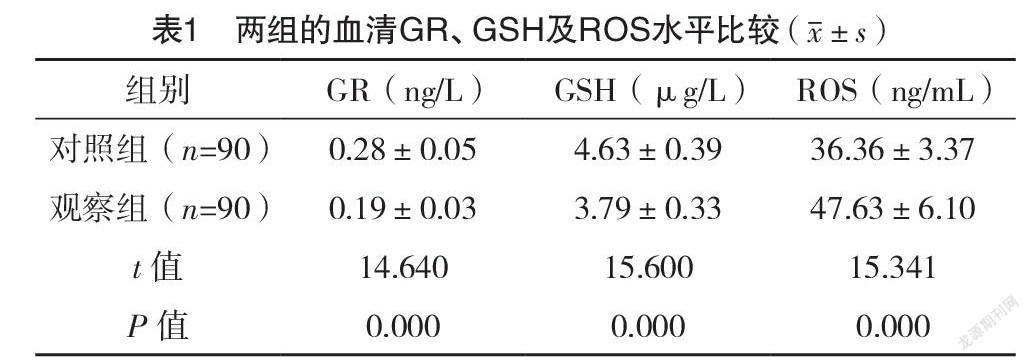

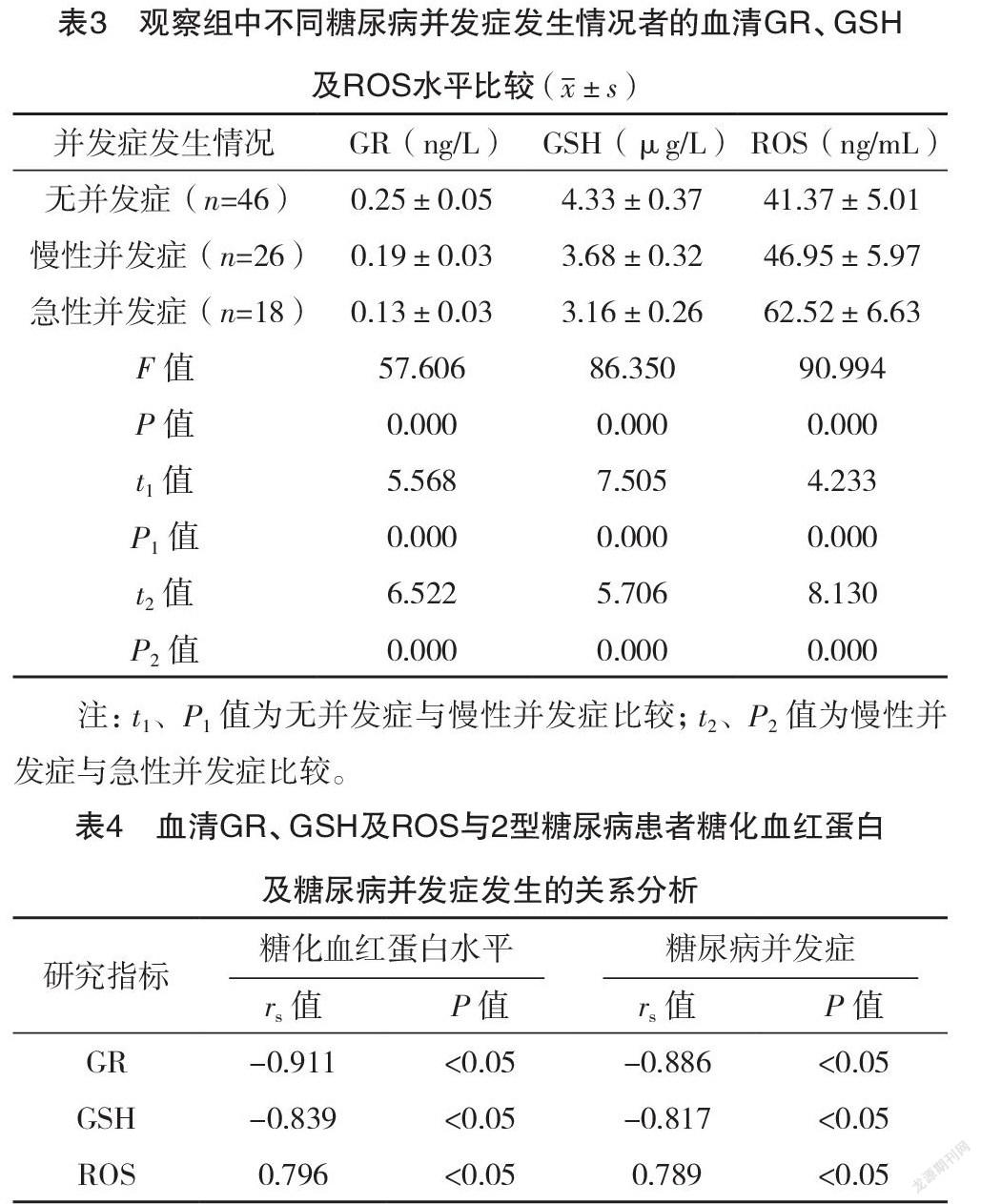
【摘要】 目的:探究血清谷胱甘肽还原酶(GR)与2型糖尿病的关系。方法:选取2020年3月-2021年3月的90例2型糖尿病患者为观察组,同时期的90名体检健康者为对照组。比较两组的血清GR、GSH及ROS水平,同时比较观察组中不同糖化血红蛋白水平及糖尿病并发症发生情况者的上述检测结果,并采用Spearman秩相关分析上述血清指标与2型糖尿病患者糖化血红蛋白水平及糖尿病并发症发生情况的关系。结果:观察组的血清GR及GSH水平均显著低于对照组,血清ROS水平显著高于对照组,差异均有统计学意义(P<0.05)。观察组中不同糖化血红蛋白水平者的血清GR、GSH及ROS水平比较,差异均有统计学意义(P<0.05)。糖化血红蛋白水平较高者的血清GR及GSH水平均显著低于糖化血红蛋白水平较低者,血清ROS水平显著高于糖化血红蛋白水平较低者,差异均有统计学意义(P<0.05)。观察组中不同糖尿病并发症发生情况者的血清GR、GSH及ROS水平比较,差异均有统计学意义(P<0.05)。急性并發症者的血清GR及GSH水平均显著低于慢性并发症及无并发症者,慢性并发症者则显著低于无并发症者(P<0.05)。急性并发症者的血清ROS水平显著高于慢性并发症及无并发症者,慢性并发症者则显著高于无并发症者(P<0.05)。Spearman秩相关分析显示,血清GR及GSH与2型糖尿病患者糖化血红蛋白水平及糖尿病并发症发生情况呈负相关,血清ROS与2型糖尿病患者糖化血红蛋白水平及糖尿病并发症发生情况呈正相关(P<0.05)。结论:血清GR在2型糖尿病患者中呈现异常表达的状态,且与糖化血红蛋白及糖尿病并发症的发生有密切关系,在2型糖尿病患者中的检测价值较高。
【关键词】 血清 谷胱甘肽还原酶 2型糖尿病 糖化血红蛋白 糖尿病并发症
Investigation on the Relationship between Serum Glutathione Reductase and Type 2 Diabetes Mellitus/FAN Xiujing, CHEN Xinhao, GU Jiechao. //Medical Innovation of China, 2021, 18(16): 0-015
[Abstract] Objective: To investigate the relationship between serum glutathione reductase (GR) and type 2 diabetes mellitus. Method: A total of 90 patients with type 2 diabetes mellitus from March 2020 to March 2021 were selected as the observation group, and 90 healthy subjects during the same period were selected as the control group. The serum levels of GR, GSH and ROS were compared between the two groups, and the above test results of the observation group with different levels of HbA1c and the incidence of diabetes complications were compared. Spearman rank correlation was used to analyze the relationship between the above serum indexes and the level of HbA1c and the incidence of diabetes complications in type 2 diabetes mellitus patients. Result: Serum GR and GSH levels in the observation group were significantly lower than those in the control group, and serum ROS level was significantly higher than that in the control group, the differences were statistically significant (P<0.05). Comparison of serum GR, GSH and ROS levels in observation group with different HbA1c levels, the differences were statistically significant (P<0.05). Serum GR and GSH levels of patients with higher HbA1c levels were significantly lower than those with lower HbA1c levels, while serum ROS level was significantly higher than that with lower HbA1c levels, the differences were statistically significant (P<0.05). Comparison of serum levels of GR, GSH and ROS in the observation group with different incidence of diabetes complications, the differences were statistically significant (P<0.05). Serum GR and GSH levels in patients with acute complications were significantly lower than those in patients with chronic complications and without complications, and those in patients with chronic complications were significantly lower than those without complications (P<0.05). The serum ROS level of patients with acute complications was significantly higher than that of patients with chronic complications and those without complications, and that of patients with chronic complications was significantly higher than that of patients without complications (P<0.05). Spearman rank correlation analysis showed that serum GR and GSH were negatively correlated with the level of HbA1c and the incidence of diabetic complications in patients with type 2 diabetes mellitus, while serum ROS was positively correlated with the level of HbA1c and the incidence of diabetic complications in patients with type 2 diabetes mellitus (P<0.05). Conclusion: Serum GR is abnormally expressed in patients with type 2 diabetes mellitus, and is closely related to the occurrence of HbA1c and diabetic complications, so it has a high detection value in patients with type 2 diabetes mellitus.
[Key words] Serum Glutathione reductase Type 2 diabetes mellitus Glycosylated hemoglobin Diabetic complications
First-authors address: Jiangmen Peoples Hospital, Jiangmen 529000, China
doi:10.3969/j.issn.1674-4985.2021.16.003
2型糖尿病在我国具有极高的发病率,且每年的发病率仍呈现持续大幅度提升的状态,因此与2型糖尿病相关的各方面研究均是临床重点。近年来,较多研究显示2型糖尿病普遍存在氧化失衡的情况,但是本方面的研究差异较为显著。谷胱甘肽还原酶(GR)作为与谷胱甘肽(GSH)等密切相关的方面[1-2],对GR的调控有助于影响GSH及活性氧(ROS)的表达,从而达到调控机体氧化损伤状态的目的[3-4],同时其在2型糖尿病中的细致表达变化研究极为不足,因此在疾病诊治中的参考价值仍有待深入探究。本研究就血清GR与2型糖尿病的关系进行细致全面的探究,现报道如下。
1 资料与方法
1.1 一般资料 选取2020年3月-2021年3月的90例2型糖尿病患者为观察组,另选取同时期的90名体检健康者为对照组。纳入标准:20~65岁者;男女不限;观察组为确诊的2型糖尿病患者,对照组为体检示健康者。……
登录APP查看全文
猜你喜欢
中老年保健(2022年5期)2022-08-24 02:35:42
中老年保健(2022年1期)2022-08-17 06:14:56
中老年保健(2021年5期)2021-08-24 07:07:20
中老年保健(2021年3期)2021-08-22 06:50:04
中老年保健(2021年11期)2021-08-22 03:15:16
天津医科大学学报(2021年2期)2021-03-29 05:31:08
现代临床医学(2021年1期)2021-01-26 00:56:02
世界科学技术-中医药现代化(2020年2期)2020-07-25 02:05:56
西南军医(2016年6期)2016-01-23 02:21:19
西南军医(2015年2期)2015-01-22 09:09:37