NSCLC患者血清PCT、D-D、SAA水平与TNM分期的关系及其对肺部感染的诊断价值
2021-03-24 20:57:26周建中
中国医学创新
2021年25期
关键词:降钙素原
周建中

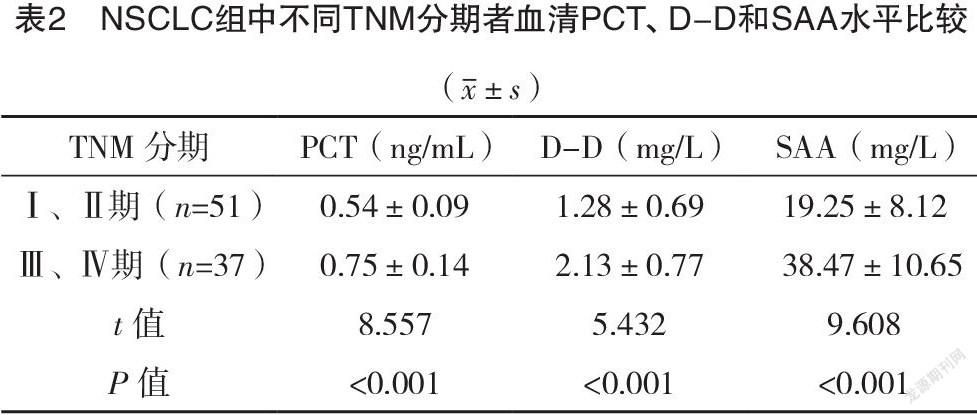

【摘要】 目的:探討非小细胞肺癌(NSCLC)患者血清降钙素原(PCT)、D-二聚体(D-D)、血清淀粉样蛋白A(SAA)水平与TNM分期的关系及其对肺部感染的诊断价值。方法:选取2018年1月-2021年1月于本院确诊的88例NSCLC患者为NSCLC组,其中Ⅰ、Ⅱ期51例,Ⅲ、Ⅳ期37例;合并肺部感染25例,未合并肺部感染63例。另选取88例同期于本院行健康体检者为对照组。比较两组PCT、D-D及SAA水平;比较NSCLC组中不同TNM分期、有无合并肺部感染者的PCT、D-D及SAA水平。分析NSCLC患者血清PCT、D-D、SAA水平与TNM分期的相关性;分析血清PCT、D-D和SAA水平对NSCLC患者并发肺部感染的诊断价值。结果:NSCLC组血清PCT、D-D及SAA水平均高于对照组(P<0.05);Ⅲ、Ⅳ期NSCLC患者血清PCT、D-D和SAA水平均高于Ⅰ、Ⅱ期患者(P<0.05)。Spearman秩相关系数分析显示,NSCLC患者血清PCT、D-D、SAA水平与TNM分期均呈正相关(rs=0.328、0.219、0.213,P<0.05)。合并肺部感染的NSCLC患者血清PCT、D-D和SAA水平均高于未合并肺部感染者(P<0.05)。血清PCT、D-D和SAA诊断NSCLC患者合并肺部感染的AUC分别为0.733、0.745和0.769,联合检测的AUC为0.891。结论:NSCLC患者血清PCT、D-D和SAA水平异常升高,其水平变化与TNM分期均呈正相关,且三者联合检测对肺部感染诊断价值较高,可用于预测NSCLC患者肺部感染的发生。
【关键词】 非小细胞肺癌 TNM分期 肺部感染 降钙素原 D-二聚体 血清淀粉样蛋白A
[Abstract] Objective: To explore the relationship between serum procalcitonin (PCT), D-dimer (D-D), serum amyloid A (SAA) levels and TNM staging in patients with non-small cell lung cancer (NSCLC) and their diagnostic value for pulmonary infection. Method: A total of 88 patients with NSCLC diagnosed in our hospital from January 2018 to January 2021 were included in the NSCLC group, including 51 patients with stage Ⅰ and Ⅱ, 37 patients with stage Ⅲ and Ⅳ; 25 cases were complicated with pulmonary infection and 63 cases were not complicated with pulmonary infection. In addition, 88 healthy people who underwent physical examination in our hospital during the same period were selected as the control group. The levels of PCT, D-D and SAA were compared between the two groups. The levels of PCT, D-D and SAA in NSCLC groups of patients with different TNM staging and with or without pulmonary infection in NSCLC groups were compared. The correlation between serum PCT, D-D, SAA levels and TNM staging in NSCLC patients was analyzed. The diagnostic value of serum PCT, D-D and SAA levels in patients with NSCLC complicated with pulmonary infection was analyzed. Result: Serum PCT, D-D and SAA levels in NSCLC group were higher than those in control group (P<0.05). The levels of serum PCT, D-D and SAA in stage Ⅲ and Ⅳ NSCLC patients were higher than those in stage Ⅰ and Ⅱ (P<0.05). Spearman rank correlation coefficient analysis showed that serum PCT, D-D and SAA levels of NSCLC patients were positively correlated with TNM staging (rs=0.328, 0.219, 0.213, P<0.05). The levels of serum PCT, D-D and SAA in NSCLC patients with pulmonary infection were higher than those without pulmonary infection (P<0.05). The AUC of serum PCT, D-D and SAA for diagnosis of NSCLC patients with pulmonary infection were 0.733, 0.745 and 0.769, respectively, and the AUC of combined detection was 0.891. Conclusion: The levels of serum PCT, D-D and SAA are abnormally increased in NSCLC patients, their changes are positively correlated with TNM staging, and the combined detection of the three has high diagnostic value for pulmonary infection, which can be used to predict the occurrence of pulmonary infection in patients with NSCLC.
[Key words] Non-small cell lung cancer TNM staging Pulmonary infection PCT D-D SAA
First-author’s address: Affiliated Hospital of Jinggangshan University, Ji’an 343000, China
doi:10.3969/j.issn.1674-4985.2021.25.004
非小细胞肺癌(NSCLC)是除小细胞肺癌外的所有肺上皮癌,常见类型包括鳞状细胞癌、大细胞癌和腺癌,占所有肺癌的80%以上[1]。NSCLC具有恶性程度高、病情进展迅速的特点,早期患者整体5年生存率可达45%以上,而中晚期患者五年生存率常低于10%[2-3]。因此,寻找可靠的敏感性检测指标对不同分期NSCLC患者的病情进行评估,有利于早期对其采取有效诊治,对降低病死率具有重要意义。……
登录APP查看全文
猜你喜欢
中国当代医药(2016年30期)2017-01-07 13:19:35
中国实用医药(2016年29期)2016-12-26 10:04:59
中国实用医药(2016年23期)2016-12-26 09:51:08
中国实用医药(2016年29期)2016-12-26 08:16:34
中国当代医药(2016年28期)2016-12-20 15:43:56
华夏医学(2016年4期)2016-12-12 00:12:41
中外医学研究(2016年26期)2016-11-30 02:44:00
中国实用医药(2016年24期)2016-10-17 04:27:23
中国实用医药(2016年24期)2016-10-17 04:15:03
中国实用医药(2016年24期)2016-10-17 03:21:57