基于平补平泻针刺法研究不同刺激量针刺天枢穴治疗中风后便秘的临床观察
2021-03-30 08:36:57袁海妮林林雁刘坤明杨作卿
云南中医中药杂志
2021年2期
袁海妮 林林雁 刘坤明 杨作卿
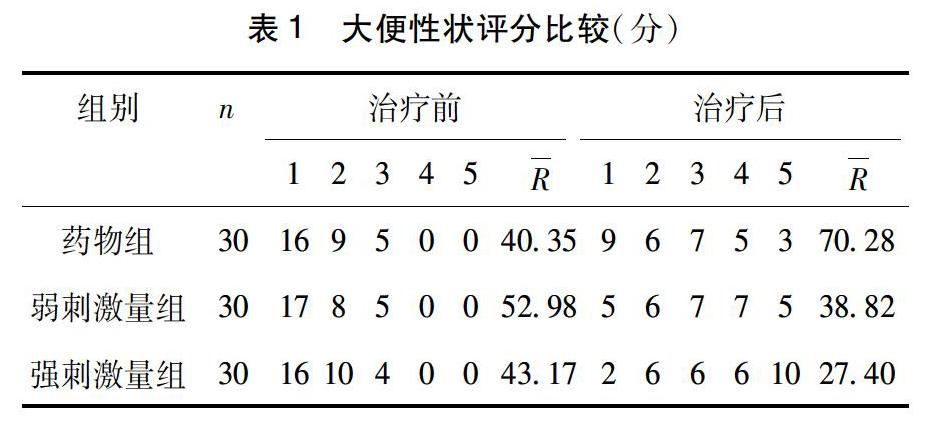
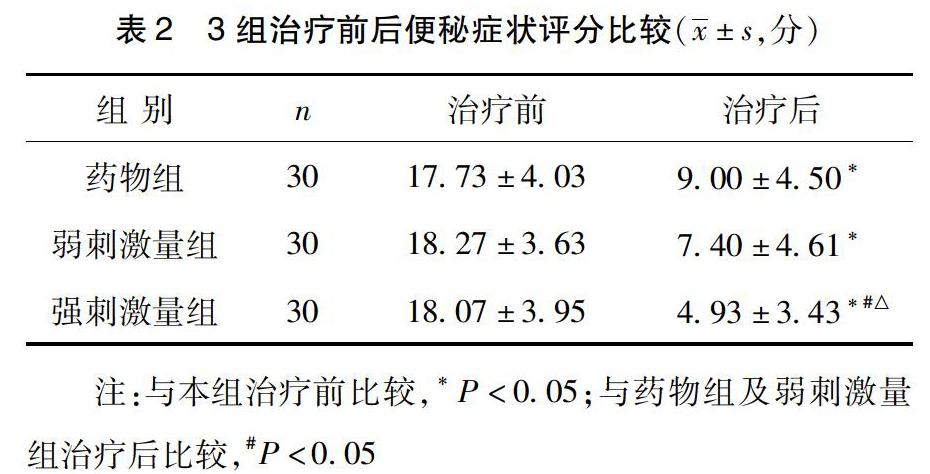
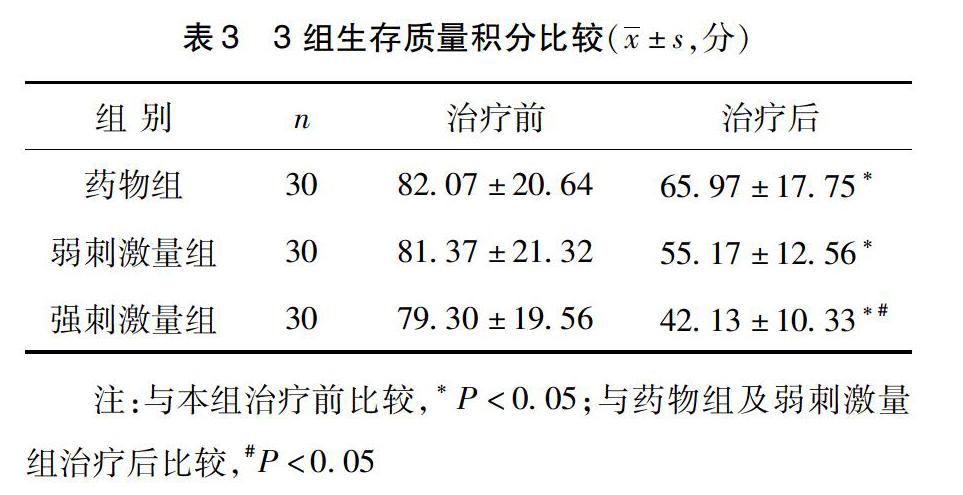
摘要:目的基于平补平泻针刺法,观察不同刺激量针刺天枢穴治疗中风后便秘的臨床疗效。方法将90例符合研究纳入标准的中风后便秘患者随机分为3组,每组各30例。药物组采用乳果糖口服液口服;弱刺激量组采用天枢穴弱刺激量针刺;强刺激量组采用天枢穴强刺激量针刺。3组均常规采用药物控制基础疾病及康复训练治疗。观察3组患者治疗前后的大便性状评分(BSFS)、便秘症状积分、便秘患者生存质量评分(PAC-QOL),并比较3组临床疗效。结果3组治疗前大便性状评分、便秘症状积分及生存质量评分差异无统计学意义(P>0.05);3组治疗后大便性状评分均较治疗前增高,便秘症状积分及便秘患者生存质量评分较治疗前降低(P<0.05),且强刺激量组大便性状评分增幅高于药物组及弱刺激量组(P<0.05),便秘症状积分及便秘患者生存质量评分降幅高于药物组及弱刺激量组(P<0.05)。结论基于平补平泻针刺法基础上,采用天枢穴强刺激量针刺更能有效改善中风后便秘患者粪便性状及便秘症状,提高中风后便秘患者生存质量。
关键词:中风后便秘;天枢穴;针刺刺激量;弱刺激量;强刺激量
中图分类号:R246文献标志码:B文章编号:1007-2349(2021)02-0046-05
Clinical Observation on Treatment of Post-stroke Constipation by Acupuncture
at Tianshu Point with Different Stimulation Acupuncture Based
on Mild Reinforcing-attenuating Acupuncture
YUAN Hai-ni, LIN Lin-yan, LIU Kun-ming, YANG Zuo-qing
(Traditional Chinese Medicine Hospital of Longchuan County, Longchuan 517300, China)
【Abstract】Objective: To observe the clinical effect of acupuncture at Tianshu acupoint with different stimulation in the treatment of post-stroke constipation based on the method of mild reinforcing-attenuating acupuncture. Methods: 90 patients with post-stroke constipation who met the study inclusion criteria were randomly divided into three groups, 30 cases each group. The drug group was orally given with lactulose oral liquid, the weak stimulation group was acupunctured with weak stimulation at Tianshu and the strong stimulation group was acupunctured with strong stimulation at Tianshu. The three groups were routinely treated with drugs to control basic diseases and rehabilitation training. The stool trait score (BSFS), constipation symptom score and constipation quality of life score (PAC-QOL) of the three groups were observed before and after treatment, and the clinical effects of the three groups were compared. Results: There was no significant difference in the stool trait scores, constipation symptom scores and quality of life scores among the three groups before treatment (P>0.05). The stool trait scores in the three groups after treatment were all higher than those before treatment, and the constipation symptom scores and quality of life scores was lower than those before treatment (P<0.05). The stool trait scores of the strong stimulation group increased more than that of the drug group and the weak stimulation group (P<0.05). The constipation symptom score and the quality of life score of constipation patients in the strong stimulation group decreased more than those of the drug group and weak stimulation group (P<0.05). Conclusion: Based on the acupuncture method of blooding-letting and reducing acupuncture, the acupuncture with a strong stimulating amount at Tianshu point can more effectively improve the stool trait and symptoms of post-stroke constipation patients and improve the quality of life of patients.
【Key words】Post-stroke constipation; Tianshu point; Acupuncture stimulation; Weak stimulation; Strong stimulation
中風后便秘是中风后最常见的胃肠道并发症,是以排便周期延长,或排便周期正常,但粪便干结,难以自行排出为主要临床表现的疾病。研究表明[1],约有30%~60%的患者在中风后均表现出不同程度的便秘。由于中风后患者饮食习惯、睡眠习惯等因素发生变化,兼之长期卧床,翻身活动困难,导致胃肠动力不足,胃肠蠕动减弱,因此容易出现便秘。中风后便秘不仅严重影响者患者的日常生活起居,降低生活质量,而且大多数患者,尤其是急性期中风便秘患者因排便时过度用力,不仅容易损伤肠道黏膜,而且容易引起血压一过性增加,加重脑水肿,或引起卒中复发,严重者甚至会危及患者的生命[2]。研究……
登录APP查看全文