
基于网络药理学探讨沙参麦冬汤治疗肺癌的作用机制
2021-04-02 10:11:40吴文韬李俊熙尹晓清
中国中医药图书情报
2021年2期
关键词:肺癌
吴文韬 李俊熙 尹晓清
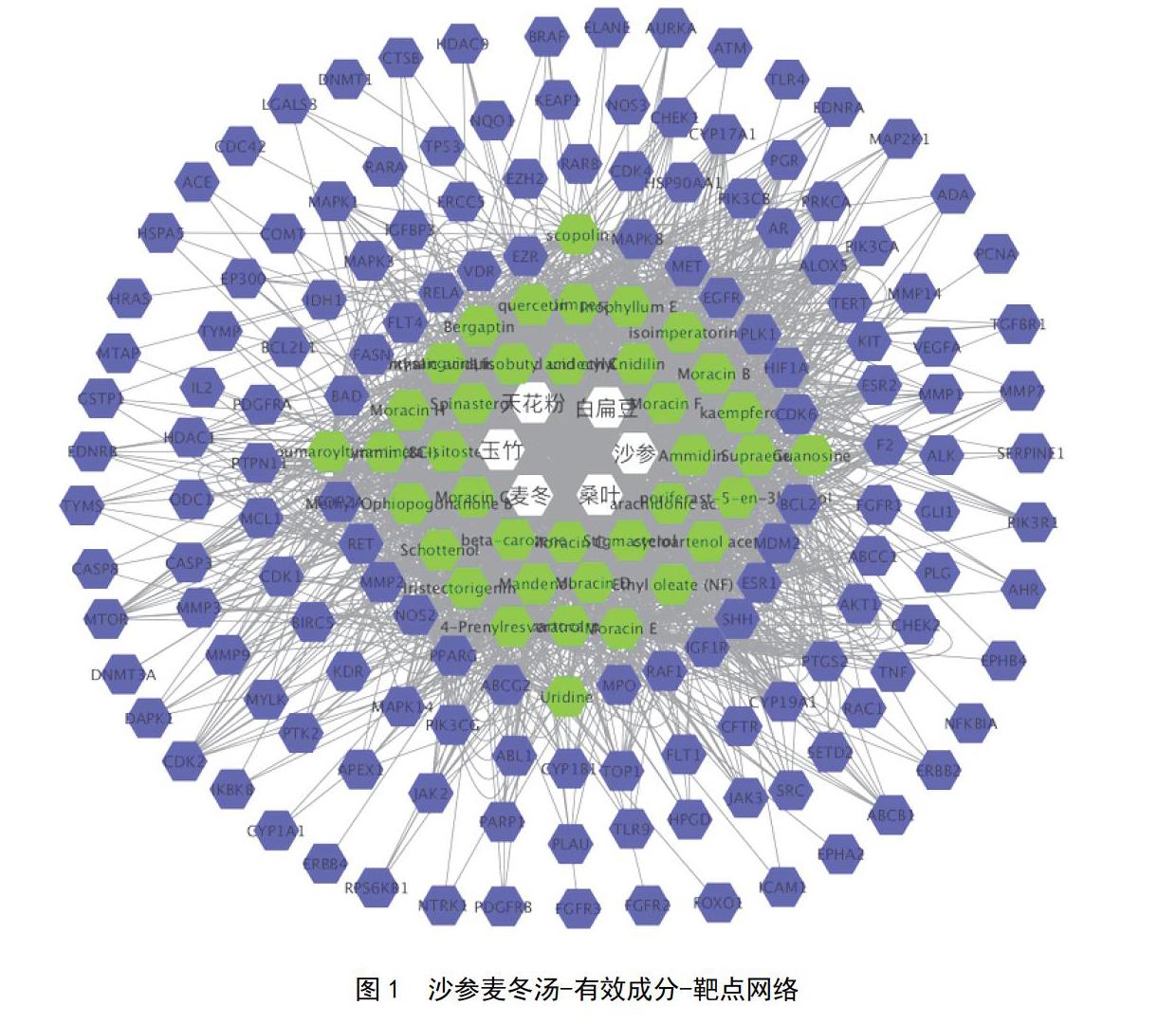
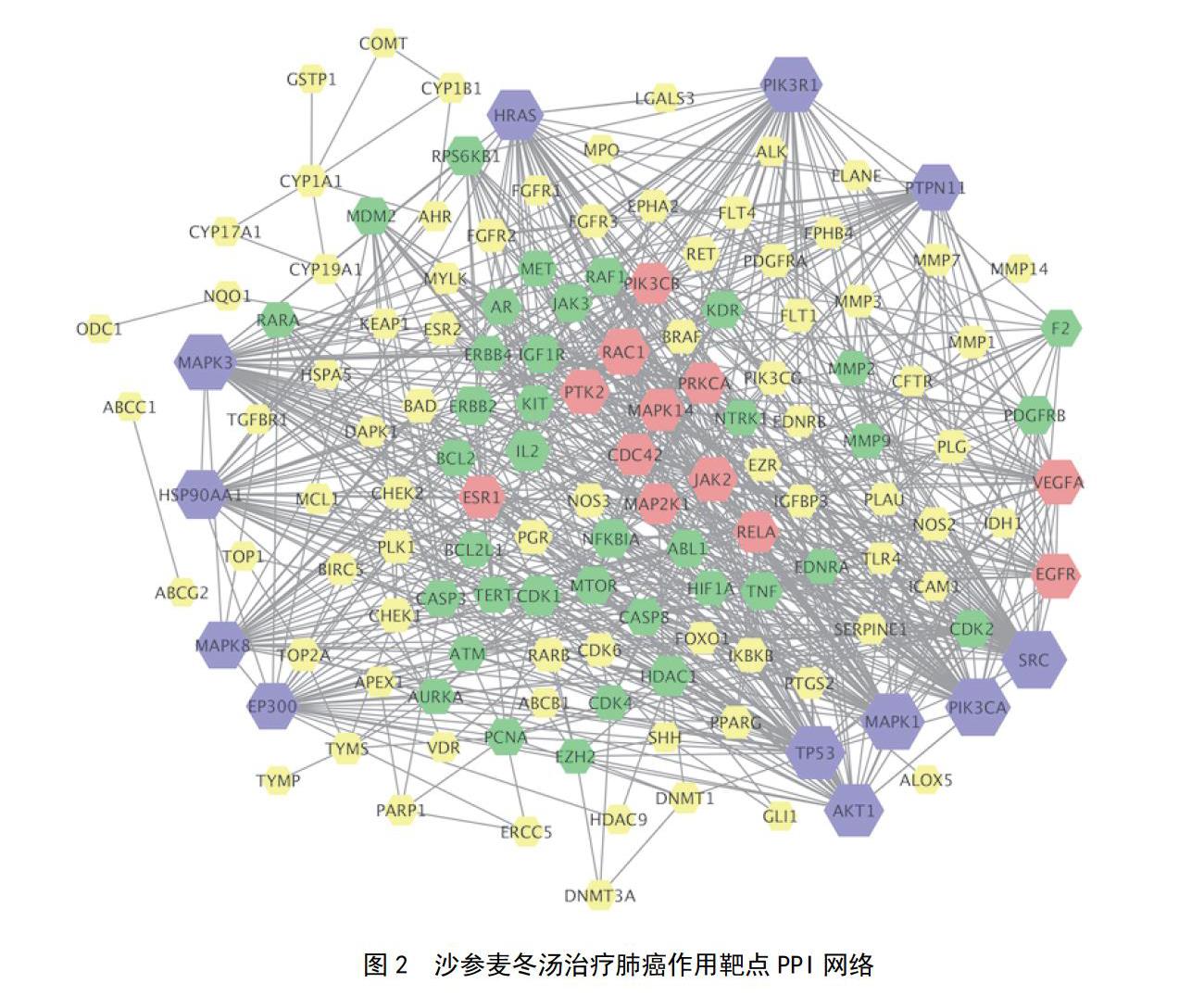
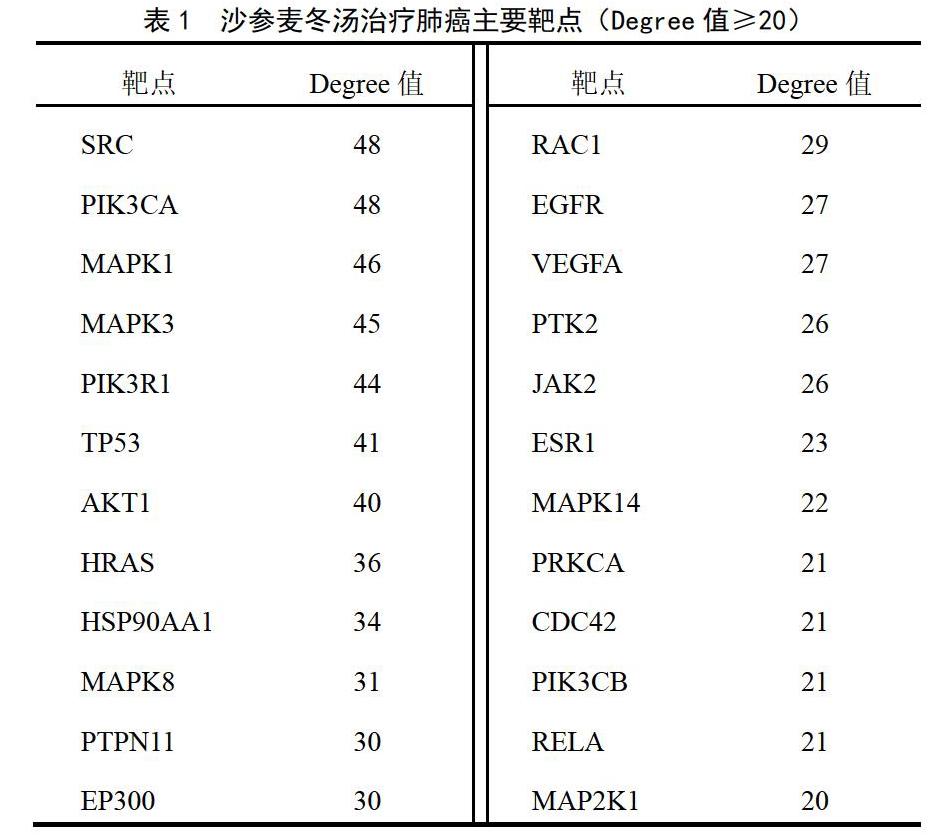
摘要:目的 从药物、疾病、靶点角度研究沙参麦冬汤治疗肺癌的作用机制,为进一步实验验证提供理论基础。方法 通过中药系统药理学数据库与分析平台(TCMSP)及中医药综合数据库(TCMID)收集沙參麦冬汤药物有效成分,导入PubChem数据库获取有效成分结构,将结构导入Swiss TargetPrediction数据库进行靶点预测;通过GeneCards数据库收集肺癌靶点,将有效成分靶点与肺癌靶点取交集,并绘制中药-有效成分-疾病网络;通过String数据库及Cytoscape 3.8.0软件构建蛋白相互作用网络;通过DAVID数据库对交集靶点进行GO功能富集与KEGG通路富集。结果 收集并筛选沙参麦冬汤有效成分56个,靶点852个,肺癌疾病靶点614个,二者交集靶点145个,主要靶点有SRC、PIK3CA、MAPK1、MAPK3、PIK3R1等。GO功能富集得到生物过程条目604个、细胞成分条目78个、分子功能条目124个;KEGG通路富集共计143条信号通路,主要涉及癌症通路、癌症中蛋白多糖、PI3K-Akt信号通路、癌症中心碳代谢等。结论 本研究揭示了沙参麦冬汤在肺癌治疗中多成分、多靶点、多途径的作用特点,为后续研究提供了理论依据。
关键词:沙参麦冬汤;网络药理学;肺癌;信号通路;靶点
中图分类号:R285;R259 文献标识码:A 文章编号:2095-5707(2021)02-0006-05
DOI: 10.3969/j.issn.2095-5707.2021.02.002 开放科学(资源服务)标识码(OSID):
Mechanism of Shashen Maidong Decoction in Treatment of Lung Cancer Based on Network Pharmacology
WU Wen-tao1, LI Jun-xi1, YIN Xiao-qing2*
(1. Hunan University of Chinese Medicine, Changsha 410208, China; 2. The First Hospital of Hunan University of Chinese Medicine, Changsha 410007,China)
Abstract: Objective To study the mechanism of Shashen Maidong Decoction in treatment of lung cancer from the perspective of drug, disease, and target; To provide theoretical basis for further experimental verification. Methods The main active components of Shashen Maidong Decoction were collected and screened by TCMSP and TCMID, which were imported into the PubChem database to obtain the active component structure, and the structure was imported into the Swiss TargetPrediction database for target prediction; the target of lung cancer was predicted by GeneCards database, the common targets were screened and integrated, and TCM-active components-disease network was pictured. A common target PPI network was constructed using String database and Cytoscape 3.8.0 software; GO and KEGG enrichment analysis were performed on the common target using DAVID database combined with Cytoscape software. Results Totally 56 active components, 852 targets, 614 lung cancer disease targets, and 145 common targets of Shashen Maidong
原发性支气管肺癌简称肺癌,是我国及世界范围内发病率和死亡率最高的恶性肿瘤之一[1]。肺癌属中医“肺积”“咳嗽”“咳血”“胸痛”范畴,多由正气内虚、感受邪毒、情志抑郁、饮食损伤、宿有旧疾等所致,使脏腑功能失调,气血津液运行失常而产生气滞、血瘀、痰凝、湿浊、热毒等病理变化。……
登录APP查看全文
猜你喜欢
保健医苑(2023年2期)2023-03-15 09:03:04
中国临床医学影像杂志(2022年2期)2022-05-25 13:24:34
中国药学药品知识仓库(2022年1期)2022-03-23 04:16:57
昆明医科大学学报(2021年4期)2021-07-23 01:21:44
天津医科大学学报(2021年2期)2021-03-29 05:30:38
天津医科大学学报(2019年6期)2019-08-13 07:04:26
癌变·畸变·突变(2016年3期)2016-02-27 06:15:34
医学研究杂志(2015年12期)2015-06-10 06:57:46
中国当代医药(2015年7期)2015-03-01 02:01:19
郑州大学学报(医学版)(2015年1期)2015-02-27 14:50:26
