
卵形鲳鲹生长抑素家族基因的全基因组鉴定及组织表达特征分析
2021-04-15 19:52:44余艳玲冯鹏霏潘传燕林勇宋漫玲张永德罗洪林
南方农业学报
2021年12期
余艳玲 冯鹏霏 潘传燕 林勇 宋漫玲 张永德 罗洪林
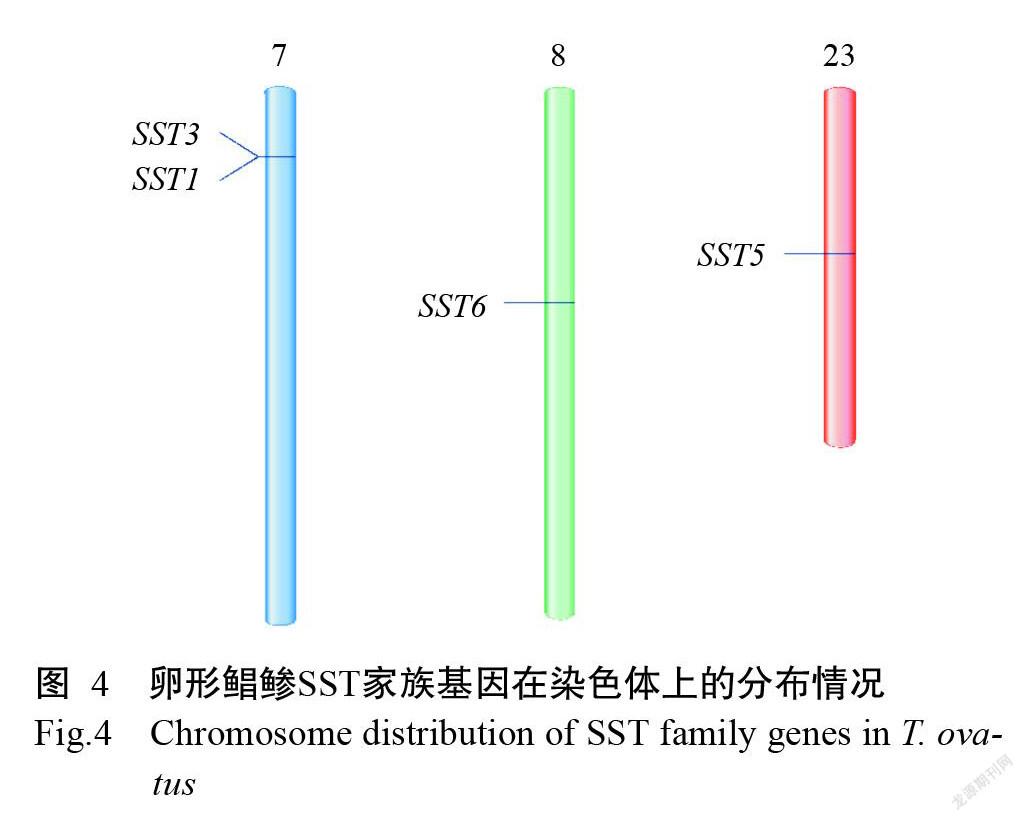

摘要:【目的】明确卵形鲳鲹生长抑素(SST)家族基因的种类及其组织表达特征,为进一步揭示SST家族基因在其生长发育过程中的作用机制打下基础。【方法】采用HMMER 3.1对卵形鲳鲹全基因组数据进行搜索,然后通过Pfam、SMART及NCBI CDD等数据库确认搜索获得的基因是否属于SST家族基因;采用ProtParam和PSORT等在线软件进行生物信息学分析,并以实时荧光定量PCR检测SST家族基因在卵形鲳鲹不同组织中的表达情况。【结果】从卵形鲳鲹全基因组中共鉴定出4个SST家族基因(SST1、SST3、SST5和SST6),分别编码122、127、106和110个氨基酸残基,对应的编码蛋白分子量介于12249.3~14316.1 Da,理论等电点(pI)介于6.51~7.43,均定位于细胞外。4个卵形鲳鲹SST基因结构较简单且相似,均包含2个外显子和1个内含子;SST1和SST3基因位于7号染色体上,SST6和SST5基因则分别位于8号和23号染色体上;4个卵形鲳鲹SST氨基酸序列相似性的平均值为33.42%,以SST5氨基酸序列与SST6氨基酸序列的相似性最高(39.78%),SST3氨基酸序列与SST5氨基酸序列的相似性最低(28.16%)。SST家族基因在卵形鲳鲹脑、胃、性腺和肌肉等组织中均有不同程度的表达,SST1、SST3和SST6基因在脑组织中显著高表达(P<0.05,下同),而SST5基因在性腺和肌肉组织中显著高表达;此外,SST3、SST5和SST6基因在卵形鲳鲹卵巢中的相对表达量均显著高于在精巢中的相对表达量。【结论】从卵形鲳鲹基因组中鉴定出4个SST家族基因(SST1、SST3、SST5和SST6),其表达分布存在组织特异性和种属特异性,可能介导卵形鲳鲹的神经调节、性腺发育及性二型性等多种生理功能,且不同物种的SST基因功能可能存在差异。
关键词: 卵形鲳鲹;生长抑素(SST)家族基因;基因结构;基元(Motif);组织表达
中图分类号: S965.331 文獻标志码: A 文章编号:2095-1191(2021)12-3212-09
Genome-wide identification and tissue expression analysis of the somatostatin family genes in Trachinotus ovatus
YU Yan-ling, FENG Peng-fei, PAN Chuan-yan, LIN Yong, SONG Man-ling,
ZHANG Yong-de, LUO Hong-lin*
(Guangxi Academy of Fishery Sciences/Guangxi Key Laboratory of Aquatic Genetic Breeding and Healthy
Aquaculture, Nanning 530021, China)
Abstract:【Objective】To study the type of somatostatin (SST) family genes and their tissue expressions in Trachinotus ovatus, and to lay the foundation for further research on the role of SST family genes in the growth and development of T. ovatus. 【Method】 HMMER 3.1 was used to identify somatostatin family genes from the whole genome data of T. ovatus, and then Pfam, Smart and NCBI CDD were used to confirm the searched genes belong to SST gene family. Subbioinformatic analysis was performed using online software such as ProtParam and PSORT. The expression of SST family genes in different tissues of T. ovatus were quantitatively analyzed by real-time fluorescence quantitative PCR. 【Result】Four SST family genes (SST1, SST3, SST5 and SST6) were identified from the whole genome of T. ovatus, encoding 122, 127, 106 and 110 amino acids, respectively. The molecular weight of the corresponding coding protein ranged from 12249.3 to 14316.1 Da, theoretical isoelectric points (pI) ranging from 6.51 to 7.43, and the four gene products were all located outside the cell. The structures of the four SST genes were similar, including two exons and one intron. SST1 and SST3 genes were located on chromosome 7, while SST6 and SST5 genes were located on chromosome 8 and 23, respectively. The average similarity of the four SST amino acid sequences was 33.42%, among which the similarity between SST5 and SST6 was the highest (39.78%), and the similarity between SST3 and SST5 was the lowest (28.16%). The expression levels of the SST family genes were different in brain, stomach, gonad and muscle of T. ovatus. Among them, the expressions of SST1, SST3 and SST6 genes were significantly higher in brain tissue (P<0.05, the same below), while SST5 was significantly highly expressed in gonad and muscle tissues. In addition, the expression of SST3,SST5 and SST6 genes in the ovary were significantly higher than in the testis. 【Conclusion】Four SST family genes (SST1, SST3, SST5 and SST6) are identified from the genome of T. ovatus and the expression and distribution are tissue-specific and species-specific. SST genes may mediate a variety of physiological functions in neuroregulation, gonadal development, and sexual dimorphism of T. ovatus, and the function of SST genes in different species may differ.
Key words: Trachinotus ovatus; somatostatin (SST) family gene; gene structure; Motif; tissue expression
Foundation item: Guangxi Innovation Driven Development Project (Guike AA17204080-3, Guike AA18242031-2); Independent Project of Guangxi Key Laboratory of Aquatic Genetic Breeding and Healthy Aquaculture(17-A-01-02, 19-A-01-05)
0 引言
【研究意义】卵形鲳鲹(Trachinotus ovatus)隶属于鲹形目(Carangiformes)鲹科(Carangidae),是适合我国近海、远海集约化养殖的名贵水产品种之一,在我国南部沿海地区已得到迅速发展(Liu et al.,2010;黄小林等,2018;张永德等,2020a)。然而,近年来由于不规范的保种与选育,卵形鲳鲹已出现种质退化现象,主要表现为生长速率下降、群体整齐度低、畸形、抗病力低、病害发生频繁及鱼苗死亡率高等,且种群遗传多样性面临着丢失的风险(张永德等,2020b)。……
登录APP查看全文
