固相萃取-UPLC-MS/MS同时测定水中16种磺胺类抗生素残留
2021-08-12 05:19:29王运儒孟祥至秦玉燕邓有展
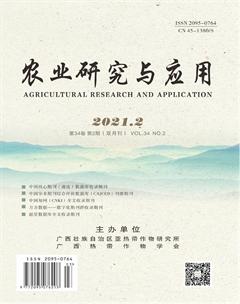
农业研究与应用
2021年2期
王运儒 孟祥至 秦玉燕 邓有展


摘 要:建立了固相萃取-超高效液相色谱-串联质谱(SPE-UPLC-MS /MS)同时检测水中16种磺胺类抗生素的分析方法。水中的磺胺类抗生素经 HLB净化柱富集纯化后经Acquity UPLC HSS T3 柱分离,多反应监测模式( MRM) 进行定性定量分析。流动相由乙腈和0.1 %的甲酸水溶液(V/V)组成,梯度洗脱。该方法的检出限:1.0~5.0 μg/kg;加标回收率范围:78.6 %~103.2 %;相对标准偏差范围:1.1 %~12.8 %。结果表明,该方法灵敏度高、具有良好的精密度和准确度,适用于水中 16 种磺胺类药物残留检测。
关键词:磺胺类抗生素 固相萃取 超高效液相色谱串联质谱法
中图分类号:TS201.6 文献标志码:A
Determination of 16 Kinds of Sulfonamides Residues in Water by Solid Phase Extraction-UPLC-MS/MS
WANG Yunru1,2,3*, MENG Xiangzhi4,QIN Yuyan1,2,3*,DENG Youzhan1,2,3
(1Guangxi Subtropical Crops Research Institute, Nanning, Guangxi 530001, China;2 Laboratory of Quality Risk Assessment for Agro-products (Nanning) Ministry of Agriculture and Rural Affairs,Nanning, Guangxi 530001, China;3 Quality Supervision and Testing Center of Subtropical Fruit and Vegetable,Ministry of Agriculture and Rural Affairs,Nanning, Guangxi 530001, China;4 Shandong Benyuan Environmental Technology Co. Ltd.,Jinan, Shandong 250100, China)
Abstract: A method was developed for simultaneous determination of 16 sulfonamides antibiotics in surface water by solid-phase extraction with ultra-high performance liquid chromatography-tandem mass spectrometry(SPE-UPLC-MS/MS). The sulfonamides in water was enriched and purified by HLB solid phase extraction column, and separated by Acquity UPLC HSS T3 column with a gradient elution of acetonitrile and 0. 1% formic acid (v:v), then the qualitative and quantitative analysis was performed under the multiple reaction monitoring(MRM) mode. The detection limit was 1.0~5.0 μg/kg, recovery rate was 78.6%~103.2% and the relative standard deviations was 1.1%~12.8%. The method with high sensitivity, good precision and accuracy is suitable for detection of 16 sulfonamides residues in water.
Key words: Sulfonamide antibiotics; solid phase extraction; ultra high performance liquid chromatography tandem mass
磺胺類抗生素药物(Sulfonamides,SAs)是我国目前应用最多,使用量最大的抗生素之一,具有抗菌谱广、低成本、高稳定性和较强的亲水性等特征[1-3]。磺胺类抗生素通过干扰细菌的叶酸合成从而使细菌生长和繁殖受到抑制,被广泛用于医疗、畜牧业和水产养殖业等,属于少有的人类、畜牧和水产养殖业共同使用的药物。据统计,在2013年,SAs 在我国的使用量达到了7920 t,其中用于兽药的占76 %,用于医药的占11 %[4]。目前磺胺类抗生素污染的来源主要是药物生产过程中排放的废水、水产养殖业、畜牧业和人类医疗用药。磺胺类抗生素因具有很高的稳定性,在环境中降解速度慢,人畜服用后磺胺类药物后大部分在体内没有代谢就直接以原药的形式排入环境中,会长时间残留在土壤环境和水环境中,严重影响人类的健康[5-6]。因此,近几年来磺胺类抗生素的滥用造成的环境污染和风险隐患,成为了研究的热点。……
登录APP查看全文
猜你喜欢
儿童故事画报(2019年5期)2019-05-26 14:26:14
海峡科技与产业(2016年3期)2016-05-17 04:32:12
Coco薇(2016年2期)2016-03-22 02:42:52
Coco薇(2015年1期)2015-08-13 02:47:34
小雪花·成长指南(2015年7期)2015-08-11 15:03:12
小雪花·成长指南(2015年4期)2015-05-19 14:47:56