肺表面活性物质联合经鼻持续气道正压通气治疗对新生儿呼吸窘迫综合征患儿血气指标及预后的影响
2021-09-13 16:10:34薛洁英王有禄吕智敏陈燕燕
中国医药科学
2021年22期
关键词:肺表面活性物质
薛洁英 王有禄 吕智敏 陈燕燕
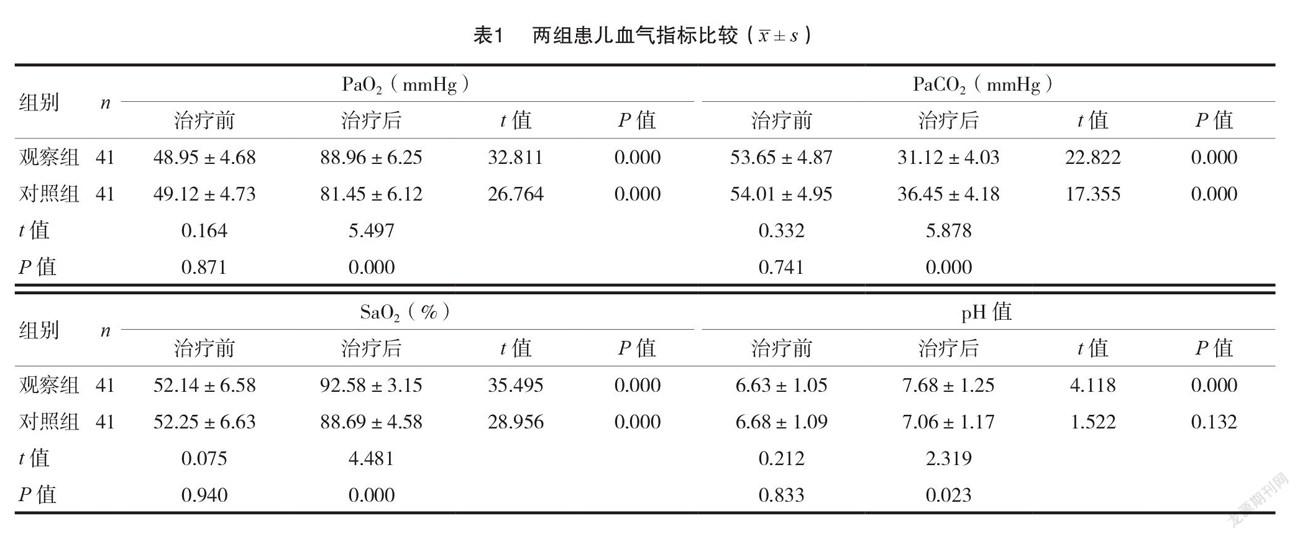

[摘要]目的探討肺表面活性物质(PS)联合经鼻持续气道正压通气(nCPAP)治疗新生儿呼吸窘迫综合征(NRDS)的临床效果和安全性。方法选取2018年8月至2020年10月于广东省廉江市人民医院治疗的82例 NRDS 患儿,按随机数字表法分为两组,每组各41例。对照组予以nCPAP治疗,观察组加用 PS 治疗。比较两组血气指标、临床相关指标和并发症发生状况。结果治疗后,观察组患儿血氧分压(PaO2)、血氧饱和度(SaO2)、pH 值分别为(88.96±6.25)mmHg、(92.58±3.15)%、(7.68±1.25),高于对照组的(81.45±6.12)mmHg、(88.69±4.58)%、(7.06±1.17),观察组患儿二氧化碳分压(PaCO2)为(31.12±4.03)mmHg,低于对照组的(36.45±4.18)mmHg,差异有统计学意义( P <0.05);观察组患儿氧疗时间、nCPAP时间和住院时间为(87.89±7.85)h、(95.14±9.46)h、(19.58±2.36)d,短于对照组的(115.46±9.37)h、(130.58±20.76)h、(24.55±4.12)d,差异有统计学意义( P <0.05);观察组患儿并发症发生率为4.88%,较对照组的19.51%低,差异有统计学意义( P <0.05)。结论 PS 联合nCPAP可增强 NRDS 患儿治疗效果,改善患儿动脉血气指标,纠正机体缺氧症状,缩短住院时间,减少并发症发生。
[关键词]新生儿呼吸窘迫综合征;肺表面活性物质;经鼻持续气道正压通气;血气指标
[中图分类号] R722.19 [文献标识码] A [文章编号]2095-0616(2021)22-0080-04
Effect of pulmonary surfactant combined with nasal continuous positive airway pressure on blood gas index and prognosis in neonates with respiratory distress syndrome
XUE Jieying WANG Youlu LV Zhimin CHEN Yanyan
Department of Neonatology, Lianjiang People's Hospital, Guangdong, Lianjiang 524400, China
[Abstract] Objective To explore the clinical efficacy and safety of pulmonary surfactant (PS) combined with nasal continuous positive airway pressure (nCPAP) in the treatment of neonatal respiratory distress syndrome (NRDS). Methods A total of 82 children with NRDS treated in Lianjiang People's Hospital, Guangdong from August 2018 to October 2020 were selected and randomly divided into two groups, with 41 cases in each group. The control group was treated with nCPAP, while the observation group was treated with nCPAP combined with PS. The blood gas indexes, clinical related indexes and complications of the two groups were compared. Results After treatment, the partial pressure of blood oxygen (PaO2), saturation of blood oxygen (SaO2) and pH value of observation group were (88.96±6.25) mmHg, (92.58±3.15)% and (7.68±1.25), which were higher than those of control group ([81.45±6.12]mmHg, [88.69±4.58]% and [7.06±1.17]). The partial pressure of carbon dioxide (PaCO2) was (31.12±4.03) mmHg, which was lower than that of the control group [(36.45±4.18) mmHg], with statistically significant differences (P <0.05). The oxygen therapy time, nCPAP time and hospitalization time in observation group were (87.89±7.85) h, (95.14±9.46) h and (19.58±2.36) d, which were shorter than those in control group ([115.46±9.37] h, [130.58±20.76] h and [24.55±4.12] d), with statistically significant differences (P <0.05). The incidence of complications in the observation group was 4.88%, which was lower than that in the control group (19.51%), with statistically significant difference (P <0.05). Conclusion PS combined with nCPAP can enhance the therapeutic effect of NRDS, improve the arterial blood gas index of children, correct the symptoms of hypoxia, shorten the hospitalization time and reduce the occurrence of complications.
[Key words] Neonatal respiratory distress syndrome; Pulmonary surfactant; Nasal continuous positive airwaypressure ventilation; Blood gas index
新生儿呼吸窘迫综合征(neonatal respiratory distress syndrome, NRDS)属于新生儿特有疾病,患儿常出现呼吸困难并逐渐加重,严重者可发生呼吸衰竭,胎龄越小,NRDS 发生率越高,体重越轻则病死率越高[1-2]。目前,临床早期多予以辅助通气治疗,经鼻持续气道正压通气(nasal continuous positive airway pressure,nCPAP)较为常见,其具有无创性、人机协调好等特点,可增强患儿呼吸功能,促进呼吸困难等症状消失,加快病情好转[3-4]。但临床研究显示[5],该病发生与肺表面活性物质(pulmonary surfactant,PS)缺乏关系密切,单纯通气治疗不利于快速缩短病程。若早期予以 PS 制剂则可补充内源性 PS 不足,加快肺泡表面细胞发育,提高肺泡稳定性,从而增强患儿肺功能,改善病情进展。鉴于此,本研究旨在分析 PS 联合nCPAP治疗 NRDS 的临床效果。现报道如下。
1资料与方法
1.1一般资料
选取2018年8月至2020年10月于广东省廉江市人民医院(我院)治疗的82例 NRDS 患儿,按随机数字表法分为两组,每组各41例。……
登录APP查看全文
猜你喜欢
中外医学研究(2017年1期)2017-02-23 14:16:28
中外医学研究(2017年1期)2017-02-23 14:09:59
中国现代医生(2016年25期)2016-11-19 10:45:36
中国医药科学(2016年6期)2016-10-10 01:30:56
中国实用医药(2016年13期)2016-07-05 03:54:49
中国实用医药(2016年2期)2016-01-05 19:42:24
中国当代医药(2014年6期)2014-03-24 10:20:51