重型颅脑外伤患者应用改良标准外伤大骨瓣开颅术治疗的效果分析
2021-09-13 16:57:00董永尧石祥飞张宗胜王德勇陈雅倩
中国医药科学
2021年22期
董永尧 石祥飞 张宗胜 王德勇 陈雅倩
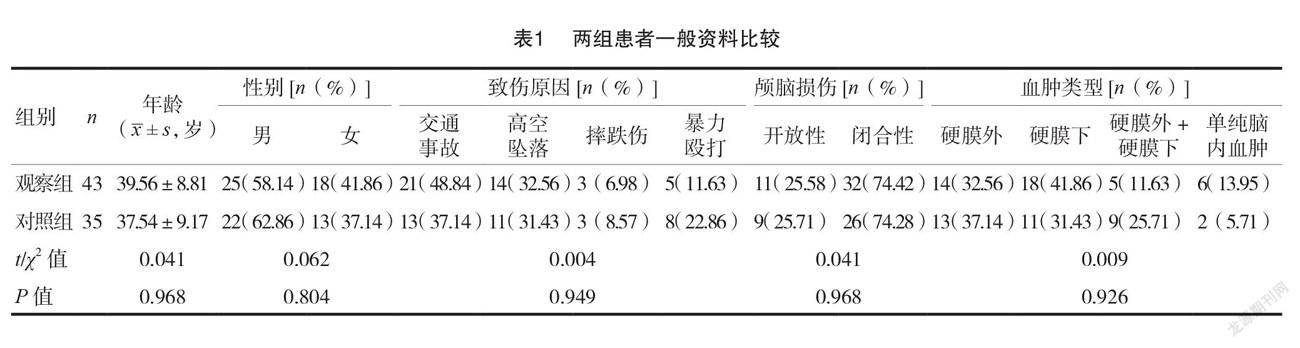
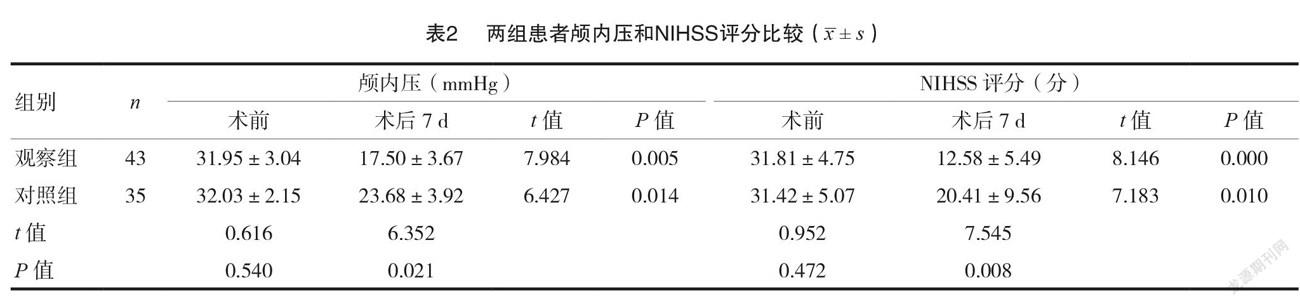
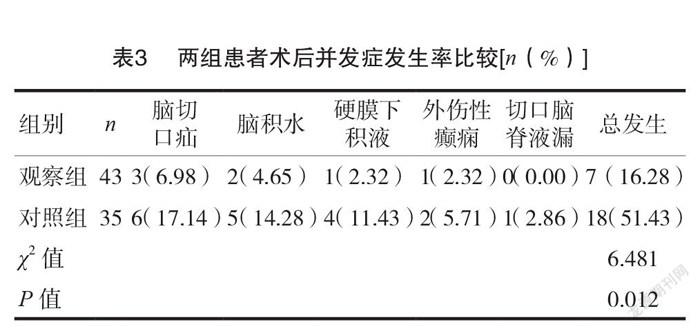
[摘要]目的探討改良标准外伤大骨瓣开颅术对重型颅脑外伤(TBI)患者的治疗效果及安全性。方法回顾性分析2019年1月至2020年12月邳州市人民医院神经外科住院的78例重型 TBI 患者的临床资料,根据不同的治疗方法分为观察组( n=43)和对照组( n=35),对照组给予常规区域性骨瓣开颅术治疗,观察组应用改良标准外伤大骨瓣开颅术。记录所有患者颅内压及美国国立卫生研究院卒中量表(NIHSS)评分,观察所有患者术后并发症发生情况。随访6个月,根据格拉斯哥预后评分(GOS)对所有患者预后进行评价。结果手术前,观察组与治疗组颅内压和 NIHSS 评分比较,差异无统计学意义(P >0.05)。术后7 d 两组颅内压和 NIHSS 评分均明显低于术前,且观察组术后7 d 颅内压和 NIHSS 评分均明显低于对照组,差异有统计学意义(P <0.05)。观察组术后并发症总发生率明显低于对照组,差异有统计学意义(16.28% vs.51.43%,χ2=6.481,P=0.012)。术后随访6个月,观察组病死率和预后不良发生率明显低于对照组,差异有统计学意义(9.30% vs.40.00%,χ2=8.472,P=0.000;34.88% vs.65.71%,χ2=9.147,P=0.000)。结论改良标准外伤大骨瓣开颅术可明显降低重型 TBI 患者颅内压和 NIHSS 评分,改善神经功能,降低术后并发症发生率和预后不良发生率,提高患者疗效及安全性。
[关键词]重型颅脑外伤;标准外伤大骨瓣开颅术;昏迷;格拉斯哥预后评分
[中图分类号] R651.15 [文献标识码] A [文章编号]2095-0616(2021)22-0165-04
Analysis on the efficacy of modified standard large trauma craniotomy in patients with severe traumatic brain injury
DONGYongyao1 SHIXiangfei1 ZHANGZongsheng1 WANGDeyong1 CHENYaqian2
1. Department of Neurosurgery, the People's Hospital of Pizhou, Jiangsu, Pizhou 221300, China;2. Department of Pharmacy, the People's Hospital of Pizhou, Jiangsu, Pizhou 221300, China
[Abstract] Objective To investigate the efficacy and safety of modified standard large trauma craniotomy in patients with severe traumatic brain injury (TBI). Methods The clinical data of 78 patients with severe TBI hospitalized in the Department of Neurosurgery of The People's Hospital of Pizhou from January 2019 to December 2020 were retrospectively analyzed. These patients were divided into the observation group (n=43) and the control group (n=35) according to different treatment methods. The control group received conventional regional craniotomy, while the observation group received modified standard large trauma craniotomy. The intracranial pressure and the score of the National Institute of Health Stroke Scale (NIHSS) of all patients were recorded, and the occurrence of postoperative complications of all patients was observed. All patients were followed up for 6 months. The prognosis of all patients was evaluated by the Glasgow prognostic score (GOS). Results Before surgery, there was no statistically significant difference between the observation group and the treatment group in terms of intracranial pressure and NIHSS scores (P >0.05). At 7 days after surgery, the intracranial pressure and NIHSS scores of both groups were significantly lower than those before surgery, and those of the observation group were significantly lower than those of the control group at 7 days after surgery, with statistically significant differences (P <0.05). The incidence of postoperative complications in the observation group was significantly lower than that in the control group, with statistically significant difference (16.28% vs.51.43%, χ2=6.481, P=0.012). During the 6 months of postoperative follow-up, the morbidity rate and the incidence of poor prognosis in the observation group were significantly lower than those in the control group, with statistically significant differences (9.30% vs.40.00%, χ2=8.472, P=0.000;34.88% vs.65.71%, χ2=9.147, P=0.000). Conclusion In the treatment of patients with severe TBI, modified standard large trauma craniotomy can significantly reduce the intracranial pressure and NIHSS scores, improve neurological function, and reduce the incidence of postoperative complications and poor prognosis, with higher efficacy and safety.
[Key words] Severe traumatic brain injury; Standard large trauma craniotomy; Coma; Glasgow prognostic score
颅脑外伤(traumatic brain injure, TBI)是一种复杂的损伤,可导致神经细胞死亡,影响脑内的分子途径,从而导致感官、运动和行为的改变,深刻影响生活质量,是世界范围内死亡的主要原因之一[1-2]。目前,对颅脑损伤的诊治水平有了很大的提高,但随着社会的发展,交通工具逐渐增加,导致 TBI 发生率明显上升[3]。重型 TBI 是一种常见的发病和死亡原因。有研究证明,伴有颅外损伤的重型 TBI 确实会导致先天免疫系统的损伤后抑制,但这种损伤对适应性免疫系统的影响尚不清楚[4]。近年来,重型 TBI 发病率居高不下,可能与患者未能得到及时处理以及处理不当等有关。有研……
登录APP查看全文