134例桥本甲状腺炎合并甲状腺结节患者的中医证候分布规律
2021-11-29 16:25:35章丽琼邹碧君陈清光陆灏徐佩英
世界中医药
2021年20期
章丽琼 邹碧君 陈清光 陆灏 徐佩英
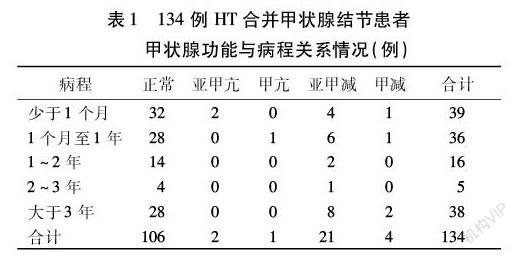
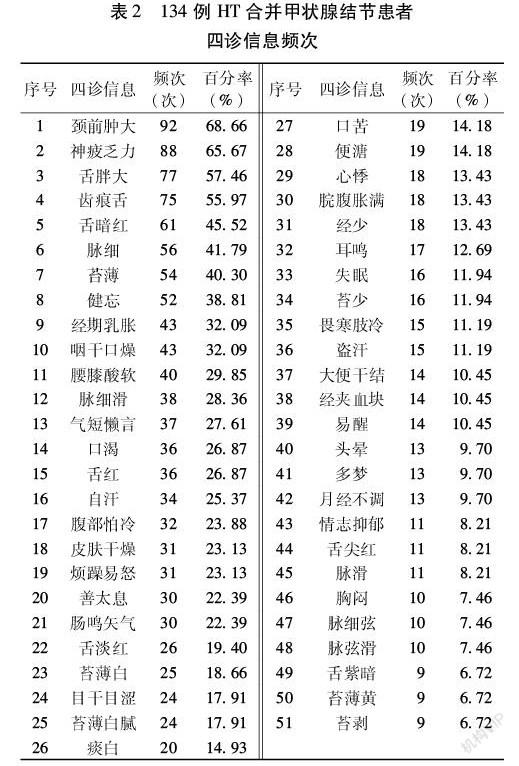
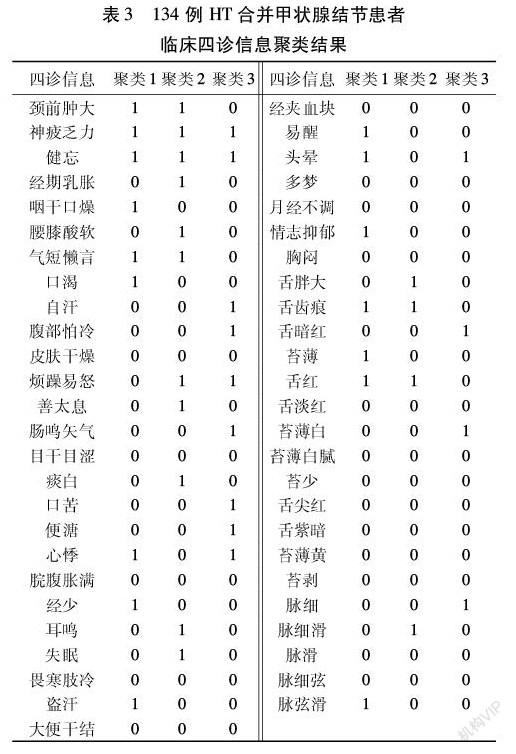
摘要 目的:總结桥本甲状腺炎合并甲状腺结节患者常见中医证候分布及辨证分型规律,从而为桥本甲状腺炎合并甲状腺结节的中医防治提供依据。方法:选取2017年6月至2018年5月上海中医药大学附属曙光医院收治的桥本甲状腺炎合并甲状腺结节患者134例作为研究对象。采集临床症状、体征等中医四诊资料。建立相应所需的数据库,将信息转化成计数资料。应用频数分析和聚类分析方法对收集的资料进行整理,总结出中医常见证候及辨证分型。结果:134例患者中女117例、男17例,平均年龄(40.19±12.61)岁,平均病程(28.48±40.42)个月。51项四诊信息中,临床症状出现频次最高的5项证候为:颈前肿大、神疲乏力、健忘、经期乳胀、咽干口燥;主要脉象为:细脉、细滑脉、滑脉;主要舌象为:舌胖大、有齿痕、舌暗红、苔薄或者苔薄白。通过聚类分析得出3个证型:气阴两虚证;肝郁肾虚、气滞痰凝证;脾虚肝郁、气滞血瘀证。结论:本病主要病变部位为肝、脾、肾。病机本虚标实,虚实夹杂。本虚为气阴两虚、脾肾亏虚为主,标实表现为肝郁、气滞、痰凝、血瘀。整体临床表现以虚证为主,实证为次。
关键词 桥本甲状腺炎合并甲状腺结节;中医证候分布;聚类分析;频数分析;体征;脉象;舌象
Abstract Objective:To summarize the distribution of common traditional Chinese medicine(TCM) symptoms and syndrome differentiation rules of Hashimoto′s thyroiditis combined with thyroid nodules through standardization of syndromes,and provide evidence for the prevention and treatment of Hashimoto′s thyroiditis combined with thyroid nodules by TCM.Methods:A total of 134 patients with Hashimoto′s thyroiditis and thyroid nodules,who were admitted to the Shuguang Hospital affiliated to Shanghai University of Traditional Chinese Medicine from June 2017 to May 2018,were selected as the research objects.A total of 4 four-diagnosis data of TCM were collected,including clinical symptoms and physical signs.The corresponding required database were established and information was converted into counting data.Frequency analysis and cluster analysis were used to sort out the collected data,and the common syndromes and syndrome differentiation types of TCM were summarized.Results:There were 117 females and 17 males in 134 patients,with an average age of 40.19±12.61 years and an average course of 28.48±40.42 months.Among the 51 items of information based on four diagnostic methods,the 5 most frequent clinical symptoms are anterior neck swelling,fatigue,forgetfulness,menstrual breast distension,dry throat and mouth.The main pulse manifestations are thready pulse,thready and slippery pulse,and slippery pulse.The main tongue manifestations include plump tongue,teeth printed tongue,dark red tongue,thin fur or thin white fur.Through cluster analysis,3 syndrome types were obtained:syndrome of deficiency of both qi and yin,syndrome of liver depression and kidney deficiency,qi stagnation and phlegm coagulation,syndrome of stagnation of liver qi and spleen deficiency,qi stagnation and blood stasis.Conclusion:The main lesions of this disease are liver,spleen and kidney.The pathogenesis of the disease is true deficiency disease with false excessive manifestation.True deficiency is the deficiency of both qi and yin,and the deficiency of spleen and kidney.False excessive manifestations are liver depression,qi stagnation,phlegm coagulation,and blood stasis.The overall clinical manifestations are mainly deficient syndrome,followed by excessive manifestations.
Keywords Hashimoto′s thyroiditis with thyroid nodules; Distribution of traditional Chinese medicine syndromes; Cluster analysis; Frequency analysis; Signs; Pulse signs; Tongue signs
中图分类号:R259;R581.4文献标识码:Adoi:10.3969/j.issn.1673-7202.2021.20.022
桥本甲状腺炎(Hashimoto Thyroiditis,HT)是最常见的器官特异性自身免疫疾病之一。在我国,HT的发病率为0.4%~1.5%,约占甲状腺疾病的22.5%[1]。男女患病比为1∶8~9,高发年龄在30~50岁[2]。甲状腺结节通过触诊获得的患病率为3%~7%,高分辨率超声检查获得的患病率为20%~76%,甲状腺结节中甲状腺癌的发病率为5%~15%[3]。……
登录APP查看全文