风光互补发电系统的建模与仿真研究
2021-12-08 21:23:51王汀元
中小企业管理与科技·中旬刊
2021年12期
王汀元
【摘 要】论文基于一种较为先进的风-光-储混合发电的模型,通过分析风能发电和光伏发电的特性,分别搭建风力发电、光伏发电的数学模型,再基于数学模型,利用MATLAB/Simulink实验平台搭建仿真模型,运行得到结果后对其进行简要分析。论文总结风力发电和光伏发电的优势与劣势,并制定能够使其互补的控制策略,实现减少“弃风、弃光”现象的目的。
【Abstract】This paper is based on a more advanced wind-photovoltaic-storage hybrid power generation model. By analyzing the characteristics of wind power generation and photovoltaic power generation, the paper constructs mathematical models of wind power generation and photovoltaic power generation respectively. Then, based on the mathematical models, the paper uses the MATLAB/Simulink experimental platform to construct a simulation model, and briefly analyzes the results after running. The paper summarizes the advantages and disadvantages of wind power generation and photovoltaic power generation, and formulates a control strategies that can complement each other to achieve the goal of reducing the phenomenon of "abandoning wind and solar energy".
【关键词】风光互补发电;控制系统;混合储能;建模
【Keywords】wind-photovoltaic hybrid power generation; control system; hybrid energy storage; modeling
【中图分类号】TM61 【文献标志码】A 【文章编号】1673-1069(2021)12-0179-03
1 风光发电系统模型的建立
1.1 风力发电机组模型与控制系统
根据贝茨定律,可以得到风机发电功率的数学模型:
式中,Cp为风能利用系数;ρ为空气密度,单位是kg/m3;R为风轮机的半径,单位是m;V为风速,单位是m/s。
通过式(1)可知,若在风轮机半径、风速以及空气密度为常数的情况下,风机从风能中获取的功率随着风能利用系数Cp的增加而成线性增加。
其中,风能利用系数Cp是关于叶尖速比λ和桨距角β的非线性函数。有如下关系式:
式中,ω为风力角速度,单位是rad/s;n为风机的转速,单位是r/min。Cp和λ存在如下关系:
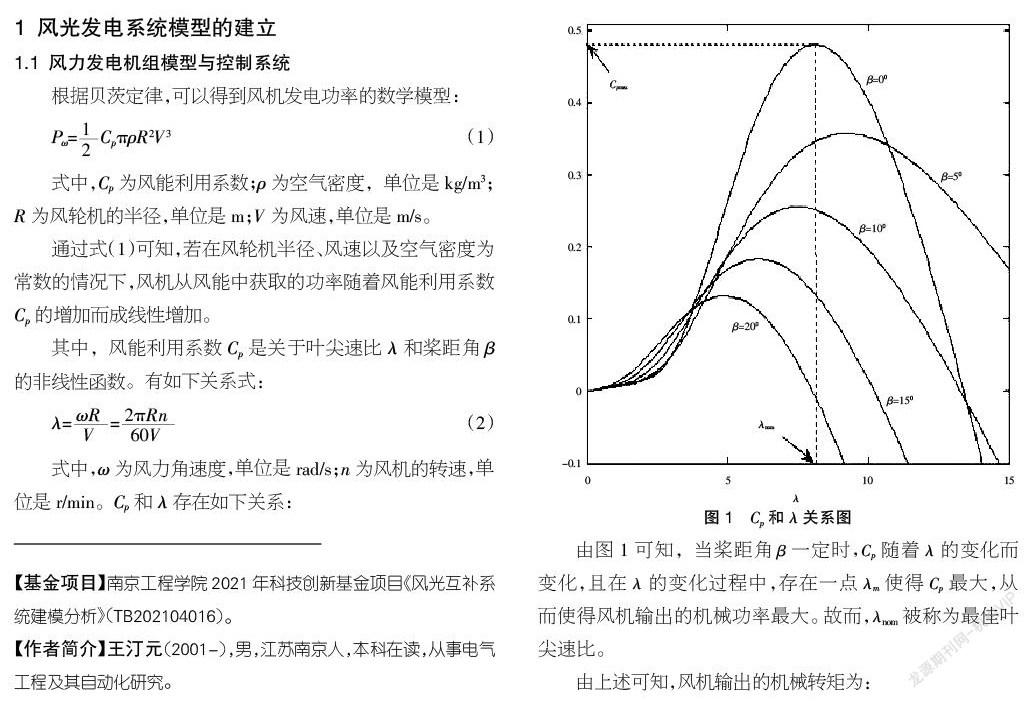
由图1可知,当桨距角β一定时,Cp随着λ的变化而变化,且在λ的变化过程中,存在一点λm使得Cp最大,从而使得风机输出的机械功率最大。故而,λnom被称为最佳叶尖速比。
由上述可知,风机输出的机械转矩为:
通过对数学模型的分析可得,桨距角β值为0时,风能利用率最大;β值约为20时,风能利用系数最小。β值越大风能利用系数的值越小。通过物理模型,外界风速小于额定风速时,风机的桨距角β一直保持为0,因而,由图1可知,此时的风能利用系数Cp是叶尖速比λ的函数,通过对叶尖速比λ的实时调节,可以得到一个最大的风能利用系数Cpmax,从而使得输出功率最大。……
登录APP查看全文