B超引导腰丛阻滞(“三叶草”法)复合不同熵指数控制水平的喉罩全身麻醉在老年THA患者中的应用研究
2024-05-21 13:42:28唐波黄晓华占文武
中国医学创新
2024年8期
唐波 黄晓华 占文武
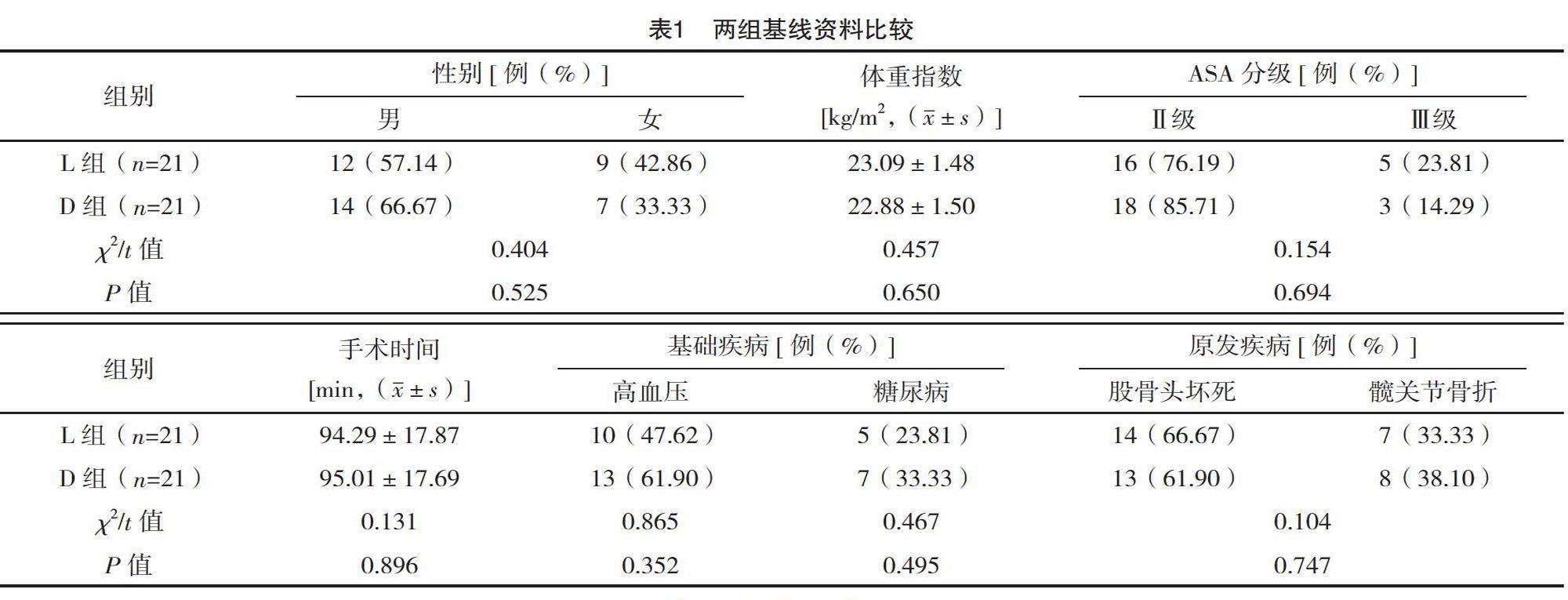
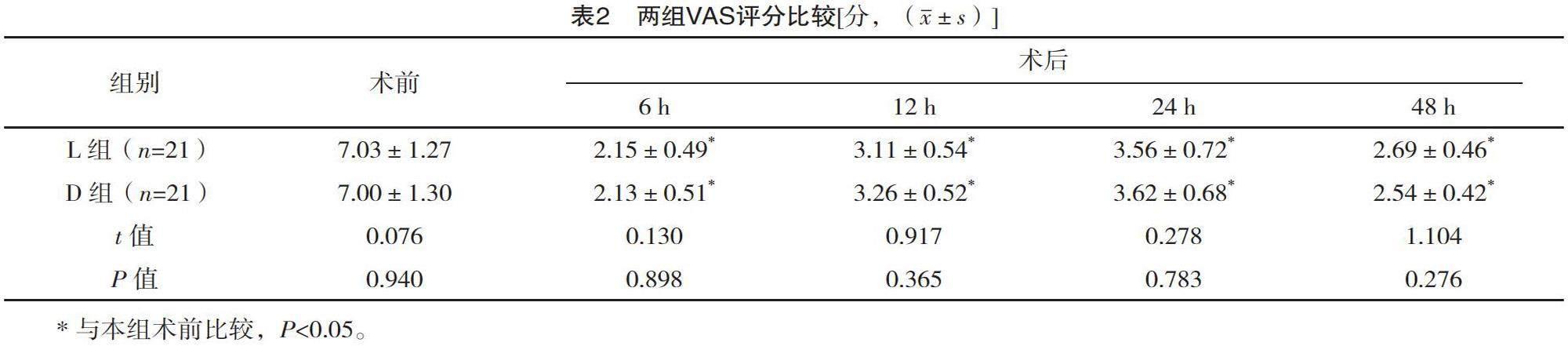
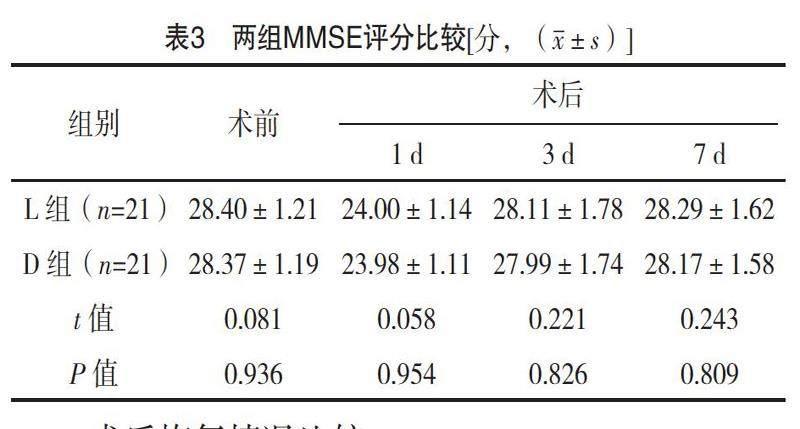
【摘要】 目的:探討B超引导腰丛阻滞(“三叶草”法)复合不同熵指数控制水平的喉罩全身麻醉在老年全髋关节置换术(THA)患者中的应用效果。方法:选取2021年6月—2023年10月云浮市人民医院收治的42例行THA老年患者,按手术时间顺序分组法(奇数日为L组,偶数日为D组)分为两组,其中D组给予深麻醉喉罩全身麻醉,熵指数维持于40~50,L组给予浅麻醉喉罩全身麻醉,熵指数维持于50~60,比较两组术前及术后6、12、24、48 h视觉模拟评分法(VAS)评分,术前及术后1、3、7 d 简易智力状态检查量表(MMSE)评分,术后恢复情况,入室时、切皮即刻、手术开始15 min、手术开始30 min、术毕即刻生命体征,术后自控镇痛使用情况。结果:两组术前及术后6、12、24、48 h的VAS评分对比差异均无统计学意义(P>0.05),但与术前相比均显著下降(P<0.05)。术前及术后1、3、7 d两组MMSE评分差异均无统计学意义(P>0.05),L组术后苏醒时间、拔管时间、定向力恢复时间均较D组显著早(P<0.05),入室时、切皮即刻、手术开始15 min、手术开始30 min、术毕即刻两组心率(HR)、呼吸频率(RR)、平均动脉压(MAP)水平差异均无统计学意义(P>0.05),但与入室时比较,两组切皮即刻、手术开始15 min、手术开始30 min、术毕即刻RR、HR、MAP水平均显著下降(P<0.05),两组术后自控镇痛首次时间使用时间、平均使用次数、舒芬太尼使用量、有效按压率差异均无统计学意义(P>0.05)。结论:B超引导腰丛阻滞(“三叶草”法)复合喉罩全身麻醉可提高THA患者麻醉及术后镇痛效果,维持患者处于稳定的状态,但是熵指数控制在50~60(浅度麻醉)即可起到显著麻醉和镇痛效果,尤其是在患者术后恢复方面更具有优势。
【关键词】 B超引导腰丛阻滞 熵指数 喉罩麻醉 全髋关节置换术 老年
Application of B-ultrasound Guided Lumbar Plexus Block ("Clover" Method) Combined with Laryngeal Mask General Anesthesia with Different Entropy Index Control Levels in Elderly Patients with THA/TANG Bo, HUANG Xiaohua, ZHAN Wenwu. //Medical Innovation of China, 2024, 21(08): 00-006
[Abstract] Objective: To explore and analyze the application effect of B-ultrasound guided lumbar plexus block ("clover" method) combined with laryngeal mask general anesthesia with different entropy index control level in elderly patients with total hip arthroplasty (THA). Method: Forty-two elderly patients with THA treated in Yunfu People's Hospital from June 2021 to October 2023, according to the operation time sequence, patients with odd days of operation time were included in group L and patients with even days were included in group D. Group D was given deep anesthesia with laryngeal mask general anesthesia, and the entropy index was maintained at 40-50; group L was given shallow anesthesia with laryngeal mask general anesthesia, and the entropy index was maintained at 50-60. The visual analogue scale (VAS) scores before operation and 6, 12, 24, 48 h after operation, mini-mental state examination (MMSE) scores before operation and 1, 3, 7 d after operation, postoperative recovery, vital signs at admission, immediately after skin incision, 15 min, 30 min after the start of surgery, and immediately after operation, and use of postoperative controlled analgesia were compared between the two groups. Result: There were no significant differences in VAS scores before operation and 6, 12, 24, 48 h after operation between the two groups (P>0.05), However, they were significantly lower than those before operation (P<0.05). There were no significant differences in MMSE scores between the two groups before and 1, 3 and 7 d after surgery (P>0.05). The postoperative recovery time, extubation time and orientation recovery time of patients in group L were significantly earlier than those in group D (P<0.05). There were no significant differences in RR, HR and MAP between the two groups when entering the room, immediately after skin incision, 15 min after the start of surgery, 30 min after the start of surgery, and immediately after surgery (P>0.05). RR, HR and MAP of both groups were significantly decreased immediately after incision, 15 minutes after the start of surgery, 30 minutes after the start of surgery, and immediately after surgery compared those at entering the room (P<0.05). There were no significant differences between the two groups in the first time of use of postoperative controlled analgesia, the average number of use, the amount of Sufentanil used, and the effective compression rate (P>0.05). Conclusion: The application of B-ultrasound guided lumbar plexus block ("clover" method) combined with laryngeal mask general anesthesia in elderly THA patients has significant anesthetic and postoperative analgesic effects, maintaining patients in a stable state, but the entropy index control of 50-60 (shallow anesthesia) can play a significant anesthetic and analgesic effect, especially in the postoperative recovery of patients.
[Key words] B-ultrasound guided lumbar plexus block Entropy index Laryngeal mask general anesthesia Total hip arthroplasty Elderly
First-author's address: Department of Anesthesiology, Yunfu People's Hospital, Yunfu 527300, China
doi:10.3969/j.issn.1674-4985.2024.08.001
全髋关节置换术(THA)是临床上治疗股骨头坏死和髋关节骨折的常用手段,高龄、合并糖尿病、高血压等基础疾病是THA高发人群,此类患者在手术过程麻醉风险增加,因此对麻醉的把控要求更高[1-2]。近年……
登录APP查看全文
猜你喜欢
中国实用医药(2016年30期)2016-12-28 14:34:56
中国实用医药(2016年27期)2016-11-30 11:39:10
今日健康(2016年12期)2016-11-17 11:51:51
今日健康(2016年12期)2016-11-17 11:50:41
中国实用医药(2016年24期)2016-10-17 06:10:10
中国实用医药(2016年24期)2016-10-17 05:39:30
中国实用医药(2016年24期)2016-10-17 05:15:48
中国实用医药(2016年24期)2016-10-17 04:26:41
中国实用医药(2016年22期)2016-08-19 12:00:22
中国实用医药(2016年8期)2016-03-30 23:35:18