腹腔镜下子宫肌瘤切除术后不孕的风险因素分析
2024-05-21 09:11:06刘蘅哲范盛然赵慧娟
中国医学创新
2024年7期
刘蘅哲 范盛然 赵慧娟
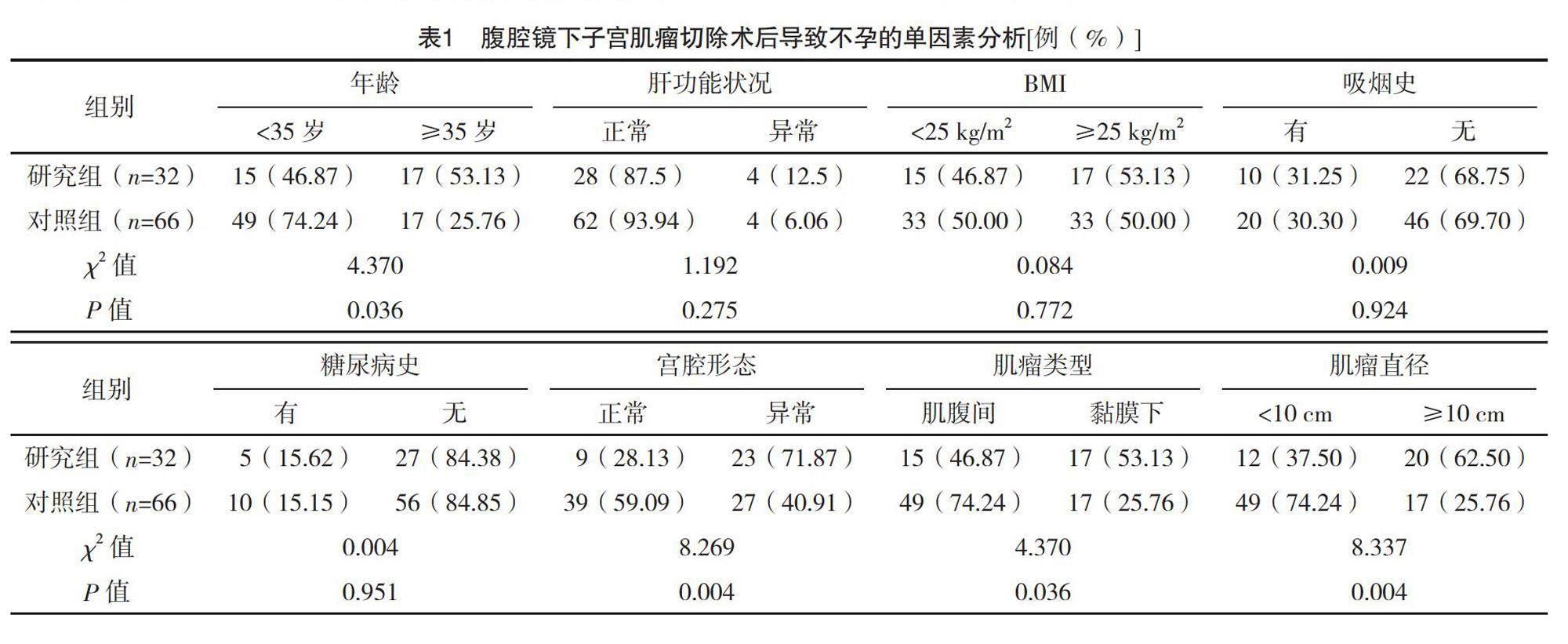
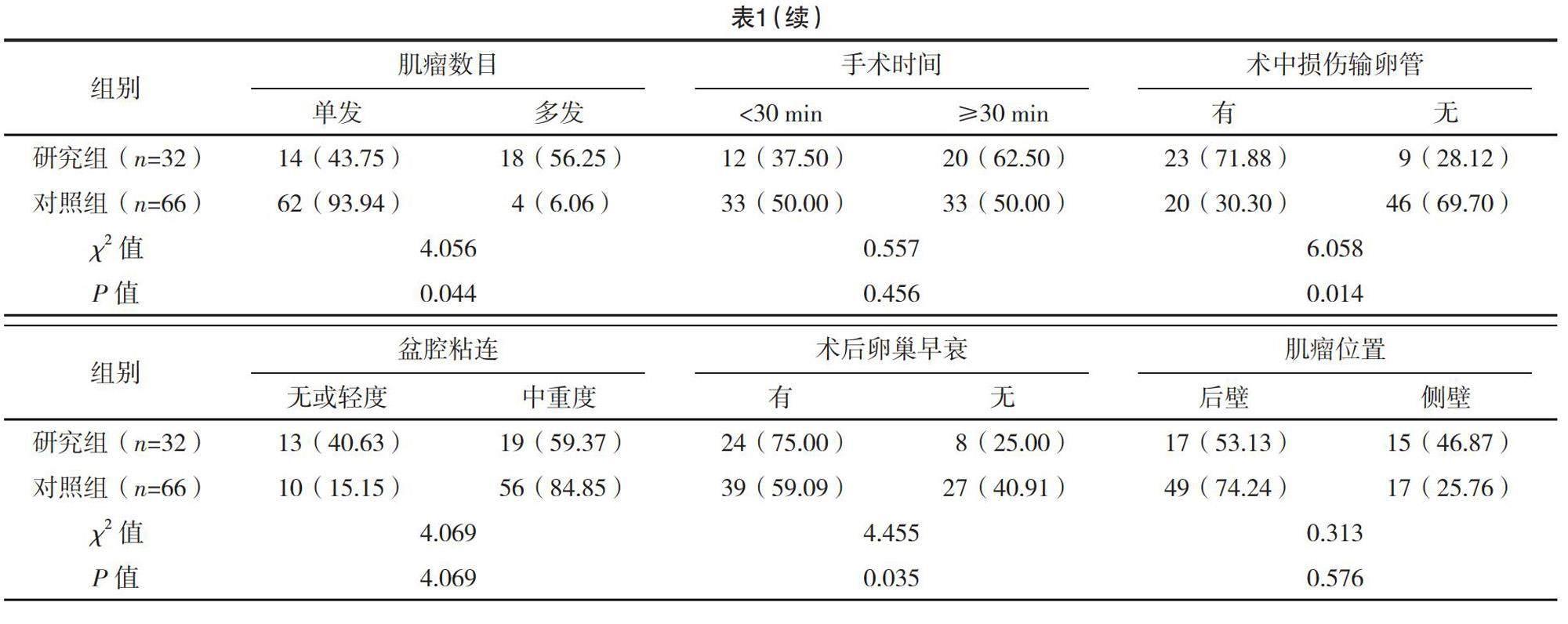
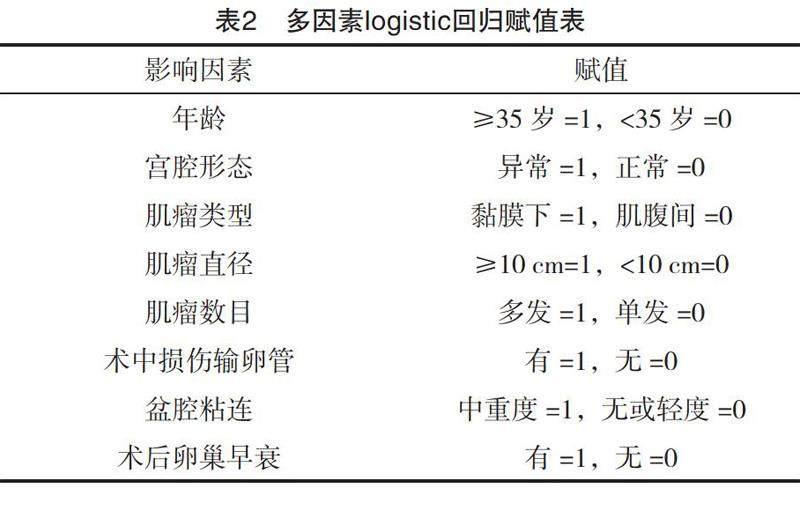
【摘要】 目的:探討腹腔镜下子宫肌瘤切除术后不孕的风险因素。方法:回顾性分析2021年1月—2023年3月在菏泽医学专科学校附属医院接受腹腔镜下子宫肌瘤切除的98例患者的临床资料,根据术后是否妊娠,将患者分为对照组(66例,妊娠)和研究组(32例,未妊娠)。对两组患者的临床资料进行单因素分析,并将有统计学意义的变量纳入多因素回归分析。结果:两组在肝功能状况、BMI、吸烟史、糖尿病史、手术时间、肌瘤位置方面差异无统计学意义(P>0.05);在年龄、宫腔形态、肌瘤类型、肌瘤直径、肌瘤数目、术中损伤输卵管、盆腔粘连和术后卵巢早衰方面差异均有统计学意义(P<0.05)。多因素回归分析显示,年龄≥35岁,宫腔形态异常,肌瘤直径≥10 cm,术中损伤输卵管,盆腔中重度粘连和术后卵巢早衰是导致腹腔镜下子宫肌瘤切除术后不孕的独立风险因素(P<0.05)。结论:年龄过高、宫腔形态异常、肌瘤直径过大、术中损伤输卵管、盆腔中重度粘连和术后卵巢早衰是腹腔镜下子宫肌瘤切除术后不孕的风险因素。针对这些因素的有效预防和管理对于降低术后不孕风险至关重要。
【关键词】 腹腔镜 子宫肌瘤 子宫肌瘤切除术 不孕
Analysis of Risk Factors for Infertility after Laparoscopic Myomectomy/LIU Hengzhe, FAN Shengran, ZHAO Huijuan. //Medical Innovation of China, 2024, 21(07): -145
[Abstract] Objective: To explore the risk factors for infertility after laparoscopic myomectomy. Method: A retrospective analysis was conducted on the clinical data of 98 patients who underwent laparoscopic myomectomy at the Affiliated Hospital of Heze Medical College from January 2021 to March 2023. Based on postoperative pregnancy status, patients were divided into a control group (66 cases, who became pregnant) and a study group (32 cases, who did not become pregnant). A univariate analysis was performed on the clinical data of both groups, and variables with statistical significance were included in a multivariate regression analysis. Result: There were no statistically significant differences between the two groups in liver function status, BMI, smoking history, diabetes history, operation time, and fibroid location (P>0.05); there were statistically significant differences in age, uterine morphology, fibroid type, fibroid diameter, the number of fibroids, intraoperative damage to the fallopian tubes, pelvic adhesion, and postoperative ovarian failure (P<0.05). Multivariate regression analysis showed that age ≥35 years, abnormal uterine morphology, fibroid diameter ≥10 cm, intraoperative damage to the fallopian tubes, moderate to severe pelvic adhesion, and postoperative ovarian failure were independent risk factors for infertility after laparoscopic myomectomy (P<0.05). Conclusion: Higher age, abnormal uterine morphology, larger fibroid diameter, intraoperative damage to the fallopian tubes, moderate to severe pelvic adhesion, and postoperative ovarian failure are risk factors for infertility following laparoscopic myomectomy. Effective prevention and management of these factors are crucial for reducing the risk of postoperative infertility.
[Key words] Laparoscopy Surgery Uterine fibroids Infertility
First-author's address: Heze Medical College, Heze 274000, China
doi:10.3969/j.issn.1674-4985.2024.07.032
子宫肌瘤是妇科常见的良性肿瘤之一,通常发生在育龄妇女中[1]。这些肿瘤从子宫平滑肌细胞发展而来,可以是单发或多发,大小也各异。临床表现包括但不限于月经异常、腹部疼痛和压迫感,严重者甚至会引发不孕[2]。在众多治疗方式中,腹腔镜下子宫肌瘤切除术以其创伤小、恢复快的优点而广泛应用。然而,术后不孕的问题始终是医学研究关注的焦点[3]。关于腹腔镜手术后不孕风险的研究仍存在争议。既往研究集中于手术的安全性和有效性,但对于术后不孕的风险因素关注不足[4]。因此,本文深入探讨腹腔镜下子宫肌瘤切除术后导致不孕的风险因素,不仅对比了妊娠组和未妊娠组的基本情况,而且通过单因素和多因素回归分析,揭示了年龄、宫腔形态、肌瘤直径等因素与术后不孕的独立关联。这些……
登录APP查看全文
猜你喜欢
腹腔镜外科杂志(2022年7期)2022-08-16 04:31:06
中国内镜杂志(2017年2期)2017-03-20 16:18:12
中国实用医药(2016年30期)2016-12-28 23:06:30
中外医学研究(2016年26期)2016-11-30 03:01:38
知音海外版(上半月)(2016年10期)2016-11-12 17:55:27
中国实用医药(2016年21期)2016-08-19 12:58:24
腹腔镜外科杂志(2016年11期)2016-06-01 12:10:09
腹腔镜外科杂志(2016年9期)2016-06-01 12:10:07
伴侣(2016年4期)2016-05-27 11:47:50
中国实用医药(2016年8期)2016-03-30 00:47:54