
40例脑卒中患者尿失禁的护理干预
2015-08-06 20:37:43华珍娣等
中国当代医药
2015年18期
关键词:脑卒中
华珍娣等
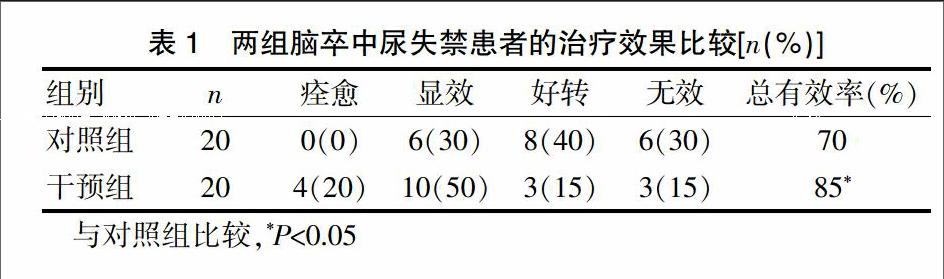
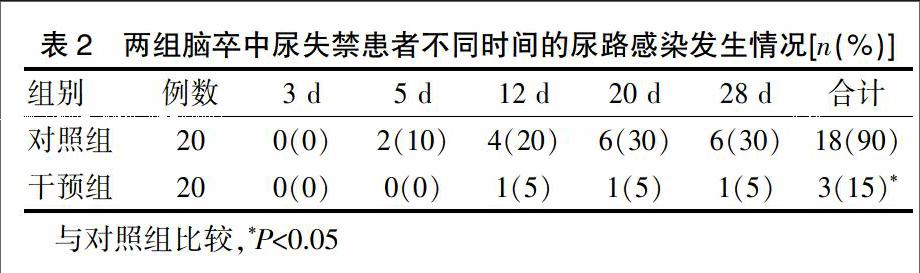
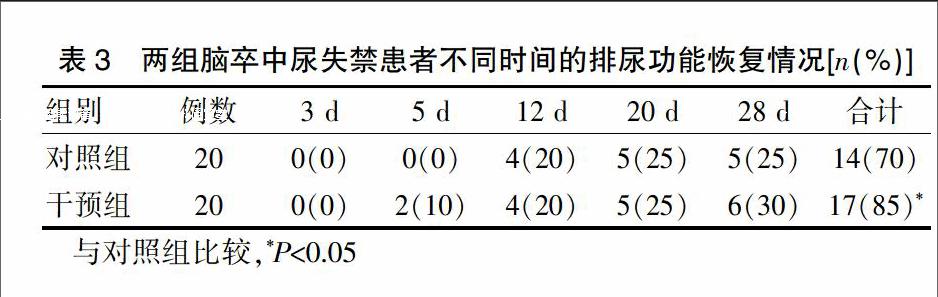
[摘要] 目的 探讨脑卒中康复患者尿失禁的护理干预进展,提高护理水平。 方法 回顾性分析本院40例脑卒中尿失禁患者,将其随机分为对照组(20例)和干预组(20例),对照组给予心理护理、皮肤护理,干预组在对照组的基础上增加认知教育、一般护理、饮食干预和辅助护理,两组均给予相同的对症治疗,定期观察患者病情,比较患者病情缓解的有效率、尿路感染的发生率及排尿情况的改善,总结护理体会。 结果 干预组20例脑卒中尿失禁患者经系统的护理干预后痊愈4例(20%),显效10例(50%),好转3例(15%),无效3例(15%);发生尿路感染3例(15%);不同时间排尿恢复的情况分别为3 d 0例(0%),5 d 2例(10%),12 d 4例(20%),20 d 5例(25%),28 d 6例(30%)。对照组20例患者痊愈0例(0%),显效6例(30%),好转8例(40%),无效6例(30%);发生尿路感染18例(90%);不同时间排尿恢复的情况分别为3 d 0例(0%),5 d 0例(0%),12 d 4例(20%),20 d 5例(25%),28 d 5例(25%)。干预组患者的病情改善明显优于对照组且尿路感染的发生率更低。 结论 对脑卒中尿失禁患者通过有针对性的、全面科学有效的护理干预,有助于患者自控排尿能力的恢复,并且减少尿路感染及有关并发症的发生。同时可使尿失禁的症状得到痊愈或缓解,从而减轻患者的痛苦,降低患者的心理压力,增加患者对待生活的信心,有效提高了生活自理能力,促进患者最大限度地回归到家庭,回归社会生活,提高其生活质量。
[关键词] 脑卒中;尿失禁;护理干预
[中图分类号] R473.74 [文献标识码] A [文章编号] 1674-4721(2015)06(c)-0194-04
[Abstract] Objective To explore urinary incontinence of nursing intervention on patients with cerebral stroke rehabilitation,raise the level of care for incontinence systematic nursing intervention. Methods 40 cases of brain stroke patients with the urine incontinence were retrospectively analyzed,and were randomly divided into control group and intervention group,control group was given psychological nursing and skin nursing,intervention group was given the cognitive education,general nursing,diet intervention and auxiliary nursing on the basis of the control group,two group were given same of symptomatic treatment, and illness of patients was regularly observed, efficiency rate of illness,occurred rate of urinary tract infection and the urination situation of improved were compared,nursing experience was summaried. Results After system nursing intervention, among 20 cases of brain stroke patients with the urine incontinence in intervention group,there were 4 cases (20%) of recovered,10 cases (50%) were excellent,3 cases (15%) were improved,3 cases (15%) were invalid; 3 cases (15%) occurred urinary tract infection; different time urination recovery of situation was respectively that, 0 case was 3 d (0%),2 cases (10%) were 5 d,4 cases (20%) were 12 d,5 cases (25%) were 20 d,6 cases (30%) were 28 d. Among 20 cases of brain stroke patients with the urine incontinence in control group,there were 0 case (0%) of recovered,6 cases (30%) were excellent,8 cases (40%) were improved,6 cases (30%) were invalid; 18 cases (90%) occurred urinary tract infection; different time urination recovery of situation was respectively that, 0 case was 3 d (0%),0 case (0%) were 5 d,4 cases (20%) were 12 d,5 cases (25%) were 20 d,5 cases (25%) were 28 d.The improved situation for patients in intervention group was superior to the control group,and the incidence of urinary tract infection was lower. Conclusion The incontinence in patients with cerebral apoplexy through targeted,comprehensive scientific and effective nursing intervention,can contribute to the recovery of the patient′s ability to control urination,and reduce urinary tract infection and related complications,at the same time making the incontinence heal or symptom relief,thereby reducing the patient′s pain,reducing the psychological pressure of patients,increasing the patient′s confidence towards life,effectively improving the ability of independent living,promoting the patient to maximize return to family life,returning to society,to improve their quality of life.
[Key words] Cerebral apoplexy;Urinary incontinence;Nursing intervention
据统计显示,脑卒中的发病率正在逐年上升,由于其病情凶险,致残率、病死率较高且无特异性治疗手段,因此给人类的健康和患者的生活带来了极大的影响。……
登录APP查看全文
猜你喜欢
中国实用医药(2016年27期)2016-11-30 11:36:50
中国医药导报(2016年25期)2016-11-30 07:48:35
中外医学研究(2016年24期)2016-11-30 02:30:04
今日健康(2016年12期)2016-11-17 13:04:21
中国实用医药(2016年24期)2016-10-17 06:05:29
中国实用医药(2016年24期)2016-10-17 05:56:32
中国实用医药(2016年24期)2016-10-17 05:47:48
中国实用医药(2016年24期)2016-10-17 05:30:14
养生保健指南(2016年4期)2016-03-22 11:53:54
