Resultsof cryoenergy andradiofrequency-based catheterablation for treating ventricular arrhythmias arising from the papillary muscles of the left ventricle, guided by intracardiac echocardiography and image integration
2016-12-21 07:08:30童鸿
心电与循环
2016年3期
Resultsof cryoenergy andradiofrequency-based catheterablation for treating ventricular arrhythmias arising from the papillary muscles of the left ventricle, guided by intracardiac echocardiography and image integration
The papillary muscles(PMs)from the left ventricle (LV)have been shown to be a potential site of origin of ventricular arrhythmias(VAs)in patients with and without structural heart disease.Catheter ablation has been described as an effective treatment for these arrhythmias,although radiofrequency delivery at these regions has been associated with poor manipulation and catheter stability compared with other VAs.This study compares procedural outcomes and recurrence rate after catheter cryoablation or radiofrequency ablation for the treatment of ventricular tachycardia(VT)and premature ventricular complexes(PVCs)localized at the PMs of the LV,with the aid of intracardiac echocardiography(ICE) and image integration.
A total of 21 patients with recurrent VAs originating at the PMs of the LV were identified from retrospective review of 189 consecutive patients with symptomatic sustained VT,nonsustained VT,or PVC referred for catheter ablation.The sites of origin of idiopathic VAs included the posteromedial PM(PMPM) in 19(10%),and anterolateral PM(ALPM)in 3(1.5%).
One operator treated the first 12 patients with cryoenergy,and a different operator treated the following 9 patients,using radiofrequency energy.Procedural outcomes suchas catheterstability,incidence of multiple VAs morphologies during energy delivery, acute success rate,and long-term recurrence rate were comparedbetweenthosepatientstreatedwith cryoenergy and those with radiofrequency.For mapping and pacing,standard multielectrode catheters were placed in the coronary sinus(CS),His bundle region, and RV apex through the right femoral vein.Arrhythmia inductionwasattemptedbyprogrammedelectric stimulation from the RV apex,RV outflow tract,and CS, with 1,2,and 3 extrastimuli introduced after an 8-beat drive train,if necessary,with the addition of an isoproterenol infusion.
Imaging
A 2-dimensional ICE probe was positioned toward the RV outflow tract and RV inflow tract to visualize the different LV structures,as shown in Figure 1.To specify VAs origin and catheter position,3 segments were attributed to each PM:the apex,at the point of insertion of the chords(distal third of the PM);the body(middle portion of the PM);and the base,at the LV wall insertion. Catheter position,contact,and stability were assessed through this method.Catheter stability was defined asthe absence of back and forth movement of the catheter during energy delivery at the effective lesion site.
Multidetector computed tomography(MDCT)was performed with a 64-detector<15 days before catheter ablation.No ionic contrast material was used and scanningwasperformedwithacollimatedslice thickness of 0.9 mm.
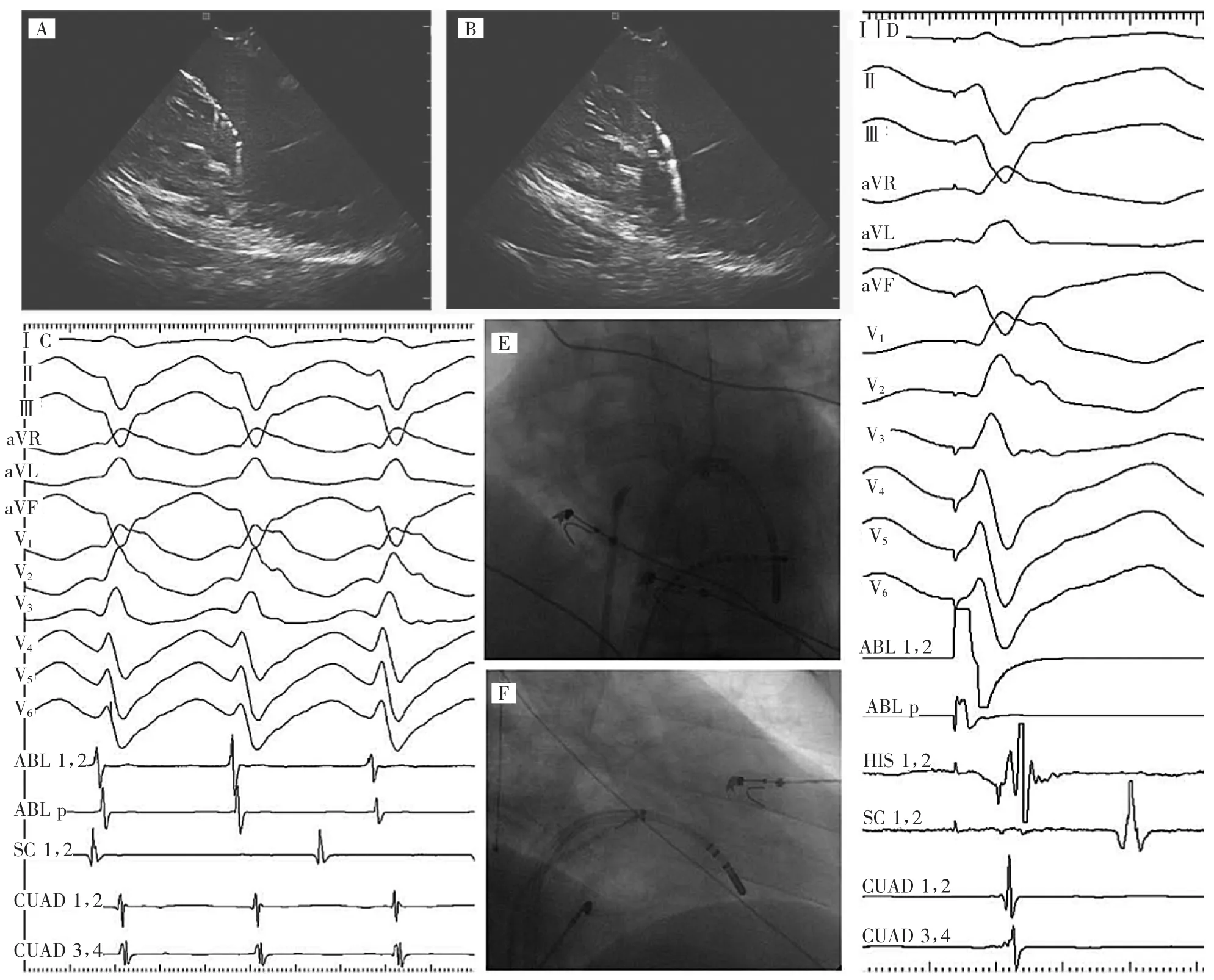
Figure 1A,Intracardiac echocardiography(ICE)image of the posteromedial papillary muscle(PMPM).A multipolar catheter is placed over the PMPM,for mapping the clinical arrhythmia.B,ICE image showing the Freezor Max 8 mm cryoablation catheter delivering cryoenergy at the base of the PMPM.C,Clinical ventricular tachycardia.D,Pace-mapping score of 24 at the site of effective lesion.E,Left anterior oblique and(F)right anterior oblique fluoroscopic projection of the cryocatheter at the effective lesion site.
Cryoablation
Cryoenergy was delivered at myocardial sites exhibiting the earliest bipolar activity or local unipolar QS pattern or at a Purkinje network with an early activity preceding the QRS onset for≥25 ms during the VA(Figure 2)at pace-mapping areas exhibiting QRS match of≥11 of 12.Focal ablation was performed with a 9-Fr/8-mm cryoablation catheter through a transeptal and transmitral approach.Transeptal access was obtained by performing a transeptal puncture with a Brockenbrough needle.Special attention was given to catheter manipulation inside the LV to avoid damage to the chords because the cryocatheter is stiffer than the radiofrequency catheter.This was continuously assessed by ICE.When a reduction in the incidence of VT or PVCs was observed,cryoenergy was delivered for≤240s with 2 freeze-thaw-freeze1cycles; otherwise,cryoenergy delivery was terminated,and the catheter was repositioned.

Figure 2Cryoablation.A,Activation map of the clinical arrhythmia at the body of the anterolateral papillary muscle(ALPM),in the 3-dimensional integrated left ventricle(LV)multidetector computed tomography model.The cryocatheter is positioned at the earliest activation site.B,Intracardiac echocardiography(ICE)visualization of the cryocatheter at the body of the ALPM.C,Melt-down effect during cryoenergy delivery at the ALPM. This corresponds to an artifact generated by the cryoenergy over the mapping system.The movement of the catheter is only apparent and continuous assessment of catheter position and stability during energy delivery is achieved by ICE.D,Clinical premature ventricular complex mapped at the body of the ALPM.The VEGM-QRS interval was measured to 35 ms.E,Pace mapping at the site of earliest activation,accounting for a score of 24.
Radiofrequency Ablation
Radiofrequency energy was delivered using the same criteria previously described.Focal ablation was performed with a 4-mm open irrigated radiofrequency ablation catheter through a transmitral or transaortic approach.When a reduction in the incidence of VT or PVCs was observed radiofrequency was delivered for≤90 s,with 2 posterior 45-s consolidation lesions at the same area;otherwise,radiofrequency delivery was terminated,and the catheter was repositioned.
The end point of catheter ablation was the eliminationandnoninducibilityofVAsduring isoproterenol infusion(2-10 μg/min)and burst pacing from the RV to a cycle length as short as 300 ms. Procedural acute success was defined as abolition of inducible or spontaneous VA.
Procedural Outcomes
Termination of the arrhythmia was observed in 19 patients without further inducibility.There were no intraoperativecomplications.Patientstreatedwith cryoenergy(n=12)showed a 100%acute success rate, whereasthosetreatedwithradiofrequency(n=9) presented a 78%success rate.Catheter stability was achieved in all patients treated with cryoenergy and only in 2 patients treated with radiofrequency.Incidence of multiple VA morphologies was observed in 7 patients treated with radiofrequency(77.7%),whereas none was observed in those treated with cryoenergy.All patients included in this study had single VA morphology before catheter ablation.
In the cryoablation group,VAs originating from the base of the PM were observed in 6 patients,the apex in3 patients,and the body in 3 patients.In the radiofrequency group,VAs originating from the base of the PM were observed in 6 patients,and 3 patients showed VAs from the body.Pace mapping showed≥11 of 12 match in all treated PMs at the site of effective lesion.Purkinje potentials(PP)were observed in 13 (62%)patients,mainly in VAs with origin at the base of the PM(base 100%versus body 16 versus apex 0%).
Follow-Up Outcomes
Median follow-up was 360 days(interquartile range,116-365)forcryoablationand87days (interquartile range,65-148)for radiofrequency.There was no increase in the incidence of mitral valve regurgitation,or an increase of MR severity after ablation,using either method.None of the patient treated with cryoablation showed VA recurrence during follow-up(recurrence rate of 0%).One patient from the cryoablation group showed a 50%VA Holter burden reduction,from 40%to 19%,during the first month. After 6 months,Holter burden was<5%and the patient remained asymptomatic,without the use of antiarrhythmic drugs.Four patients(44%)presented VA recurrence during follow-up in the radiofrequency group(P=0.03).VA Holter burden was decreased from 20±15%to 2.8±5%in the cryoablation group and from 21±12%to 11±8%in the radiofrequency group.
Discussion
Catheter irrigation is often used to cool the ablation electrode such that more power can be delivered without being limited by the formation of thrombus at the catheter-tissue interface.Amajorconcernduring radiofrequency ablation is mitral valve dysfunction by injury or rupture of the PMs,specially when using irrigated tip ablation catheters,although this has not yet been reported.Excessive intramyocardial heating can produce steam formation and abrupt volume expansion, which may be audible as steam pops.Pops are capable ofcausingdeeptissuetears,andpatientswith ventricular perforations are more likely to require surgical repair.
Catheter cryoablation was introduced into clinical electrophysiologyin1998.Cryoablationhasbeen reported as a safe alternative for catheter ablation in idiopathic VT arising from the RV outflow tract,aortic cusps,and epicardium.Cryothermal safety profile is attributed to the mechanism of tissue destruction. Histology of chronic lesions shows well-demarcated2lesions with minimal tissue disruption and preserved underlying architecture.Catheter stabilization during ablation at the PMs is a major consideration.Stabilization is achieved because of catheter-tissue adherence after reaching temperatures of-80℃.
词汇
integration n.整合,融合,集成
cryoablation n.冷冻消融
cryoenergy n.冷冻能量
probe n.&v.探测器,探针,探头;探索
specify v.具体指定,详细说明,列举
collimate v.使...平行,校准
thaw v,&n,融化,使...融化,变暖和;融化,缓和
consolidation n.巩固,合并,联合
pop adj.&v.&n.&adv.通俗的,流行的;敲击,取出;流行音乐,汽水,砰然声,枪击;突然地,砰地
cryothermal adj.冰冻的,冷冻的,冰温的
disruption n.破裂,混乱
architecture n.建筑学,建筑风格,架构
注释
1.freeze-thaw-freeze指“冷冻-融化-冷冻”过程,冷冻导管消融过程中常采用此方法,可扩大消融的创面,如Data in hepatocellular ablation show that repetitive freezethaw cycles create larger lesions than those obtainedby longer freezing at a certain temperature.肝细胞消融资料显示,在特定的温度下,重复冷冻-融化周期与较长时间的冷冻比较,能产生较大的病损。
2.well-demarcated指“界限明晰的”,如Histological analysisagainrevealedhomogeneouslesionswithwelldemarcated borders.组织学分析再次揭示有着界限明晰边缘的均质病损。
参考译文
第71课腔内心脏超声和图形整合指导下的左心室乳头肌起源室性心律失常的冷冻和射频消融
业已显示左心室乳头肌是伴或不伴心脏结构异常患者心律失常的潜在起源部位。与其他部位室性心律失常比较,这些区域的心律失常消融操作困难、导管稳定性差,但已有导管消融有效的报道。本研究借助心腔内心脏超声和图像整合,比较左心室乳头肌起源室性心动过速或期前搏动的冷冻和射频消融手术结果及复发率。
回顾性分析连续189例因症状性持续性室性心动过速、阵发性室性心动过速或室性期前搏动接受射频导管消融的患者,确定21例为左心室乳头肌起源的反复发作室性心律失常。这一特发性室性心律失常的起源部位包括后内侧乳头肌(19例)和前外侧乳头肌(3例)。
一位术者对最初12例患者行冷冻消融术,另一位术者对随后的9例患者行射频消融术。……
登录APP查看全文