不同电生理监测方法在功能性选择性脊神经后根切断术中的比较
2017-05-10 19:28:04尹靖宇张宗红徐涛黄林王健
上海医药
2017年7期
尹靖宇+张宗红+徐涛+黄林+王健

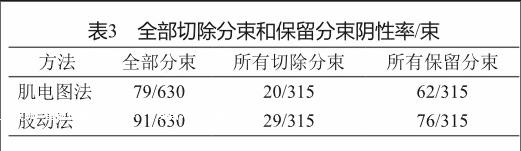
摘 要 目的:比较肌电图法和肢动法两种监测观察方法在功能性选择性脊神经后根切断术(FSPR)中电生理监测中的区别。方法:选择在我院行FSPR的平均年龄7.4岁的46例患者,使用尼高力endeavor电生理监测仪对术中选择的脊神经后根分束进行电刺激,分别记录出现动作电位的阈值和下肢活动的阈值,通过统计学分析比较两种方法的区别,比较两种监测方式的阴性率,记录监测中出现肛门括约肌动作电位的情况。结果:两种监测方法记录的阈值通过比较差异有统计学意义(P<0.05),肌电图法的阴性率较肢動法低,且肌电图监测可发现支配肛门括约肌的神经分束。结论:肌电图法较肢动法更加敏感,阴性率更低,并有效避免手术副损伤。
关键词 电生理监测 功能性选择性脊神经后根切断术 肌电图 肢动
中图分类号:R744.8 文献标识码:B 文章编号:1006-1533(2017)07-0036-03
Comparison of different electrophysiological monitoring methods in functional selective posterior rhizotomy
YIN Jingyu1*, ZHANG Zonghong2, XU Tao1, HUANG Lin1, WANG Jian1(1. Department of Cerebral Palsy and Spinal Surgery, Guangdong 999 Brain Hospital, Guangdong 510510, China; 2. Rehabilitation Hospital, the Social Welfare Institute of Guangzhou City, Guangdong 510520, China)
ABSTRACT Objective: To compare the differences of electromyography and observation of limb movement in the electrophysiological monitoring in functional selective posterior rhizotomy (FSPR). Methods: Forty-six patients with average age of 7.4 years underwent FSPR in our hospital were selected, to whom electrical stimulation was performed in the posterior root of the spinal nerve during the operation with Nicolet endeavor electrophysiological monitor and threshold of action potential and threshold of lower limb activity were recorded and compared by statistical analysis. The negative rates of the two kinds of monitoring methods were compared. The action potential of anal sphincter occurred in the monitoring was also recorded. Results: The differences of the thresholds recorded by the two monitoring methods were statistically significant (P<0.05). The negative rate of electromyography was lower than that of limb movement. The anal sphincter nerve can be found by the electromyography monitoring. Conclusion: Electromyography was more sensitive than the limb movement, its negative rate was much lower and can be used to effectively avoid the surgical accidental injury.
KEY WORDS electrophysiological monitoring; selective posterior rhizotomy; electromyography; limb movement
上运动神经元损伤常引起痉挛性瘫痪,严重的痉挛状态对运动功能造成极大的影响,并且对康复训练造成阻碍。常见引起痉挛性瘫痪的疾病包括痉挛型脑性瘫痪、外伤后遗症、脑炎后遗症、卒中后遗症等,功能性选择性脊神经后根切断术(functional selective posterior rhizotomy,FSPR)是大家所公认的解除痉挛的有效术式。目前各单位开展的FSPR主要有肌电图法和肢动法2种术中电生理监测方式。我们在2014年3月至2015年12月期间对住院进行FSPR手术的46例患者同时采用肌电图描记法和电刺激肢动法来进行术中电生理监测,并进行比较。
1 对象与方法
1.1 基本资料
46例患者中男37例,女9例,平均年龄7.4±2.4岁,其中痉挛型脑性瘫痪45例,病毒性脑炎后遗症1例。纳入标准:①均表现为不同程度的下肢痉挛,下肢肌张力按改良Ashworth分级法均≥3级;……
登录APP查看全文