高压氧联合头部亚低温对32例新生儿缺血缺氧性脑病神经行为测定的影响
2017-05-10 19:29:39周定富陈蓉邹莉严文康张坤尧
上海医药
2017年7期
周定富+陈蓉+邹莉+严文康+张坤尧
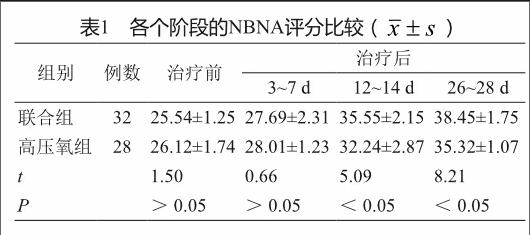
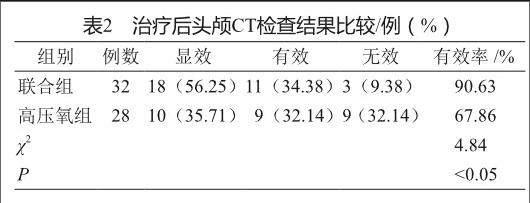
摘 要 目的:探討高压氧联合头部亚低温对新生儿缺血缺氧性脑病(HIE)神经行为测定(NBNA)的影响。方法:回顾性分析60例确诊为缺血缺氧性脑病的新生儿,根据治疗方案的不同分为高压氧组(n=28)和联合组(n=32),根据实际情况给予常规治疗以及高压氧治疗,联合组在此基础上给予头部亚低温治疗。对患儿治疗前、治疗后3~7 d、12~14 d、26~28 d进行新生儿神经行为测定,并在治疗前及治疗后28 d进行脑部CT检查评估患儿脑部神经发育情况。比较各个阶段两组患儿的NBNA测定评分结果,以及28 d后患儿脑部神经系统评估结果。结果:两组患儿在治疗前和治疗后3~7 d的NBNA测定结果差异无统计学意义(P>0.05),但联合组患儿在12~14 d、26~28 d的NBNA测定结果明显高于高压氧组(P<0.05);联合组的CT检查评估结果优于高压氧组(P<0.05)。结论:高压氧治疗联合头部亚低温可有效改善缺血缺氧性脑病患儿的神经功能。
关键词 高压氧 亚低温 缺血缺氧性脑病 神经行为测定
中图分类号:R722.12 文献标识码:B 文章编号:1006-1533(2017)07-0039-03
Effects of hyperbaric oxygen combined with head mild hypothermia on neonatal behavioral neurological assessment of 32 neonates with hypoxic ischemic encephalopathy*
ZHOU Dingfu**, CHEN Rong, ZOU Li, YAN Wenkang, ZHANG Kunyao(Department of Pediatrics, Huizhou Municipal Central Hospital, Guangdong Huizhou 516001, China)
ABSTRACT Objective: To study the effect of hyperbaric oxygen combined with head mild hypothermia on neonatal behavioral neurological assessment (NBNA) of neonates with hypoxic-ischemic encephalopathy (HIE). Methods: The data from 60 cases of neonates with HIE were retrospectively analyzed, and they were divided into a control group (n=28) and an observation group (n=32) according to different treatment options. All the neonates were given conventional treatment and hyperbaric oxygen treatment according to their actual situation, and the observation group was additionally given the head mild hypothermia treatment. NBNA was conducted before treatment and at 3~7 days, 12~14 days and 26~28 days after treatment, respectively, and brain CT examination was also conducted to assess brain development before treatment and 28 days after. The NBNA scores at separate times were compared between the two groups, and the neurological outcome was evaluated after 28 days. Results: There were no significant differences in NBNA between the two groups before and after treatment (P>0.05), but the results of NBNA test were significantly higher in the observation group than in the control group at 12~14 days and 26~28 days after treatment (P<0.05). The results of CT examination were much better in the observation group than in the control group(P<0.05). Conclusion: Hyperbaric oxygen combined with head mild hypothermia therapy can effectively improve neurological function in children with hypoxic ischemic encephalopathy.
KEY WORDS hyperbaric oxygen; hypothermia; hypoxic-ischemic encephalopathy; neonatal behavioral neurological assessment
新生儿缺血缺氧性脑病(hypoxie-ischemic encephalopathy, HIE)是指围产期新生儿窒息导致的缺血缺氧性脑损伤,易引起新生儿死亡或导致严重后遗症,如语言障碍、癫痫、脑性瘫痪、听力障碍等终生残疾,是新生儿科常见的危重症[1]。目前尚无针对该病的特效治疗,临床上一般采取高压氧、亚低温等对症治疗方法,但临床效果尚需进一步研究证实[2]。高压氧是指在较大气压的环境下吸入纯氧,增大机体组织中氧的溶解度,改善缺血脑细胞的供氧弥散作用和距离,挽救新生儿脑内濒死的神经细胞。头部亚低温是指使用人工方法使患儿脑部温度下降2~5 ℃,从而减轻缺血缺氧时的大脑损害[3]。神……
登录APP查看全文