运动干预对女性骨质疏松性股骨颈骨折患者关节功能、心理弹性及日常生活能力的影响
2017-06-21 22:48:46姚李春董峻峰朱慧锋郑咪
中国现代医生
2017年14期
姚李春 董峻峰 朱慧锋 郑咪
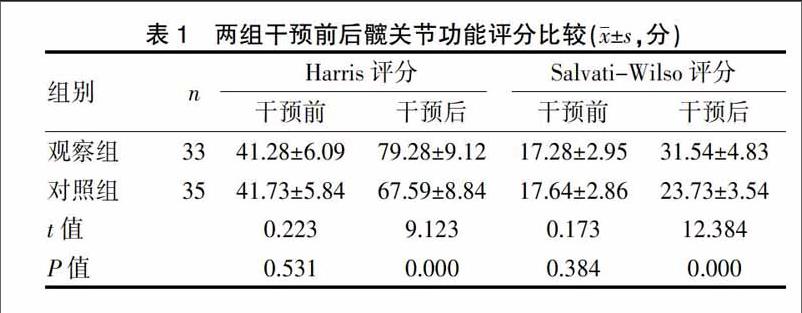


[摘要] 目的 探讨运动干预对女性骨质疏松性股骨颈骨折患者关节功能、心理弹性及日常生活能力的影响。 方法 收集2014年5月~2016年4月间在本院接受治疗的骨质疏松性股骨颈骨折女性68例,回顾临床干预方法并將入组患者分为接受常规干预的对照组35例、接受运动干预的观察组33例,干预从患者下床活动时开始、持续至出院当日。干预前后,采用Harris评分、Salvati-Wilso评分评估两组患者的髋关节功能;采用心理弹性评分(CD-RISC)评估两组患者的心理弹性情况;采用日常生活能力评分(ADL)评估两组患者的日常生活能力。 结果 干预前,两组患者的髋关节功能、心理弹性、日常生活能力差异无统计学意义(P>0.05)。干预后,观察组的Harris评分、Salvati-Wilso评分值高于对照组,CD-RISC评分中坚韧、力量、乐观评分值高于对照组,ADL评分值大于对照组(P<0.05)。 结论 运动干预可提升女性骨质疏松性股骨颈骨折患者的髋关节功能,优化心理弹性并增强日常生活能力。
[关键词] 骨质疏松性股骨颈骨折;运动干预;关节功能;心理弹性;日常生活能力
[中图分类号] R683.4 [文献标识码] B [文章编号] 1673-9701(2017)14-0089-04
[Abstract] Objective To investigate the effects of exercise intervention on joint function, psychological elasticity and daily living ability in the female patients with osteoporotic femoral neck fractures. Methods 68 female patients with osteoporotic femoral neck fractures who were treated in our hospital from May 2014 to April 2016 were collected. The clinical intervention method was reviewed and 35 patients were assigned into the control group who were given conventional intervention, and 33 patients were assigned into the observation group who were given exercise intervention. The intervention was from the time when the patients took off-bed activity until the day of discharge. Before and after the intervention, Harris score and Salvati-Wilso score were used to evaluate the hip function of the two groups; the CD-RISC score was used to evaluate the psychological elasticity of the two groups; the ability of daily living of the two groups was evaluated by the score of daily living ability(ADL). Results Before the intervention, there was no statistically significant differences in hip joint function, psychological elasticity and daily living ability between the two groups(P>0.05). After the intervention, the Harris score and Salvati-Wilso score in the observation group were higher than those in the control group. In CD-RISC score,the scores of toughness, strength, and optimism were higher than those in the control group, and the ADL score was higher than that in the control group(P<0.05). Conclusion Exercise intervention can improve the hip joint function in the female patients with osteoporotic femoral neck fractures, optimize the psychological elasticity and enhance the daily living ability.
[Key words] Osteoporotic femoral neck fractures; Exercise intervention; Joint function; Psychological elasticity; Ability of daily living
老年女性绝经后雌激素水平降低、骨钙代谢障碍,骨质疏松发生率迅速上升,同时骨质疏松性骨折发生率也倍增[1]。股骨颈骨折是临床最为常见的骨质疏松性骨折类型,多于外力作用后出现,患者具体表现为剧烈疼痛、患肢活动障碍等,需早期采取积极的干预手段,避免患者生活质量下降。骨质疏松性骨折的出现与中老年女性运动锻炼不足密切相关,经系统手术治疗后,早期恢复适当强度的运动有助于肢体功能康复。由于女性心理韧性不足、对疼痛的恐惧等因素,大部分女性患者股骨颈骨折后运动锻炼不足,这也成为此类患者远期康复质量存在缺陷的重要因素之一。传……
登录APP查看全文
猜你喜欢
中国民族民间医药·下半月(2017年1期)2017-03-07 23:19:15
中国医药科学(2016年13期)2017-02-06 17:28:11
哈尔滨体育学院学报(2016年3期)2017-01-03 03:56:26
中外医学研究(2016年28期)2016-11-28 11:46:34
体育时空(2016年8期)2016-10-25 20:39:04
中国医药科学(2016年4期)2016-10-08 21:29:47
教师·中(2016年6期)2016-08-23 21:02:16
中国实用医药(2016年17期)2016-07-26 01:07:23
中国民族民间医药·下半月(2016年5期)2016-06-27 12:02:00
山东体育学院学报(2015年5期)2015-12-31 20:34:43