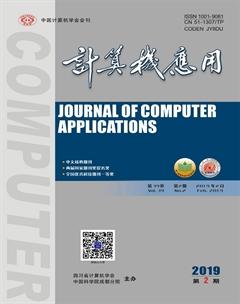
基于深层长短期记忆网络与批规范化的间歇过程故障检测方法
2019-08-01 03:15:58王硕王培良
计算机应用
2019年2期
关键词:深度学习
王硕 王培良


摘 要:传统的基于数据驱动的间歇过程故障诊断方法往往需要对过程数据的分布进行假设,而且对非线性等复杂数据的监控往往会出现误报和漏报,为此提出一种基于长短期记忆网络(LSTM)与批规范化(BN)结合的监督学习方法,不需要对原始数据的分布进行假设。首先,对间歇过程原始数据运用一种按变量展开并连续采样的预处理方式,使处理后的数据可以向LSTM单元输入;然后,利用改进的深层LSTM网络进行特征学习,该网络通过添加BN层,结合交叉熵损失的表示方法,可以有效提取间歇过程数据的特征并进行快速学习;最后,在一类半导体蚀刻过程上进行仿真实验。实验结果表明,所提方法比多元线性主成分分析(MPCA)方法故障识别的种类更多,可以有效地识别各类故障,对故障的整体检测率达到95%以上;比传统单层LSTM模型建模速度更快,且对故障的整体检测率提高了8个百分点以上,比较适合处理间歇过程中具有非线性、多工况等特征的故障检测问题。
关键词:数据驱动;深度学习;长短期记忆网络;间歇过程;故障检测
中图分类号: TP277
文献标志码:A
Abstract: Traditional fault detection methods for batch process based on data-driven often need to make assumptions about the distribution of process data, and often lead to false positives and false negatives when dealing with non-linear data and other complex data. To solve this problem, a supervised learning algorithm based on Long Short-Term Memory (LSTM) network and Batch Normalization (BN) was proposed, which does not need to make assumptions about the distribution of original data. Firstly, a preprocessing method based on variable-wise unfolding and continuous sampling was applied to the batch process raw data, so that the processed data could be input to the LSTM unit. Then, the improved deep LSTM network was used for feature learning. By adding the BN layer and the representation method of cross entropy loss, the network was able to effectively extract the characteristics of the batch process data and learned quickly. Finally, a simulation experiment was performed on a semiconductor etching process. The experimental results show that compared with Multilinear Principal Component Analysis (MPCA) method, the proposed method can identify more faults types, which can effectively identify various faults, and the overall detection rate of faults reaches more than 95%. Compared with the traditional single-LSTM model, it has higher recognition speed, and its overall detection rate of faults is increased by more than 8%, and it is suitable for dealing with fault detection problems with non-linear and multi-case characteristics in the batch process.
Key words: data driven; deep learning; Long Short-Term Memory (LSTM) network; batch process; fault detection
0 引言
隨着工业系统向大型化、复杂化方向发展,传统数据驱动的故障诊断方法无法适应新时期这种工业大数据特性的故障诊断需求,具体表现在过程数据量大、种类多,且价值密度低。虽然数据维数多,但对监测诊断任务来说不一定都是有用、有价值的[1]。间歇生产过程[2]是一类复杂工业过程,指生产过程在同一位置但在不同的时间分批进行,操作状态不稳定,过程参数随时间而变,由于不同的操作阶段具有不同的过程特性,使得监测变量会受到时间维度上的影响。……
登录APP查看全文
猜你喜欢
中国教育技术装备(2016年19期)2016-12-27 19:23:52
中国远程教育(2016年11期)2016-12-27 18:07:31
现代商贸工业(2016年25期)2016-12-26 09:58:02
江苏教育·中学教学版(2016年11期)2016-12-21 11:45:08
江苏教育·中学教学版(2016年11期)2016-12-21 11:36:29
现代情报(2016年10期)2016-12-15 11:50:53
考试周刊(2016年94期)2016-12-12 12:15:04
新教育时代·教师版(2016年23期)2016-12-06 06:02:38
法制与社会(2016年32期)2016-12-01 15:25:53
软件导刊(2016年9期)2016-11-07 22:20:49