南昌市东湖区居民营养综合干预后健康状况的效果评价
2019-08-13 03:41:38汤珣颜兴伟杨玉金付俊杰赵玉静李琦刘杰朱丽萍
中国医学创新
2019年8期
汤珣 颜兴伟 杨玉金 付俊杰 赵玉静 李琦 刘杰 朱丽萍
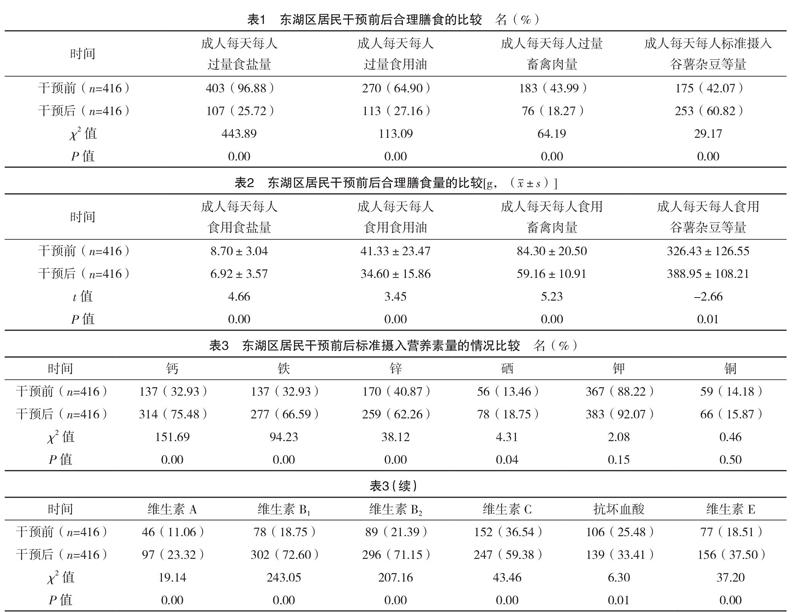
【摘要】 目的:探讨南昌市东湖区居民营养综合干预后健康状况的效果,为建立居民营养个体化干预措施提供依据。方法:采用多阶段分层整群抽样方法,以南昌市东湖区作为抽样范围,从东湖区整群抽样的1 134名居民中随机选取416名为问卷调查的研究对象,并对随机抽取的416名居民以自身对照,干预6个月后,对干预前后展开营养询问调查、医学体检、实验室检测、膳食调查。结果:与干预前比较,干预后居民膳食结构中的食盐、食用油和禽畜肉类不管是食用人数上还是食用量上都有所下降,而谷薯、雜豆类食物正常标准摄入量不管是食用人数上还是食用量上都有所增加,差异均有统计学意义(P<0.05)。综合干预后,营养素的标准摄入量人数与干预前比较均有明显的增加,差异均有统计学意义(P<0.05)。与干预前比较,东湖区居民综合干预后营养不良、超重和肥胖的人数均有所下降,差异均有统计学意义(P<0.05)。与干预前比较,综合干预后高血压、糖尿病的发病率从28.61%、39.42%分别下降至12.74%、26.44%,差异均有统计学意义(P<0.05);干预前后,血脂的改变情况比较,差异无统计学意义(P>0.05)。结论:综合干预能够树立起居民的营养观念和态度,并养成良好的营养行为,及时地了解疾病的相关性和危害性。
【关键词】 居民营养; 综合干预; 健康状况
【Abstract】 Objective:To explore the effect of health status after comprehensive nutrition intervention of residents in Donghu district of Nanchang,to provide evidence for make individualized interventions of resident nutrition.Method:The multi-stage stratified cluster sampling method was adopted,taking Donghu district of Nanchang city as the sampling range,and 416 subjects named questionnaire survey were randomly selected from 1 134 residents of Donghu district in the cluster sampling,and 416 randomly selected residents were compared with themselves,after 6 months of intervention,nutritional inquiry investigation,medical examination,laboratory testing and dietary investigation were conducted before and after the intervention.Result:Compared with before the intervention,the amount of salt,edible oil and poultry meat in the dietary structure of residents decreased after the intervention,both in terms of the number of people eating them and the amount of people eating them,however,the normal standard intake of sweet potato and miscellaneous beans increased in both number and amount,the differences were statistically significant(P<0.05).After the comprehensive intervention,the number of standard nutrient intake increased significantly compared with those before the intervention,with statistically significant differences(P<0.05).Compared with before the intervention,the number of malnourished,overweight and obese residents in Donghu district decreased after the comprehensive intervention,with statistically significant differences(P<0.05).Compared with before intervention,the incidence of hypertension and diabetes after comprehensive intervention decreased from 28.61% and 39.42% to 12.74% and 26.44%,with statistically significant differences(P<0.05);comparison of changes in blood lipid before and after intervention showed no statistical significance(P>0.05).Conclusion:Comprehensive intervention can establish the nutrition concept and attitude of residents,and develop good nutrition behaviors,timely understanding the diseases relevance and harmfulness.
【Key words】 Nutrition of residents; Comprehensive intervention; Health status
First-authors address:Center for Disease Control and Prevention in Donghu District of Nanchang,Nanchang 330008,China
doi:10.3969/j.issn.1674-4985.2019.08.016
营养不平衡和膳食能量分配不合理与慢性非传染性病的发展有密切的关系[1]。居民的营养和健康状况与慢性病之间的相关性,已经成为社会所关注的重大公共卫生问题之一[2]。经济的发展为消除营养缺乏的现况提供了物质保障,同样也使膳食模式与疾病谱发生了改变[3]。采取有效的综合干预,对居民的营养、健康状况及慢性病等改善起着至关重要的作用。探索居民膳食结构、营养和健康状况及其变化规律,建立营养状况评估及干预体系,为制定改善策略,防治措施提供了有力的科学依据。……
登录APP查看全文