逍遥抗癌解郁方对乳腺癌并发抑郁症小鼠海马CRHR1、GR、BDNFmRNA表达的影响
2019-08-13 06:28:36金狮韩远山王宇红孟盼赵洪庆杨琴凌佳杨蕙向韵
湖南中医药大学学报
2019年5期
金狮 韩远山 王宇红 孟盼 赵洪庆 杨琴 凌佳 杨蕙 向韵
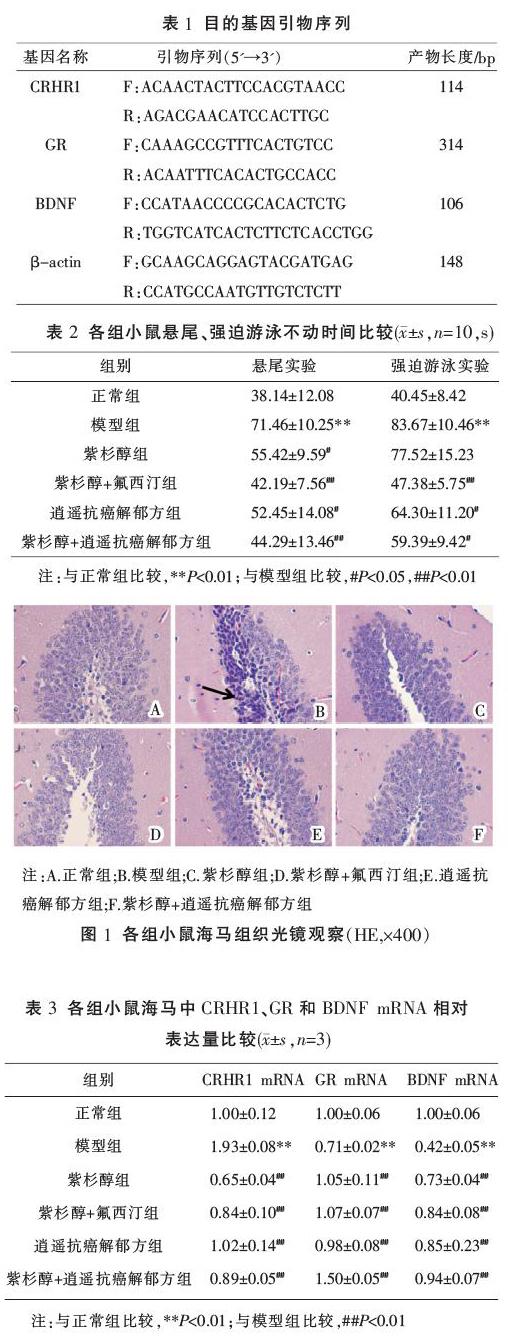
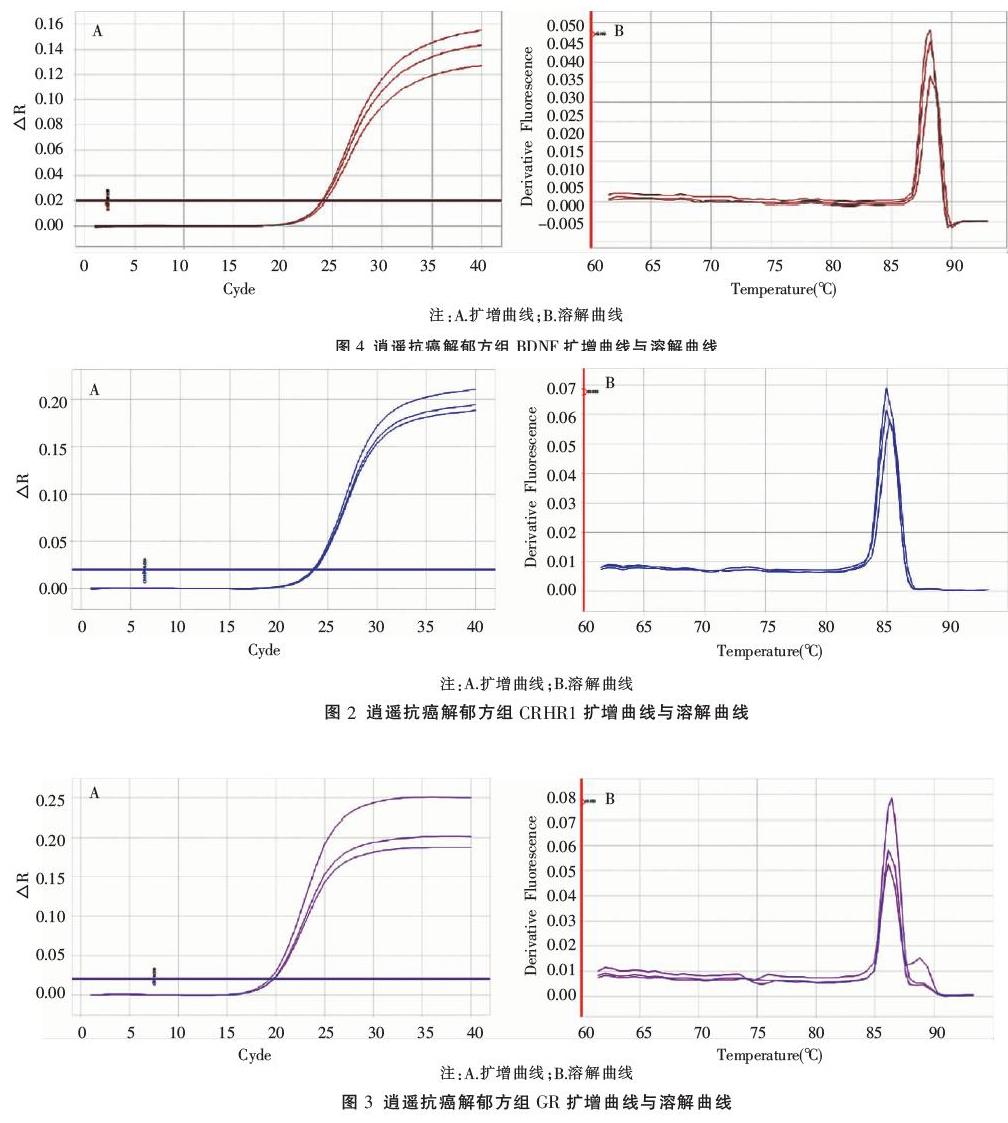
〔摘要〕 目的 研究復方中药逍遥抗癌解郁方对乳腺癌并发抑郁症(breast cancer related depression, BCRD)小鼠海马促肾上腺皮质激素释放激素受体1(corticotropin releasing hormone receptor 1, CRHR1)、糖皮质激素受体(glucocorticoid receptor, GR)、脑源性神经营养因子(brain-derived neurotrophic factor, BDNF) mRNA的调控作用,阐明其对海马组织的可能保护机制。方法 通过腋下注射4T1炎性乳腺癌细胞联合背部皮下注射皮质酮建立BCRD小鼠模型并随机分为模型组、紫杉醇组、紫杉醇+氟西汀组、逍遥抗癌解郁方组、紫杉醇+逍遥抗癌解郁方组,同时设正常组。采用悬尾实验和强迫游泳实验检测小鼠抑郁样行为,HE染色观察小鼠海马的病理结构变化,实时荧光定量PCR检测CRHR1、GR、BDNF mRNA的表达。结果 与正常组相比,模型组小鼠悬尾实验、强迫游泳实验中不动时间显著增加(P<0.01),海马结构损伤明显,GR、BDNF mRNA表达显著下降(P<0.01),CRHR1 mRNA表达显著上升(P<0.01);给予逍遥抗癌解郁方干预后,模型小鼠悬尾实验、强迫游泳实验中不动时间下降(P<0.05),海马结构损伤得以恢复,GR、BDNF mRNA表达显著上升(P<0.01)、CRHR1 mRNA表达显著下降(P<0.01)。结论 逍遥抗癌解郁方可以改善BCRD小鼠的抑郁症状,保护海马组织,其作用机制与上调GR、BDNF和下调CRHR1的mRNA表达有关。
〔关键词〕 海马组织;促肾上腺皮质激素释放激素受体1;糖皮质激素受体;脑源性神经营养因子;乳腺癌并发抑郁症;逍遥抗癌解郁方
〔中图分类号〕R285.5;R737.9;R749 〔文献标志码〕A 〔文章编号〕doi:10.3969/j.issn.1674-070X.2019.05.005
〔Abstract〕 Objective To study the effects of Xiaoyao Kangai Jieyu Decoction on corticotropin releasing hormone receptor 1 (CRHR1), glucocorticoid receptor (GR), brain-derived neurotrophic factor (BDNF) and regulation of mRNA in Hippocampus of breast cancer related depression (BCRD) mice, to elucidate its possible protective mechanism on hippocampus. Methods The BCRD mice model was established by subaxillary injection of 4T1 inflammatory breast cancer cells combined with subcutaneous injection of corticosterone on the back, and the mice were randomly divided into a model group, a paclitaxel group, a paclitaxel + fluoxetine group, a Xiaoyao Kangai Jieyu Decoction group, a paclitaxel + Xiaoyao Kangai Jieyu Decoction and a normal group. The depression-like behavior of mice was detected by tail suspension test and forced swimming test. The pathological changes of hippocampus were observed by HE staining. The mRNA expressions of CRHR1, GR and BDNF were detected by real-time fluorescent quantitative PCR. Results Compared with the normal group, the immobility time in the tail suspension test and forced swimming test in the model group was significantly increased (P<0.01), and the hippocampal structural damage was obvious. The mRNA expressions of GR, BDNF were significantly decreased (P<0.01). The mRNA expression of CRHR1 increased significantly (P<0.01). After the intervention of Xiaoyao Kangai Jieyu Decoction, the immobility time in tail suspension test and forced swimming test in the model mice were decreased significantly (P<0.05), the mRNA expression of GR, BDNF was increased significantly (P<0.01), and the mRNA expression of CRHR1 was decreased significantly (P<0.01). Conclusion Xiaoyao Kangai Jieyu Decoction can improve the depressive symptoms of BCRD mice and protect hippocampus, and the mechanism of action is related to up-regulation of GR, BDNF and down-regulation of mRNA expression of CRHRI.
〔Keywords〕 hippocampus; corticotropin releasing hormone receptor 1; glucocorticoid receptor; brain-derived neurotrophic factor; breast cancer complicated with depression; Xiaoyao Kangai Jieyu Decoction
乳腺癌是女性恶性肿瘤之首。随着治疗手段的不断革新,乳腺癌的治愈率虽有所提高,但化疗通常会导致乳腺癌患者出现抑郁和认知功能下降等不良反应[1]。临床研究表明,10%~25%的乳腺癌患者出现抑郁症[2],持续性抑郁症状会加速肿瘤恶化,导致患者生存率降低。因此,研究乳腺癌并发抑郁症(breast cancer related depression, BCRD)的发病机制,并在此基础上开展防治具有十分重要的意义。
目前关于BCRD的生物学机制研究多集中在神经免疫因子、神经内分泌、神经生理及生化等方面[3],而以上生物学机制均与下丘脑-垂体-肾上腺(hypothalamic-pituitary-adrenal, HPA)軸功能紊乱有关[4]。……
登录APP查看全文
猜你喜欢
中老年保健(2022年6期)2022-08-19 01:41:48
作文周刊·小学二年级版(2022年20期)2022-05-05 01:33:06
创新作文(小学版)(2019年10期)2019-09-25 08:12:28
中国生殖健康(2019年2期)2019-08-23 08:11:42
中国生殖健康(2019年6期)2019-01-06 09:20:12
祝您健康(2018年5期)2018-05-16 17:10:16
实用口腔医学杂志(2017年6期)2017-09-19 02:51:06
小学生学习指导(低年级)(2017年5期)2017-05-04 04:14:38
中外医疗(2016年15期)2016-12-01 04:25:50
哈尔滨医药(2015年2期)2015-12-01 03:57:41