R1234ze(E)与R134a在光管与低肋管外凝结传热数值模拟
2021-01-05 19:42:20党坤儒
科技风
2021年35期

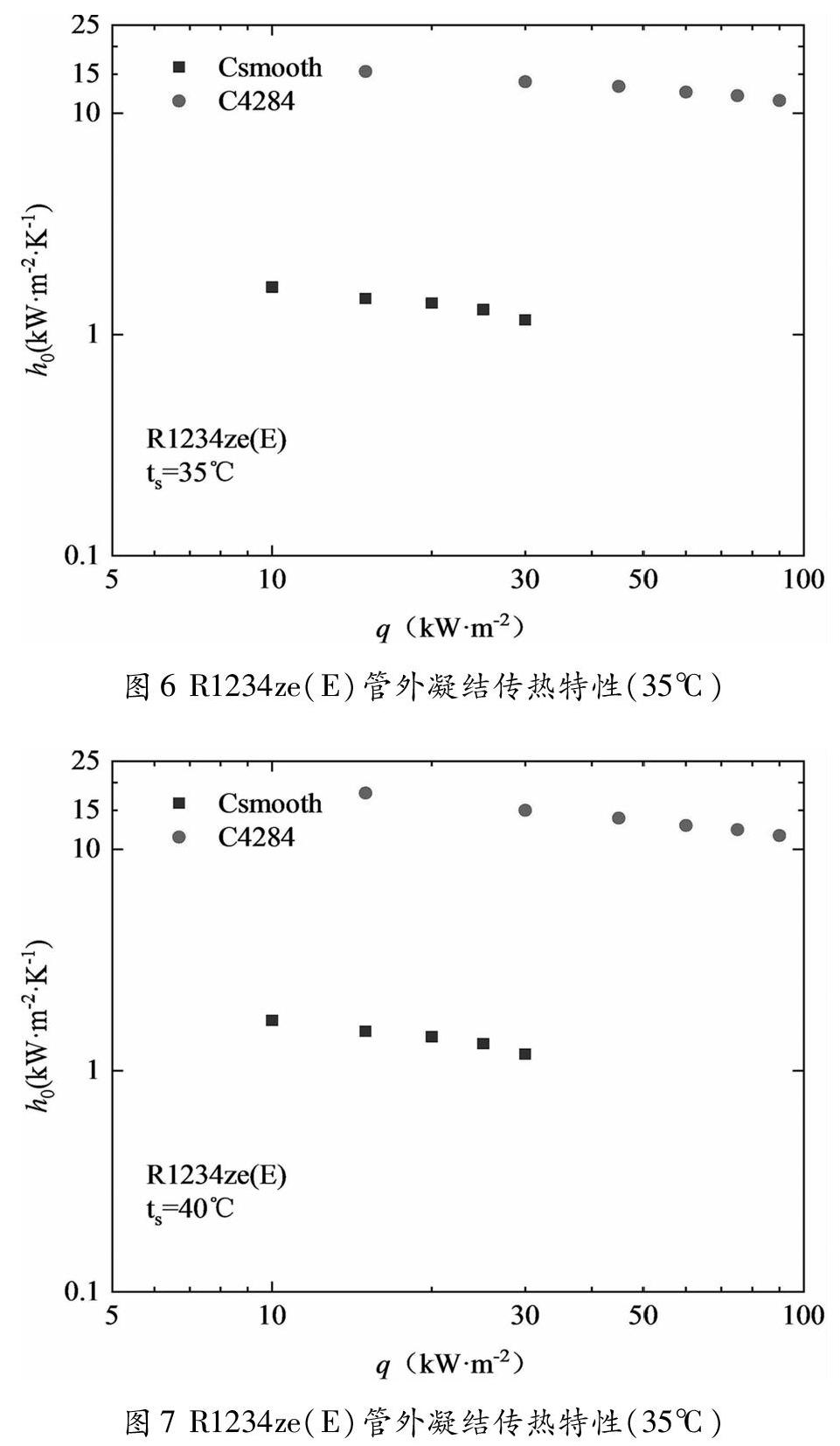

摘 要:使用R1234ze(E)和R134a进行水平光管及低肋管外凝结传热的数值模拟。采用VOF多相流模型和Lee相变传质模型来获得R1234ze(E)和R134a的管外凝结传热特性。模拟结果表明,光管外凝结传热系数与Nusselt理论解的偏差在±10%以内;随着冷凝温度的增加,R1234ze(E)的管外凝结传热系数增大;R134a的管外凝结传热系数要高于R1234ze(E);C4284低肋管相比光管,对管外凝结传热有明显的增强作用,在热流密度为30kW/m2时,R1234ze(E)在冷凝温度为35℃时,管外凝结传热系数比光管高10.9倍,40℃时比光管高11.7倍。
关键词:数值模拟;低肋管;VOF;凝结传热
Abstract:R1234ze(E)and R134a were used for numerical simulation of condensation heat transfer outside plain and low rib tube.The condensation heat transfer characteristics of R1234ze(E)and R134a were obtained by using VOF multiphase flow model and Lee phase change mass transfer model.The simulation results show that the deviation between condensation heat transfer coefficient and Nusselt theory is within ±10%.With increase of condensing temperature,the condensation heat transfer coefficient outside the tube of R1234ze(E)increases;the condensation heat transfer coefficient outside the tube of R134a is higher than R1234ze(E);the low rib tube of C4284 has a significant enhancement of condensation heat transfer coefficient outside the tube compared with plain tube.At a heat flow of 30 kW/m2,R1234ze(E)has 10.9 times higher condensation heat transfer coefficient outside the tube than plain tube at 35 ℃ and 11.7 times higher than plain tube at 40 ℃.
Keywords:Numerical simulation;Low rib tube;VOF;Condensation heat transfer
管外膜狀凝结传热广泛存在于我们的生活中,从最初的光管外凝结发展到现在效率更高的强化管外凝结。冷凝器在换热设备中作为一个重要的组件,其换热能力对设备性能有很大的影响。国内外对强化管外凝结传热进行了相关研究。马志先等[1]、Randall等[2-3]使用R134a研究了不同管型的管外凝结传热特性,发现强化管能显著提高管外凝结传热效果,且三维强化管效果高于二维强化管,而光管最小。Tailian Chen等[4]针对不同管型使用R1233zd(E)进行管外凝结实验发现三维强化管和二维强化管外换热系数分别要比光管高近10.8倍和8.4倍,管外凝结传热系数随冷凝温差的增加而减小。Sanjeev K等[5]用R600a研究了管外凝结传热与冷凝温差和热流密度的关系,发现随着冷凝温差或热流密度的增加,传热系数开始降低。赵创要等[6]研究了R404a在不同导热系数的二维强化管和三维强化管的管外凝结传热,结果表明在管子的导热系数相同的条件下,三维强化管的效果优于二维强化管。……
登录APP查看全文